Designing a Frictionless Returns Experience for Customer Experience Wins

Retailers often focus their efforts on ensuring the checkout and delivery processes are as seamless as possible. They do this because they think those are key to shaping the customer experience. But from the customer’s point of view, the returns experience is key to deciding whether or not your company can remove uncertainty, communicate clearly, and respect the customer’s time. That is why more than ever, customers reserve their strongest judgement for the returns process. A frictionless returns experience improves customer experience by removing uncertainty from instructions, tracking, and refunds across the entire return process.
Article Brief:
- Returns fail when human-system interaction breaks down among the customer, the interface, and internal teams within the company.
- Clear user flows, tested through user research and usability tests, lower customer effort score and improve overall user experience.
- Strong customer experience management depends on predictable processes, not reactive support, because customers judge the brand during moments of friction.
- Retailers that design returns as part of the full customer journey gain a real competitive advantage that supports business growth and repeat purchases.
Why Returns Are the Weakest Link in Customer Experience
A customer initiates a return due to disappointment, confusion, or a mismatch between the promise and reality. It doesn’t matter whether it is your fault or not. But because returns occur when expectations are already fragile, they play a significant role in shaping the customer experience. That emotional state amplifies every delay, missing update, or unclear instruction.
Retailers often invest in marketing, interface design, and product pages while ignoring what happens after purchase. Such a gap damages the overall user experience because the return tests the company’s ability to support the end user’s interaction with its systems. A smooth return restores trust. A slow one destroys it.
What Friction Really Means in the Returns Process
Friction in product returns is usually a result of uncertainty. Customers will follow the outlined steps if they understand them. But if the expected response is not forthcoming, they become frustrated, which is where the problem starts. Basically, common friction points appear when instructions differ by channel, tracking stops after drop-off, or refunds arrive without warning.
Each of these gaps forces the customer to guess what happens next. And it is detrimental to the customer’s journey because it leaves them feeling out of control. Returns magnify emotional responses because money, time, and trust are at stake. That is why a return without updates feels like abandonment, whereas a return with clear signals feels safe. The difference is what defines your customer experience.
Bottleneck One: Unclear or Inconsistent Return Instructions
Unclear instructions are the first break in the customer experience because they create doubt from the start. Customers should never search emails, packaging, or websites to understand how to return an item. Clear instructions should follow simple rules such as using plain language, showing steps in the right order, and keeping rules consistent across stores, website, and support.
When instructions vary by channel, the system creates friction. That friction raises the customer effort score because customers must work harder to complete the same task. Research from Gartner shows that higher customer effort reduces loyalty more than price or product quality. The good news is that retailers can remove this bottleneck by standardizing return instructions across all platforms and presenting eligibility rules before the return starts. When customers know what applies to their purchase, they proceed with confidence.
Bottleneck Two: Lack of Tracking and Status Visibility
Tracking failures breaks customer experience because silence feels personal. Once a customer hands off the package, they expect acknowledgment. Customers typically want confirmation that the return was accepted, alerts indicating movement during shipping, and a notice when the process begins.
Tracking needs clarity, not advanced graphics. A simple status update can go a long way to reassuring the customer that the system is working. When tracking disappears, customers can overwhelm support with queries, which can be expensive for the company and frustrating for the customer. Removing this bottleneck improves the company’s ability to serve customers by reducing the number of questions that reach support teams.
In usability tests across retail platforms, customers rated visibility higher than speed in terms of satisfaction. Seeing progress matters more than how fast it moves.
Bottleneck Three: Refund Uncertainty
Refund timing shapes customer experience because money carries emotion. Customers do not expect instant refunds, but they expect predictability. Each delay creates anxiety to the point that customers begin to question whether the company will honor the return. That level of doubt damages brand trust.
Retailers can improve refund experiences by clearly separating stages. For instance, “refund approved” should not mean “refund issued.” Each step deserves its own update. When customers understand where they are in the process, uncertainty disappears.
Designing a Frictionless Returns Flow Step by Step
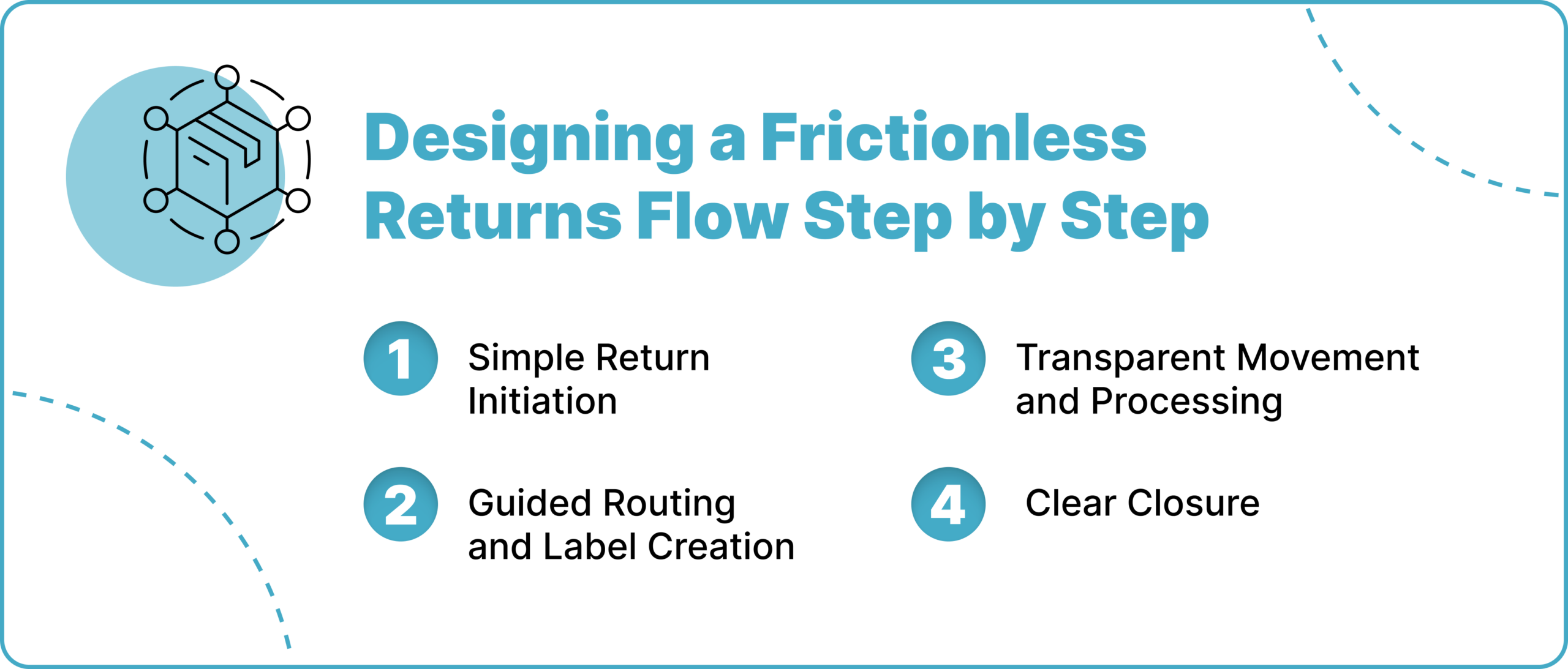
A frictionless returns experience follows a predictable flow that removes guesswork at every stage.
Step One: Simple Return Initiation
Customers should start returns with minimal input. Order lookup should work through email or account number, and eligibility should appear instantly. When customers see clear confirmation, they have more confidence in the process.
Step Two: Guided Routing and Label Creation
Customers should never decide logistics on their own. The system should guide them to drop-off, pickup, or store return options based on context. Clear routing reduces errors and failed returns.
Step Three: Transparent Movement and Processing
Tracking updates should be triggered automatically when events occur. Each alert confirms progress, keeping customers informed without requiring questions.
Step Four: Clear Closure
A return should end only when the customer receives confirmation that the refund is complete. That close is critical because it restores balance, and without it, customers feel unfinished.
Each step supports the overall user experience by replacing uncertainty with signals.
How Removing Friction Improves Customer Experience Metrics
Removing friction reduces inbound support requests because customers already have the answers they need. Moreover, fewer contacts lower the service costs and improve response quality when human interaction is needed. Frictionless returns improve confidence in repeat purchases because customers trust the system. They buy again, knowing the company will support them if something goes wrong.
Predictable returns strengthen brand perception. Customers remember how the company behaved during a difficult moment. That memory shapes future decisions more than discounts or promotions. And customers are more likely to promote brands that respect their time.
Why Customer Experience Depends on Systems, Instead of Promises
Customer experience improves when you establish a system that eliminates risks. It is not just about providing better service. And although training may help your customer support be more effective, the returns management system you have in place is more critical to preventing problems.
Interactive systems that handle returns consistently protect both customers and employees. Clear information architecture, tested user flows, and simple interface design ensure that customers reach the right outcome without confusion. Design teams that study return behavior through user research uncover where uncertainty begins. Those insights guide better design decisions that align with business goals and customer needs.
Returns are not edge cases. They are part of the entire company’s responsibility to deliver value after purchase.
Personalizing The Returns Experience With ReverseLogix For Better Customer Experience.
A frictionless returns experience comes from clarity. And with ReverseLogix, you can personalize the return experience based on each shopper’s history and behavior. Frequent or high-value customers might get faster returns approvals, store credit, or other options that keep them coming back. It also integrates with loyalty programs to automatically offer special return perks. The result is an easier, more tailored experience that rewards your best customers. Customers feel supported, respected, and confident. That confidence turns disappointment into trust. And trust becomes the strongest competitive advantage any business can earn. Get a demo today.
Frequently Asked Questions
Returns happen when expectations already feel fragile, which means every delay or missing update shapes a person’s perceptions. If the system creates confusion during refunds or tracking, the entire user experience feels broken, regardless of how smooth the purchase was.
When interface design ignores real end-user interaction, customers struggle to find return instructions, track progress, or understand refund timing. Weak user interface choices increase effort and reduce user satisfaction, even if the backend process works correctly.
Human interaction matters when systems fail or questions arise, but most customers prefer not to ask for help. A well-designed system limits support requests by clearly guiding users, while still granting access when a person needs help at a specific point.
Design teams use customer journey maps, usability tests, and user research to identify where customers hesitate, abandon flows, or request help. These findings shape better design decisions that reduce friction across websites, platforms, and interactive systems.
Clear returns processes support sales, brand trust, and long-term loyalty because customers feel safe buying again. When the entire company treats returns as part of the overall user experience, it strengthens the brand impression and protects revenue over time.
Get a Demo
Discover how you can jump-start your returns management efforts with ReverseLogix.