How to Improve Returns Turnaround Time Without Hiring More Staff

In brief
- Returns turnaround time is the gap between customer expectations (refunds in 3 to 5 days) and what most retailers deliver (an average of 9.5 days). Improving speed requires automating return authorization, receiving, inspection, disposition, and refund processing, not hiring more staff to manage manual workflows.
- Returns management software such as ReverseLogix can reduce processing times by up to 50% by connecting every stage of the returns lifecycle in a single platform. Features like automated RMA approvals, self-service portals, scan-to-receive workflows, condition-based disposition rules, and pre-approved refund triggers eliminate common bottlenecks.
- The benefits extend beyond speed. Faster return turnaround improves customer loyalty, protects brand reputation, lowers operational costs, enhances fraud detection, strengthens quality control, and provides valuable returns data that helps retailers reduce future returns while maximizing product recovery value.
85% of online shoppers expect to receive refunds within a week of returning an item. But in reality, the average return takes about 9.5 days to process. That gap is where customer dissatisfaction is created, where repeat purchases are lost, and where brand reputation is damaged. The instinct for most retailers is to add staff. According to the NRF’s 2025 report, 34% of retailers hire additional staff specifically to handle the volume of returns, and 43% hire seasonal workers for the holiday rush. That does not make a slow returns process faster. Changing the workflow does.
For the software side of this topic, see returns processing software.
In this article, we highlight the different ways to close that gap between what customers expect and what most returns operations actually deliver, without adding to your payroll.
How to Speed Up Returns Turnaround Time With Automation
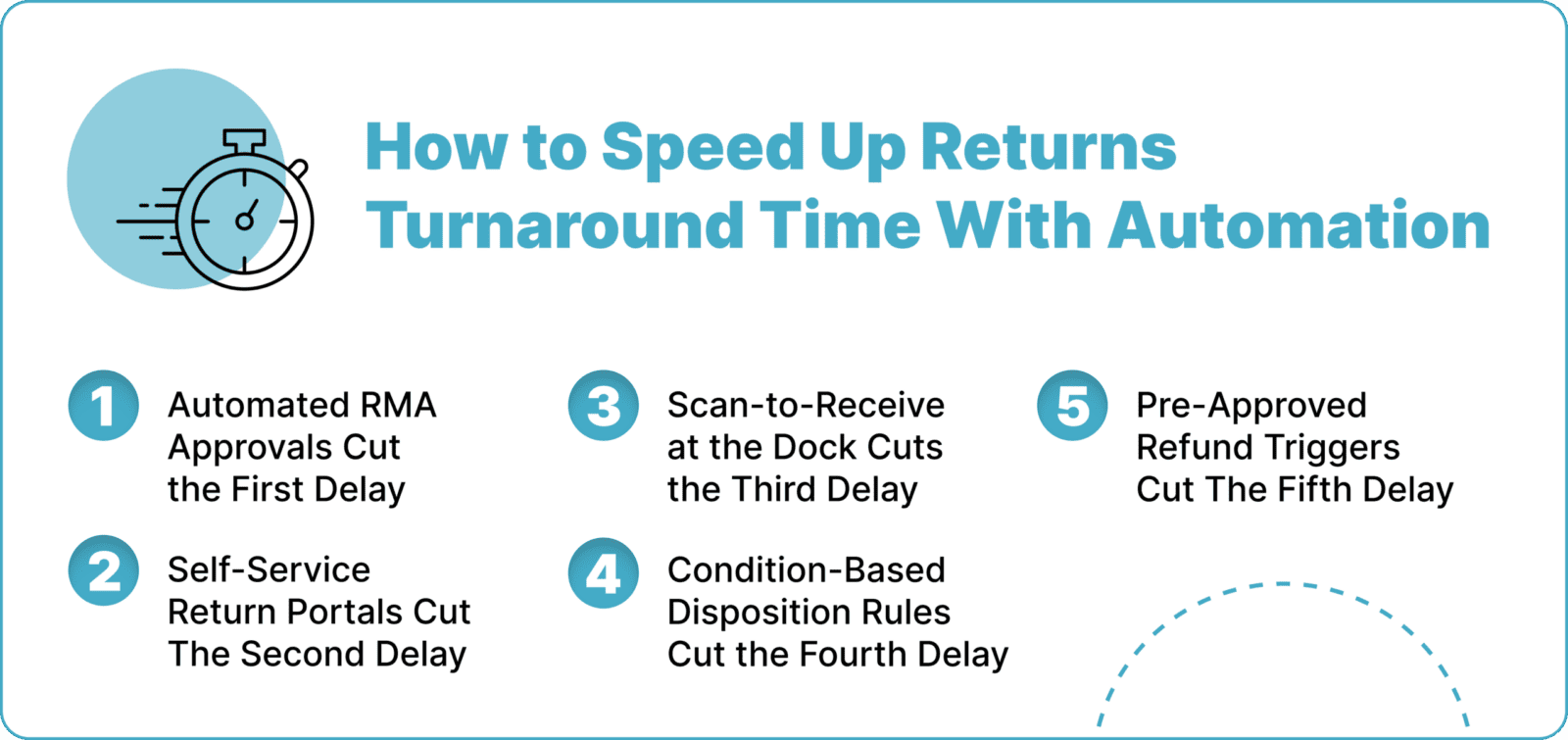
The time is made up by automating the steps where returns sit idle.
1. Automated RMA Approvals Cut the First Delay
Most in-policy returns do not require human intervention. Provided the item is within the return window, not a final-sale item, and the customer selects a valid return reason, the system automatically authorizes the return and generates return labels. There is no queue and no waiting for somebody to check their email.
2. Self-Service Return Portals Cut The Second Delay
When customers can initiate their own returns, choose the reason, print labels, and check in on progress without reaching out to support, two things happen. The customer moves faster, and the support team no longer spends time on routine return requests. According to ShipBob, 58% of online shoppers already prefer this kind of easy self-service process.
3. Scan-to-Receive at the Dock Cuts the Third Delay
Real-time barcode scanning at intake matches the physical shipment to the RMA record. The system knows what came in, when it came in, and the condition the customer reported. No manual data entry. No pile of packages left unlogged.
4. Condition-Based Disposition Rules Cut the Fourth Delay
Automated routing is fed by standardized grading criteria. Grade A items are returned to stock. Grade B items go to the repair department. Grade C items are marked for disposal. This way, decisions are made by rules, not by whoever happens to be working the floor that shift. The quality control process is consistent, and items are disposed of the same day they clear inspection.
5. Pre-Approved Refund Triggers Cut The Fifth Delay
For low-risk returns, such as same-day or next-day approvals for known customers returning low-value items with common return reasons, the refund fires at scan-in. No more waiting for the full inspection cycle. NRF says 76% of consumers prefer return options that include instant refunds. This is how you deliver that without adding staff.
How Long Should It Take to Process a Return?
76% of consumers are more likely to choose a return option that offers them an immediate refund or exchange. And 45% of customers expect a refund within 3 days of returning an item. Most retailers are not close. The average processing time, including shipping and warehouse handling, is between 7 and 10 days. 88% of shoppers say they’d limit or stop shopping with a retailer that takes too long to process refunds.
For an efficient returns operation, the target should be 3 to 5 days from when the customer initiates a return to when the refund is in their account. That sounds aggressive, but it is what customers expect, and the retailers that meet it keep those customers.
Why Hiring More Staff Doesn’t Fix Slow Returns Processing
Adding more people to the returns process without fixing the workflow only adds more people to the same bottlenecks. NRF’s 2025 data shows that 43% of retailers hire seasonal staff to manage holiday returns, but processing times don’t improve much during those times. The most expensive input in reverse logistics operations is labor. Zeta Global research finds that processing one return costs between $20 and $30, including transportation, inspection, and restocking. If you scale headcount without fixing the workflow, you are simply multiplying that per-unit cost across a larger operation. The fix is in the design of the process.
How Returns Management Software Cuts Turnaround Time Without Adding Headcount
Each of those approaches depends on a system that integrates the return authorization, receiving, inspection, disposition, and refund steps into a single workflow. Without that link, you are automating discrete steps with manual handoffs in between. At each gap, the time savings leak away.
Returns management software replaces the patchwork. Rather than email approvals, spreadsheet tracking, manual label generation, and a separate refund process, the full process flows through a single platform. And the returns management process is transparent from the time the customer initiates the return until the final inventory update.
ReverseLogix connects the entire returns process, from return authorization to disposition and refund processing, all within one system. One of our customers put it this way: “ReverseLogix essentially gave us the value of having two more rockstar customer specialists, but it’s all automated and never calls in sick.” For retailers, manufacturers, and logistics providers managing returns at scale, this kind of end-to-end automation is what shortens turnaround time.
Summary
Slow return processing quietly damages customer satisfaction. Customers expect a refund within 3 to 5 days. Manual processes take an average of 9.5 days. Automation closes the gap by starting each step, from return authorization to refund, as soon as the previous one finishes, without adding to your team. ReverseLogix manages the whole process, from the moment a customer starts a return to the final disposition and refund, in one place. If your returns operation adds headcount every time volume spikes, that is the gap ReverseLogix was built to close. Get a demo today.

Frequently Asked Questions
What is the average cost of processing a return?
Processing a single return costs between $20 and $30, including shipping, labor, inspection, and restocking, according to Zeta Global’s research. Those operational costs climb higher for retailers still running manualreturns workflows, particularly those handling high return rates across product categories like apparel, where returned products often require inspection by a repair department or quality control review before they can be resold.
Can automation handle returns during the peak holiday season without additional hiring?
Yes. Automated workflows scale with volume without requiring seasonal staff. Self-service return portals, pre-approved refund triggers, and automated disposition rules process returns at the same speed whether the warehouse handles 100 returns or 1,000 on a given day.
How does a self-service returns portal reduce processing times?
A self-service portal lets the customer handle the steps that would otherwise require a support agent: selecting the return reason, generating return labels, choosing between refunds and exchanges, and tracking the return’s status. This cuts the time between when the customer initiates the return and when the package actually ships back. It also frees up the support team to handle edge cases and customer complaints rather than processing routine return requests.
How can retailers reduce returns while also speeding up processing?
Reducing returns and speeding up the returns process are two separate problems, but they share some solutions. Poor product descriptions and inaccurate sizing information drive high return rates, especially in apparel. Fixing those issues at the product listing level, including better photography, accurate size charts, and honest descriptions of materials, can reduce returns before they start. On the processing side, returns data from automated systems helps identify which products get returned most and why, feeding back into product quality improvements and inventory management decisions. That feedback loop is where retailers start to reduce returns over time while still ensuring the returns that do happen move through the reverse supply chain quickly.
Get a Demo
Discover how you can jump-start your returns management efforts with ReverseLogix.