Returns Are No Longer a Retail Problem — They’re a Manufacturing and Asset-Lifecycle Crisis
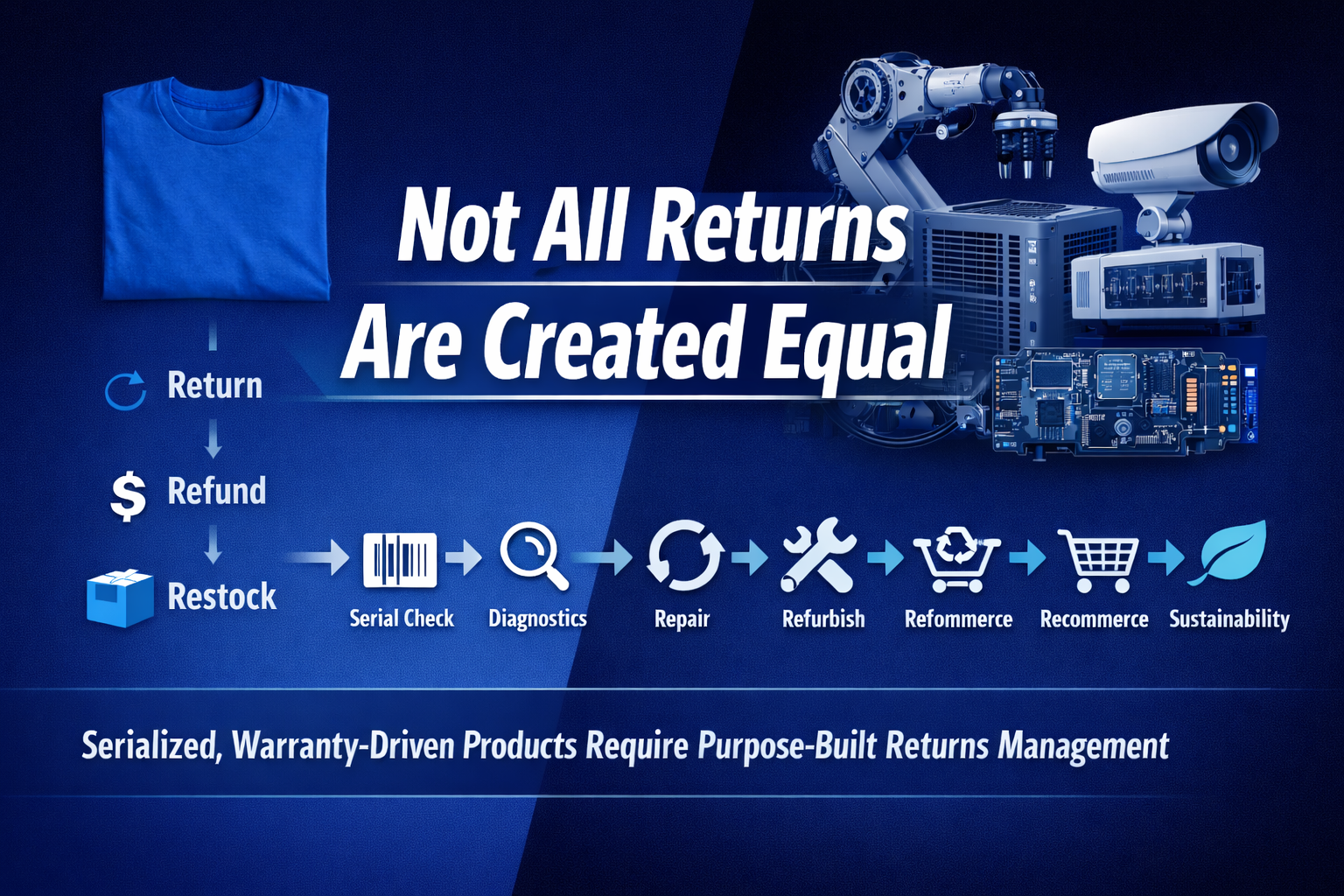
For years, returns have been treated as an e-commerce inconvenience, something to be minimized, outsourced, or hidden in the back office.
That mindset is officially a liability.
Today, returns have become a front-line profitability, customer experience, and asset-lifecycle issue. This is especially true for manufacturers managing serialized, high-value, and warranty-driven products.
This shift is no longer limited to consumer electronics. Modern warranty and serialized returns now span:
- Industrial machinery and automation
- HVAC systems and smart components
- Medical, laboratory, and field-service equipment
- Sensors, meters, and IoT hardware
- Networking, POS, and smart infrastructure
These are not “just returns.” They are contractual, compliance-driven, and margin-critical workflows.
The Great Divide: Why Manufacturing Returns are Different
Apparel returns are driven by preference and fit. They are high-volume, but operationally simple: no serial numbers, minimal logic, and quick restock.
Asset-based returns require a completely different operating model:
- Serialization & Chain of Custody: Every unit must be individually tracked from the moment it leaves the customer until it is repaired or recycled.
- Warranty Adjudication: Eligibility rules aren’t universal; they vary by contract, product version, and customer tier.
- Diagnostics & Parts Harvesting: Unlike a t-shirt, a returned industrial pump has recoverable value. Multi-stage testing and refurbishment are mandatory.
- Complex Ecosystems: You aren’t just dealing with consumers; you are managing returns from distributors, installers, and third-party service providers.
This isn’t “returns processing.” This is Asset Lifecycle Orchestration.
Why Generic Retail Tools are Costing You Millions
Most returns software was designed for the “Label and Refund” model. They optimize for shipping volume, not technical complexity. When you force a serialized product through a retail tool, you create Warranty Leakage.
Warranty Leakage occurs when manufacturers fulfill claims on expired contracts, grey-market goods, or non-defective units because their system lacks the logic to validate entitlements at the point of return.
Generic tools fail because they lack:
- Serial number validation against original build data.
- Contract-specific business rules for B2B partners.
- Repair routing and parts recovery workflows.
- Integration with deep-stack ERP and PLM systems.
The Shift to a Purpose-Built RMS
A modern Returns Management System (RMS) like @ReverseLogix unifies the entire reverse journey. It stops being a reactive cost center and becomes a strategic system of record for asset performance.
By unifying warranty claims, serialized tracking, and repair workflows, an RMS enables:
- Total Lifecycle Visibility: Real-time data on why products fail and where they are in the repair loop.
- Maximized Value Recovery: Moving beyond “restock” to intelligent refurbishment and recommerce.
- Partner Empowerment: Branded portals that allow distributors and technicians to initiate returns without manual phone calls or emails.
The Bottom Line
If your business manufactures or services high-value, serialized products, your strategy cannot be powered by e-commerce-grade tools.
You have an ERP for what goes out. You need an RMS for what comes back. In modern manufacturing, returns are no longer a nuisance—they are a competitive advantage, if you have the right engine to manage them.
#ReverseLogistics #Manufacturing #WarrantyManagement #CircularEconomy #RMS
Get a Demo
Discover how you can jump-start your returns management efforts with ReverseLogix.