Smarter Disposition Strategies Can Reduce Write-Offs for Returned Goods

Smarter disposition strategies give returned goods a fair chance at recovery before anyone reaches for the scrap bin. According to Gartner Research, less than half of returned items are sold again at full price. That points to a process problem: the decision about what to do with an item is made too quickly, with too little information, or without any structure.
This article explains why write-offs happen, what a real disposition strategy looks like, and how to add one to your returns management process without slowing down warehouse work.
Why Most Companies Default to Writing Off Returns
Write-offs are usually the result of a missing process. Returned items land on the dock and workers need to move them quickly. Under pressure to keep the floor clear, they make fast decisions with little guidance. A worker who does not know how to grade a returned item will make the safest and fastest choice: if it can clearly be sold, restock it, and if not, throw it away.
That instinct turns every unclear return into a loss. The problem is worse when a business has no secondary sales channels. An item that cannot go back into stock as new might still be worth 50 to 70 percent of its original value through a liquidation partner or after refurbishment. With no liquidation relationship and no refurbishment process, the only option is to write off a perfectly good product.
Returns data plays a role too. When the return reason is vague, such as “unwanted” or “other,” the team handling the return has little to go on. They do not know whether the item was opened, used or damaged in shipping. When people have to guess, they guess toward a loss, because restocking a broken item feels worse than throwing away a good one.
What Disposition Strategies for Returned Goods Look Like
A disposition strategy is a set of rules that says what to do with each returned item based on its condition, the reason for the return, the type of product and what it could be worth. A structured approach opens up more outcomes than the traditional two, restock or scrap.
The item could return to stock as new, go into a repair queue, or be sold for less through a liquidation or secondary market. Parts could be harvested and put back into the supply chain as spares. The item may be eligible for donation.
Some items will still be thrown away. The goal is not to eliminate all write-offs, because some returned items will never recover any value. The goal is to evaluate every product against every available path before the final decision.
Picture a consumer electronics manufacturer receiving a returned laptop. In a binary system, a warehouse worker opens the box, sees a scratch on the lid and marks it as damaged. Under a disposition strategy, the same laptop is graded “cosmetic damage only, functional,” sent to a refurbishment partner and resold through a different channel for 60% of the original price. Same product, same scratch, very different financial result.
How to Build Smarter Disposition Into Your Returns Process
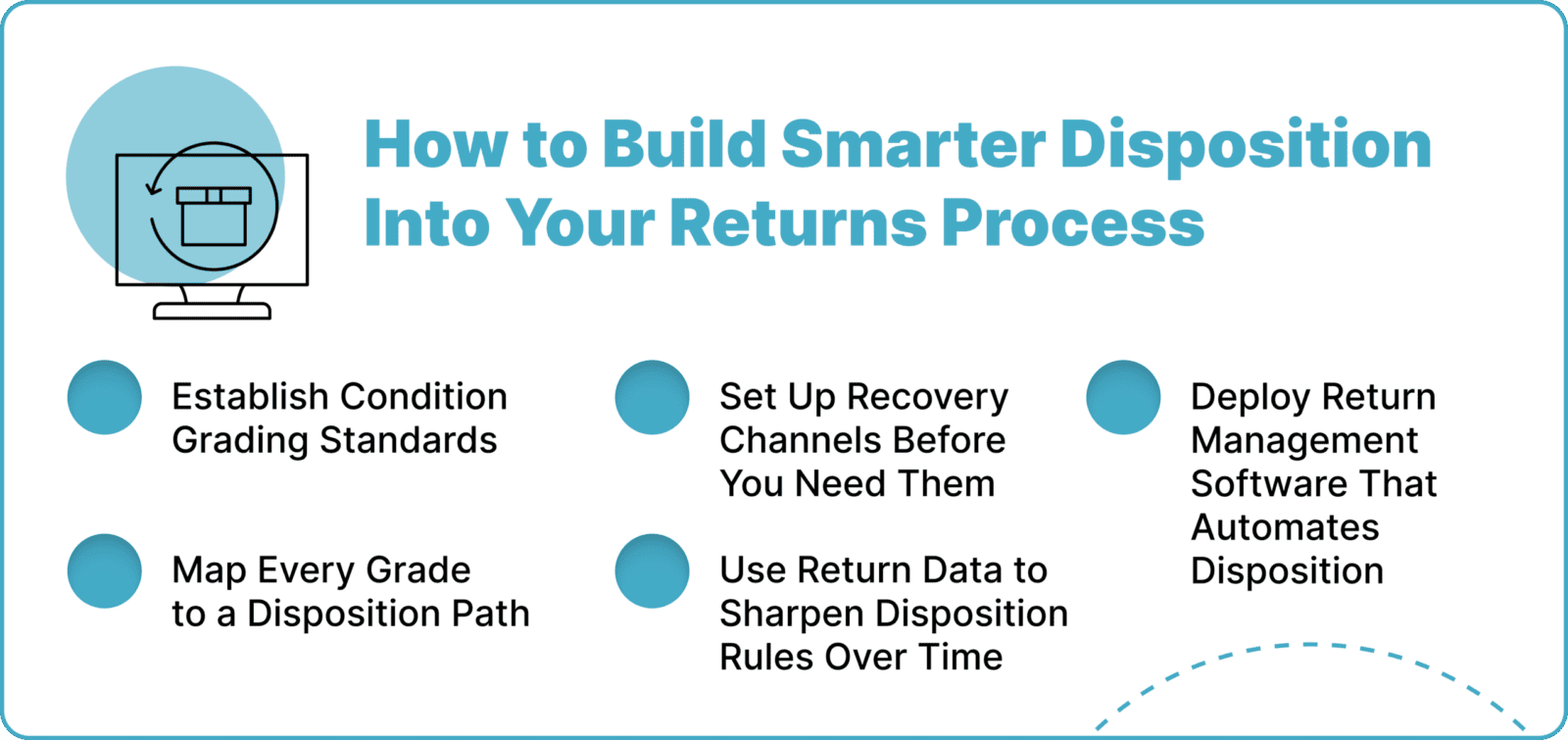
Structured disposition speeds up the return process, because it removes the guesswork that makes people hesitate and decide inconsistently.
Here is how to put it together.
1. Establish Condition Grading Standards
Create a grading scale that means the same thing at every facility. “New,” “open box,” “refurbishable,” “parts only” and “scrap” are common levels. The definitions need to be clear enough that two people would give the same returned item the same grade. For example, defining “open box” as “original packaging opened, all accessories present, no cosmetic damage” gives workers a clear choice instead of a judgment call.
2. Map Every Grade to a Disposition Path
Once an item has been graded, the next step should happen automatically.
- Grade A goes back to the main stock.
- Grade B goes to a secondary sales channel or to a repair queue.
- Grade C gets harvested for parts.
- Grade D goes to responsible disposal.
There is no second-guessing. The system routes returned items based on the grades workers assign.
3. Set Up Recovery Channels Before You Need Them
The difference between companies that write off value and companies that recover it is preparation. Before a product is returned, you should already have liquidation partners, refurbishment vendors, donation programs and secondary marketplaces set up.
If the only choice is “restock or trash,” the disposition strategy falls apart at execution. Building relationships with third-party logistics companies that specialize in reverse logistics gives you a place to send every grade of returned product.
4. Use Return Data to Sharpen Disposition Rules Over Time
Keep track of why items are returned, their condition upon arrival, and how much money each disposition path actually generates. Use data analysis tools to identify patterns across different product types. The data should change how you grade and how you mix channels over time.
If, for example, a product always comes back in good condition, it might not need to be inspected at all. But if a product consistently arrives damaged, it might need a fix in the packaging. This is where the returns process feeds improvements back into decisions about forward logistics and product quality.
5. Deploy Return Management Software That Automates Disposition
Automated systems remove the inconsistency that leads to unnecessary write-offs. ReverseLogix is a returns management platform that applies disposition rules when items are received. After checking condition grade, product category and recovery potential, the system sends the returned item down the right disposition path, so decisions do not vary from person to person or shift to shift. Get a demo to see how it works.
The Financial Case for Getting Disposition Right
Tom Enright, who oversees supply chain research at Gartner, said it clearly: “Retailers are not very good at managing returns right now, and so unless they invest in their ability to manage returns, the volume of returns coming back will cause problems in their overall supply chain.” The investment he is talking about includes a disposition strategy.
Companies that move from ad hoc disposition to a structured strategy usually achieve higher recovery rates, fewer write-offs, faster cycle times and cleaner inventory data. Savings appear immediately when you stop writing off inventory you could have sold. Dead stock and excess inventory also start to earn money once they are sent to the right recovery channel.
And when clean return data flows back into your supply chain management decisions, you can start to lower future returns by fixing the problems that caused them in the first place, such as bad product descriptions, insecure packaging, or recurring defects on a certain production line.

Frequently Asked Questions
Q1: What are the most common disposition paths for returned goods?
The main paths are restock as new, refurbish and resell, sell through a liquidation or secondary market, harvest for parts, donate, or scrap. End-of-life products that cannot be refurbished or resold may still qualify for parts recovery or responsible disposal. A structured disposition strategy evaluates every returned item against these options before making the final disposition call. This is a way to manage returns effectively rather than defaulting to the write-off.
Q2: How do disposition strategies affect customer satisfaction and repeat business?
The connection is more direct than most companies assume. When disposition decisions happen quickly, processing refunds and customer resolution happen quickly too. A customer who gets a fast refund or store credit after returning an item is far more likely to buy from you again. Customer dissatisfaction with the returns process is one of the top reasons shoppers stop buying from a brand. According to the NRF, 71% of consumers say a poor return experience would discourage them from shopping with a retailer again. Companies that pair smart disposition with clear customer communication, including easy-to-understand policies, prepaid return labels, and real-time tracking return updates, see stronger customer loyalty and repeat business over time.
Q3: How do disposition strategies differ for e-commerce returns versus in-store returns?
E-commerce returns typically arrive at a centralized warehouse or distribution center, which means the entire returns process, from return authorization to inspection to final disposition, happens in one location. In-store returns present a different situation because the item sits at a retail location that may not have the infrastructure for grading or refurbishment. Many companies address this by working with logistics providers to consolidate in-store returns at a central processing facility where disposition decisions follow the same standards regardless of the original sales channel. The goal is efficient handling across every return method, whether the customer ships the item back or drops it off at a store.
Q4: What role does customer feedback play in improving disposition outcomes?
Customer feedback is one of the most underused inputs in the reverse logistics process. When customers tell you why they returned a product, that data feeds directly into smarter disposition rules. If a product category consistently returns due to sizing issues or poor product descriptions, you can address the upstream issue to reduce future returns. If customer feedback indicates that items arrive damaged, you can address issues with secure packaging or shipping practices. Over time, this kind of feedback loop turns the reverse supply chain into a source of product and business performance intelligence. That is what separates companies that chase losses from those that prevent them.
Q5: How do you measure the success of a disposition strategy?
Track recovery rate (percentage of value recouped from returned goods), write-off rate (percentage of returns that end in scrap or disposal), cycle time (how fast a return moves from intake to final disposition), and channel performance (which recovery path produces the best results per product category). Inventory control metrics matter too. If your disposition process is working, your inventory counts should be more accurate and your order fulfillment timelines more predictable. When recovery rates climb and write-off rates drop, the strategy is delivering a competitive advantage through cost savings and future sales from recovered inventory. Reviewing these numbers regularly is how you build improvement into the process rather than treating disposition as a set-it-and-forget-it exercise.
Get a Demo
Discover how you can jump-start your returns management efforts with ReverseLogix.