Warranty & claims software for enterprise brands and manufacturers

Run by ops. Proven for finance

ReverseLogix is enterprise warranty management software for global manufacturers, handling claim intake, registration, approval routing, SLA tracking, multi-region rules, fraud detection, and warranty reserve calculation in a single platform. Used by Jabra, Tumi, Electrolux, and others to consolidate warranty workflows that previously spanned email inboxes, ERPs, and spreadsheets.
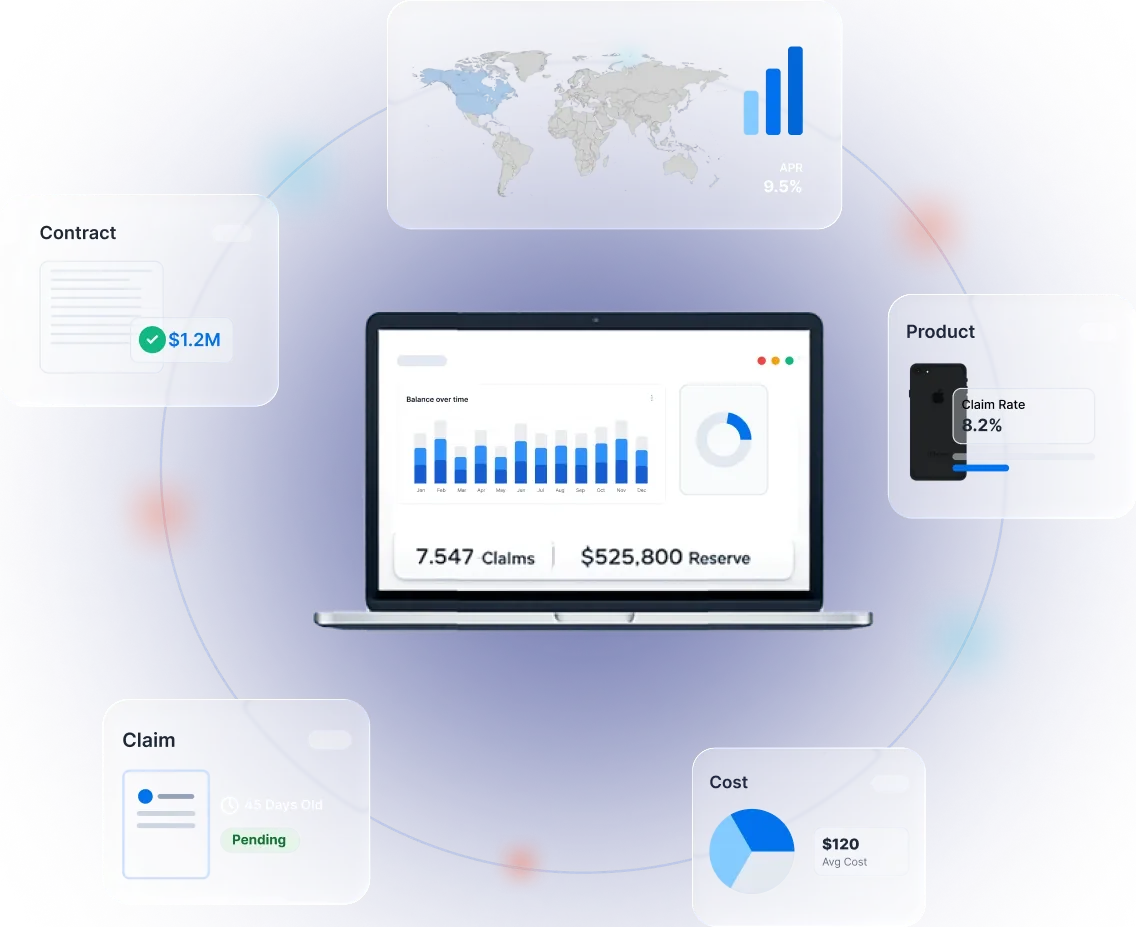
ReverseLogix warranty claims management dashboard

Trusted by logistics teams at:

The four failure patterns in enterprise warranty operations

Claims arrive through inboxes, voice notes, and shared mailboxes, so there is no system of record.

Approval workflows are tribal: when one person leaves, institutional knowledge walks out the door.

SLA tracking is reactive, and the customer service team learns about a missed SLA only when the customer escalates.

Warranty reserves are estimated rather than calculated, so when the CFO asks, no one has a defensible answer.

"Essentially, a lot of manual intervention makes it prone to error. There’re many authentication issues in this entire after-sales warranty process."

L D — Operations Excellence Manager, $7B global manufacturer

What broken warranty operations actually cost

These are not just workflow annoyances. Each pattern carries a measurable cost.

GapMechanismBusiness Impact
Unstructured IntakeClaims lost, duplicated, or rersolved inconsistentlyWarranty spend rises, customer satisfaction falls
Ad-hoc approvalsNo standardized decision logic: relies on individual judgementSlower cycle time, audit exposure
Reactive SLA trackingGaps surface only after they have caused damageProcess gap becomes a customer-retention problem
Undetected fraudNo systematic detectionDirect margin leak (a DTC, B2B medical devices client faced $500K/year in warranty fraud before automation.

$30.4B

U.S.-based manufacturers paid $30.4 billion in warranty claims in 2025 and held $71.9 billion in warranty reserves at year-end.


Warranty Week · April 2026

Why your ERP and returns portal leave a warranty gap

Warranty is neither a standard ERP transaction nor a consumer return.

THE GAP

ERP repair modules were built for parts and finance postings, not claim intake, approval routing, or SLA logic, so manufacturers bolt spreadsheets and email around them.

Ecommerce returns portals handle recently purchased consumer goods, not claims reconciled against a multi-year warranty contract, registration data, and claim management.


That leaves a gap in the middle our end-to-end reverse logistics platform is built to fill.

FRAMED FOR FINANCE

Framed for finance, an unmanaged warranty operation is a recovery gap, not just a workflow gap. Claims resolved by judgment under time pressure default to the fastest disposition rather than the most defensible one: approving claims you don’t owe, absorbing fraud as shrink, letting recoverable value age out.

Structured intake enforced entitlement rules, and fraud screening at the door turn each leak from a cost you absorb into a decision you can govern.


58%

of retailers have no single owner for returns.
– McKinsey

What ReverseLogix Does for Warranty

Framed as outcomes rather than features — what changes in your operation, not what appears on a spec sheet.

Registration with serialization

Increase the value of returned items in secondary markets. Understand recovery costs and how to connEligibility checks at the moment of claim: fraud reduction at the front door.ect returned inventory to the right channels.

Claim intake from any channel

Single source of truth for every claim, no more inboxes.

Configurable approval routing

Approvals follow your business rules, not a person’s memory.

SLA tracking with alerts

Missed SLAs caught before the customer escalates.

Stronger Multi-region warranty rulesControl

EU vs UK vs US vs APAC handled in one platform, not three.

Repair depot integration

Approved claim flows directly to depot routing, no handoff.

Book a 30-minute discovery call to map your warranty workflow

ReverseLogix warranty business intelligence dashboard

How ReverseLogix supports warranty reserve accuracy

Reserves are calculated in your financial systems, not in a returns platform. ReverseLogix is the operational system of record: it captures every claim as a structured record and feeds clean data to the ERP and finance systems where reserves are booked — active contracts, claim rates by product and region, cost-to-resolve by disposition, open-claim aging. The reserve stops being an estimate off a rolling average and becomes a number traceable to live claim data.

How fraud and counterfeit detection works

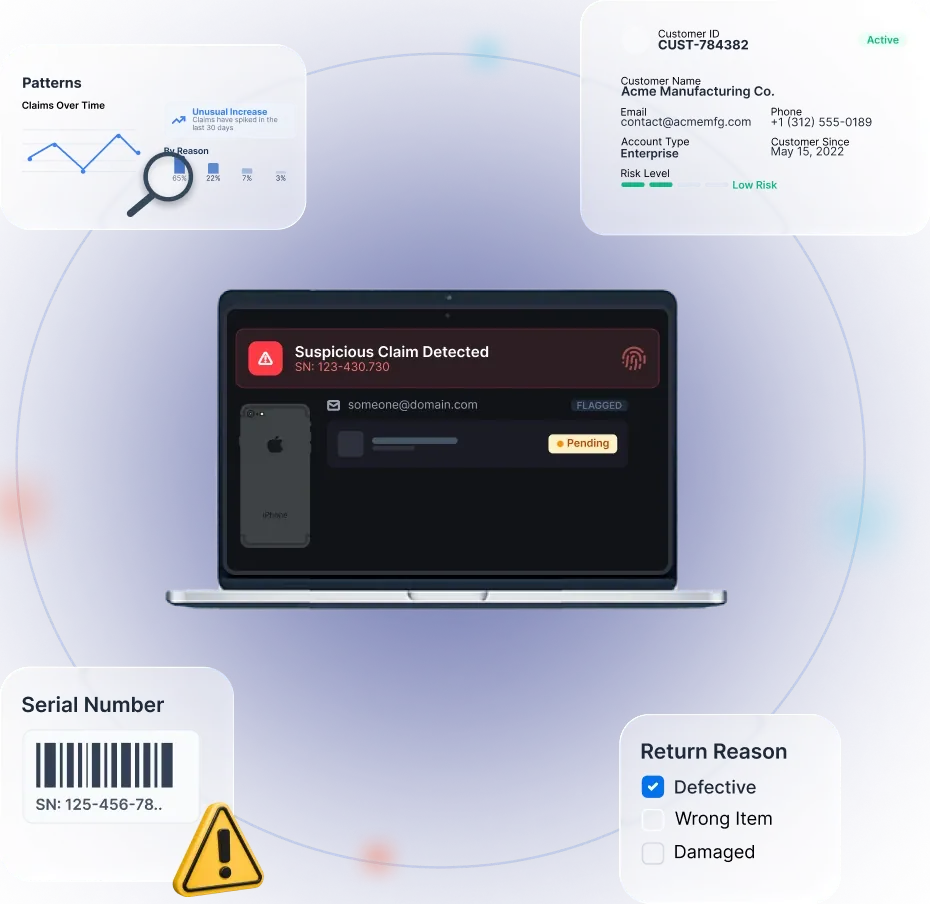
ReverseLogix flags unusual claim patterns by frequency, customer, product serial number, and return reason. Combined with serialization and registration data captured at the moment of claim, this catches counterfeit returns and channel-specific fraud that unstructured processes miss entirely. The detection runs at intake, so a suspicious claim is surfaced before it is approved rather than discovered in a year-end review. In one enterprise deployment, counterfeit units are caught at intake because the product’s tracer-tag algorithm cannot be duplicated, so a fake surfaces before the claim is approved.

ReverseLogix Vision AI screens each claim at intake, checking it against a library of known fraud actors and the client’s product master data to flag counterfeit or fraudulent submissions before approval.

ReverseLogix warranty repair intelligent triage and routing
ReverseLogix warranty repair serialized tracking and database

Handling multi-region warranty rules (EU, UK, US, APAC)

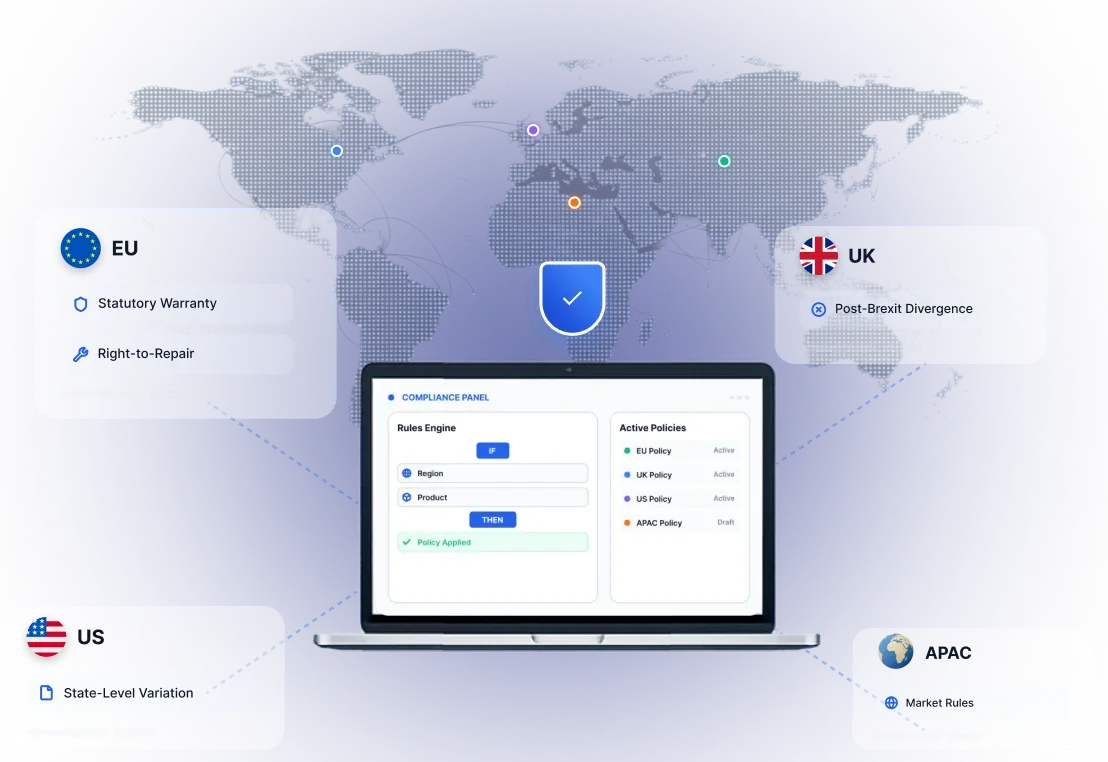
Warranty terms, statutory rights, and right-to-repair obligations differ by region, and for global manufacturers that usually means multiple disconnected systems. ReverseLogix applies region-specific rules within a single platform: EU statutory warranty and right-to-repair requirements, UK post-Brexit divergence, US state-level variation, and APAC market rules are configured as policy logic rather than maintained as separate deployments. For European consumer-electronics manufacturers, the right-to-repair mandate is a regulatory forcing function and handling it in one system removes the cost of reconciling three.

Jabra: consolidating four systems into one

Jabra consolidated four separate systems into ReverseLogix. Their right-to-repair mandate is a regulatory forcing function shared by every European consumer electronics manufacturer. The platform handles their B2B enterprise returns and B2C consumer returns in one unified system, a use case no Shopify-native vendor and no acquired enterprise vendor can credibly serve.

“We have been able to increase our customer satisfaction scores significantly. We found a partner who is truly a subject matter expert in their field.”

Martin H
VP of Support and Services, Jabra

“When we turned ReverseLogix on, it was instant visibility into the warranty volume that we had.”

R L
VP After-Sales Service, Tumi

Tumi: migrating off the SAP repair module

Tumi migrated off the SAP repair module specifically because it could not support their after-sales workflow efficiently. ReverseLogix integrates with SAP and replaces the warranty workflow layer that SAP modules have historically not handled well, so finance postings stay in SAP while claim intake, routing, and SLA tracking move to a system built for them.

Measurable outcomes across deployments

Deployment-level numbers, each traceable to a named source.

$25M+

net reduction in warranty claims

Electrolux, U.S.

50-60%

faster returns vs a legacy SAP system

Global footwear retailer

25%

higher customer satisfaction

Jabra

4-6 wks

standard go-live (vs 12–18 months for an ERP build)

ReverseLogix deployment data

How ReverseLogix compares

A returns portal handles consumer-initiated returns of recently purchased products. Warranty management software handles claims against a product’s warranty contract, which may be filed months or years after purchase, may involve repair or replacement rather than a refund, and must be reconciled against warranty terms, registration data, and reserve accounting.

Warranty management software vs a returns portal

Returns portal
  • Trigger
    Consumer-initiated
  • Timing
    Recent purchase
  • Outcome
    Refund
Warranty management
  • Trigger
    Claim against a warranty contract
  • Timing
    Months or years after purchase
  • Outcome
    Repair or replacement
  • Reconciled against
    Terms, registration, reserves

ReverseLogix: one platform, both workflows

ReverseLogix handles both in one platform, so manufacturers with a consumer channel do not need a separate returns tool alongside it.

When ReverseLogix is the right fit

(and when it isn’t)

Right fit

  • You have $50M+ revenue and material warranty claims exposure or multi-tier warranty complexity
  • Your warranty workflow lives in inboxes, spreadsheets, or ERP add-ons
  • You manage a multi-vendor or dealer/distributor network with tiered warranty rules
  • Your CFO has asked about warranty reserves, and you don’t have a defensible answer
  • You run B2B distributor and B2C consumer warranty channels in one platform

Not a fit

  • You have under $50M revenue, low warranty exposure and volume
  • You only need a consumer return portal
  • You only sell B2C / DTC through Shopify or a Direct Commerce Website
  • You’re a 3PL looking for a service to resell

See if ReverseLogix fits your warranty operation, book a discovery call

Data security, access control, and compliance

ISO/IEC 27001 Certified

ISO/IEC 27001 CERTIFIED

ISO/IEC 27001 Certified

SOC 2 TYPE II ATTESTED

ISO/IEC 27001 Certified

SECURE BY DESIGN

Integrations

Integrations are configured during implementation rather than built from scratch. Standard connectors cover the major ERPs, CRMs, WMS/OMS, and carriers listed below, and custom systems connect through a REST API and standard EDI. The practical effect is that finance data stays in your ERP, service data stays in your CRM, and ReverseLogix orchestrates the warranty workflow across them without a rip-and-replace, unless warranted.

Explore integrations by category

ERPs
CRMs
WMS / CMS
Carriers
Commerce
Marketplaces
ERPs
  • SAP S/4HANA
  • SAP Repair Module
  • Oracle
  • NetSuite
  • Microsoft Dynamics 365 F&O
  • Microsoft Dynamics AX (legacy)
  • Infor SyteLine
  • Epicor
CRMs
  • Salesforce
  • HubSpot
  • Zendesk
  • Freshdesk
WMS / CMS
  • Manhatta
  • Blue Yonder WMS
  • Körber
  • Custom OMS via REST API
Carriers
  • FedEx
  • UPS
  • DHL
  • USPS
  • 400+ regional & national carriers via standard EDI/API
Commerce
  • Salesforce Commerce Cloud
  • SAP Commerce Cloud
  • Oracle Commerce
  • Spryker
  • NetSuite Commerce Cloud
  • Shopify Plus
  • Adobe Commerce
  • BigCommerce Enterprise
  • Custom B2B portals
Marketplaces
  • Amazon
  • eBay
  • Walmart

Custom and API-based integrations

Where a system is not on the standard connector list, ReverseLogix integrates through a documented REST API. Custom OMS, homegrown B2B portals, and regional carriers connect the same way, so a nonstandard stack is not a barrier to deployment.

Frequently asked questions

What is warranty management software?

Warranty management software automates the workflow that begins when a warranty claim is filed and ends when the claim is resolved (repair, replace, refund, deny). Enterprise-grade warranty management software handles claim intake, registration, approval routing, SLA tracking, multi-region rules, fraud detection, repair depot integration, and warranty reserve calculation.

How does warranty management software differ from a returns portal?

A returns portal handles consumer-initiated returns of recently purchased products. Warranty management software handles claims against a product’s warranty contract, which may be made months or years after purchase, may involve repair or replacement (not just refund), and must be reconciled against warranty terms, registration data, and reserve accounting. ReverseLogix handles both in one platform.

Can ReverseLogix replace our SAP warranty module?

Yes. ReverseLogix integrates with SAP and replaces the warranty workflow layer that SAP modules have historically not handled well. Tumi migrated off the SAP repair module specifically because it was “so cumbersome and time-consuming”, Richard Lawrence, VP After-Sales Service, Tumi.

How does warranty fraud detection work?

ReverseLogix flags unusual claim patterns by frequency, customer, product serial number, and return reason. Combined with serialization and registration data, this catches counterfeit returns and channel-specific fraud; A leading medical device manufacturer quantified DTC fraud at approximately $500K/year before automation.

Does ReverseLogix support B2B and B2C warranty channels?

Yes, in one platform. This is one of the differentiated capabilities. Most warranty software is built for one channel or the other. Jabra specifically chose ReverseLogix for the B2B + B2C unified workflow.

How long does implementation take?

Standard implementation typically runs 4-6 weeks and follows a staged path: discovery and rule mapping, integration configuration, data migration, testing, and phased go-live by region or channel. Complexity, multi-channel, multi-module implementations and custom integrations influence timelines.

How is ReverseLogix pricing structured?

Pricing is enterprise-oriented rather than per-seat, providing room for scale and volume. It is built for $50M+ manufacturers with material warranty volume.

Is ReverseLogix SOC 2 compliant?

ReverseLogix supports enterprise security and compliance requirements including SOC 2 Trust and ISO 27001 2022 controls.

How is the claims management workflow different from warranty management?

Warranty management adjudicates a coverage entitlement: is the product registered, in-window, and is the failure a covered defect, then repair, replace, or deny. The claims management workflow is an adjacent process for requests that sit outside that coverage logic, such as damage-allowance concessions on shipped goods, evaluated against configurable rules and vendor terms. In ReverseLogix both run inside one Warranty & Claims module, so a damage claim and a warranty claim follow their own rules but share one system of record. Electrolux (U.S.) stood up a dedicated claims workflow this way alongside warranty.

Is there a difference between how warranty claims and damage claims are handled?

Yes. A warranty claim is checked against coverage terms, registration, and failure type, then routed to repair, replacement, or denial. A damage claim, for example a concession on goods damaged in transit or handling, is evaluated by a configurable rules engine that gates the request by vendor and scenario and caps the payout, rather than defaulting to a flat allowance. Electrolux (U.S.) replaced a fixed damage allotment with this gated model and reduced that spend by $100,000+ a month, part of a net reduction of more than $25M in claims. Both claim types run in the same platform.

One platform, from claim to closed.

Replace the inboxes, spreadsheets, and disconnected systems running your warranty operation today.