Approval Workflows Are the Hidden Bottleneck in Reverse Logistics
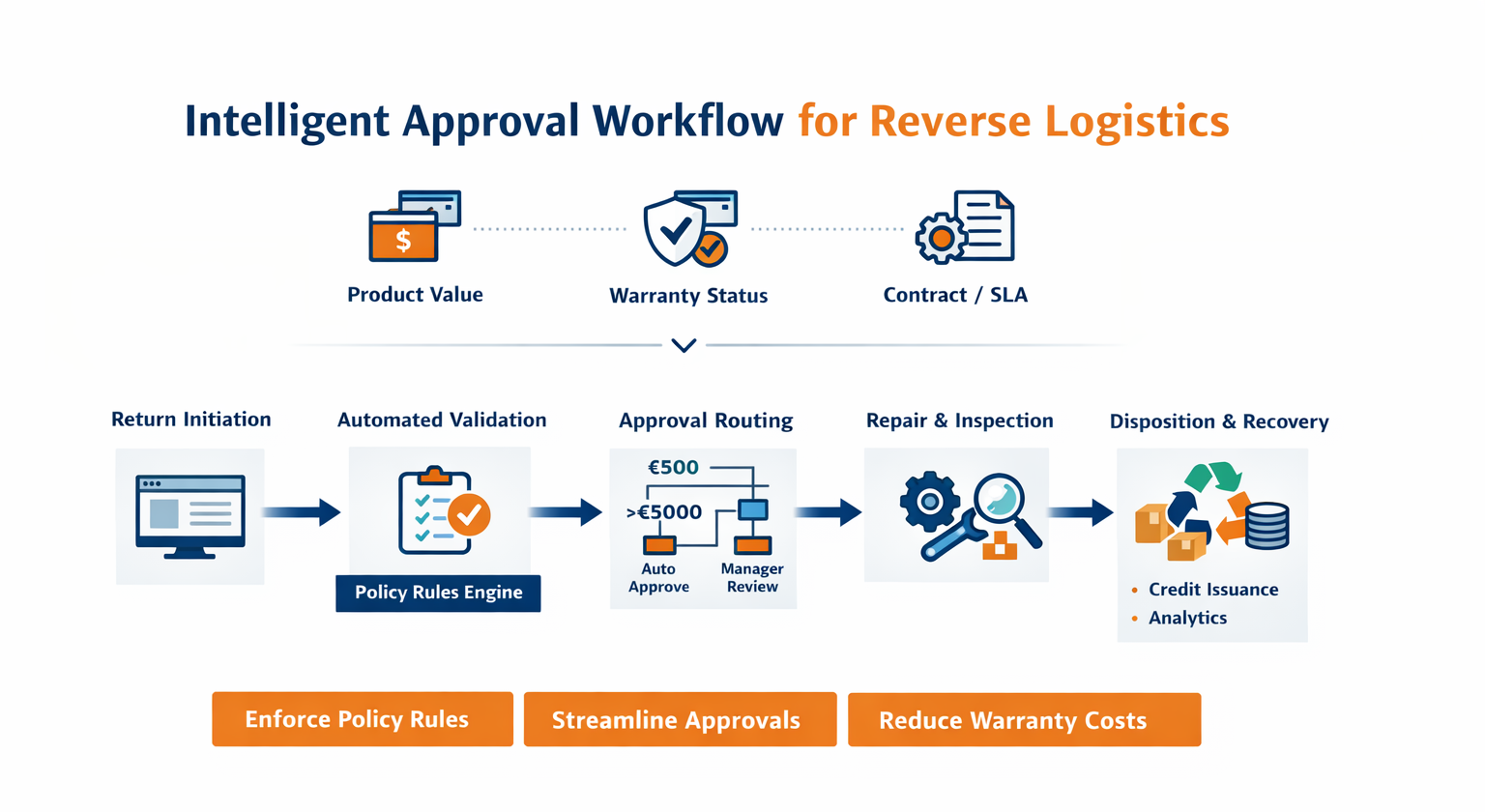
After speaking with more manufacturing and hardware teams recently, one theme keeps coming up: returns don’t fail because of technology, they fail because of approval workflows.
Most organizations have invested heavily in ERP, supply chain, and service operations. But when a product comes back for repair, calibration, or warranty evaluation, the process often breaks down. RMAs move through email chains. Paper checklists follow products across departments. Multiple stakeholders, customer service, engineering, warehouse, and finance, all need to weigh in before a decision is made.
What should be a structured lifecycle becomes a series of manual approvals that slow everything down.
The real issue isn’t just speed, it’s control.
When approval logic lives in spreadsheets or tribal knowledge, manufacturers lose visibility into warranty costs, repair outcomes, and recovery value. Different locations apply different rules. High-value items may be over-credited. Engineering teams struggle to see failure patterns because the data never connects across the workflow. This is especially common in complex manufacturing reverse logistics workflows where multiple facilities and service partners are involved.
ERP systems do a great job as systems of record. They capture transactions, manage inventory, and handle financials. But reverse logistics is operational. It requires orchestration, inspection workflows, policy enforcement, disposition decisions, and cross-functional collaboration, all happening in real time.
That’s why more organizations are moving toward a single platform designed specifically to execute reverse logistics workflows end-to-end instead of relying on manual RMA processes or disconnected tools.
When approval workflows are centralized and automated:
- Warranty entitlements can be validated instantly
- Threshold-based approvals reduce manual review
- Engineering-driven exceptions are routed automatically
- Finance gains visibility into true return costs
- Customers and partners see faster turnaround times
The goal isn’t to replace ERP or existing systems. It’s to introduce a single platform designed to manage the entire returns lifecycle that connects them, giving teams one place to manage the lifecycle from return initiation through repair, recovery, and analytics.
Reverse logistics used to be viewed as a cost center. Today, manufacturers are realizing that when approval workflows, warranty policies, and operational processes are centralized, reverse logistics becomes a margin protection engine.
I’m seeing more manufacturers rethink how approvals, policies, and operational workflows come together, not just to move products faster, but to drive better decisions across the business. If you’re evaluating ways to modernize your RMA process and gain visibility into the full lifecycle of returns, explore how ReverseLogix helps manufacturers orchestrate reverse logistics from initiation through repair and recovery
Get a Demo
Discover how you can jump-start your returns management efforts with ReverseLogix.