
Operationally speaking, most retailers treat returns like garbage. That is why, in most cases, when a product is returned, the team processes a refund, and then it’s up to someone else to handle the next steps. But the problem with this way of thinking is that it can be really expensive. For example, in 2024 alone,retail returns totaled $890 billion. But only about 30% of returned items are ever sold again. The rest were either given away, destroyed, or dumped on a liquidator for pennies. That should worry every operations manager.
The good news is that the costs of returns don’t have to be a total loss. By including structured recovery channels in the returns process, retailers can recoup costs from returned items that would otherwise be total losses. This article walks through recovery paths and what each one actually looks like in practice.
Why Costs From Returns Keep Climbing
The money lost on returns is much more than just the amount refunded. You also have to factor in the cost of shipping, labor to inspect and sort the item, warehouse space to store it, and markdowns if the item can’t be returned to the shelf at full price. Depending on the product’s cost, that value can be significant. And it is getting worse. The NRF’s 2025 report says that 19.3% of online sales will be returned this year. That’s about one out of every five purchases.
However, the refund isn’t the real drain on resources. It’s what comes next. Most retailers do not have a clear process for deciding what to do with a returned item, like whether to sell it again, fix it up, sell it off, or give it away. Without that routing logic in place, returned items will sit in a warehouse and lose value every day. Seasonality alone can make a perfectly good product become dead inventory.
Direct Resale: The Best Cost Recovery Method
The easiest and most profitable way to get your money back from returns is to put the item back on the shelf and resell it at full price or close to it. Now, not every return is eligible. But much of it can be put back into active inventory if the item is unopened, undamaged, and still in season. The question is how fast. So, for example, a winter jacket that was returned in February and processed by March might still sell. The same jacket that is sitting in a staging area until April will be marked down.
What makes direct resale work?
The first thing you need is a quick turnaround for inspections. Retailers who can inspect, repackage, and restock within 48 to 72 hours get the most out of this channel. Walmart, for instance, has invested in curbside and doorstep returns to get items back faster and in better condition. This makes the customer experience better and adds to the store’s resale inventory.
The product category also matters. For example, clothes, especially those returned in their original packaging, are usually easy to resell. Electronics, on the other hand, are harder because opened boxes make people wonder whether the product works, even when nothing is wrong with it.
The biggest mistake stores make here is taking too long to process. Time hurts resale margins. So, every day an item that is returned stays in limbo, it loses value.
Refurbishment and Repackaging: The Middle Ground
Some returned items can’t go back on the shelf right away. Usually, because the product might need to be cleaned, the packaging might be broken, or a small problem might need to be fixed right away. Rather than looking at them as garbage, see them as candidates for restoration.
However, if refurbishing isn’t done properly, then it is possible to lose money. For instance, if a TV set has been returned with a scratched box but works perfectly, it just needs packaging. There is no need to look for something to repair inside. Also, if a pair of shoes is returned without the original tissue paper, it just needs to be put back in the box. Don’t make it a choice between refurbishment and landfill.
Real-life impact of refurbishment
In 2025, Julie Ryan, HP’s manager of North America Returns and Remarketing (now Worldwise Returns and Value Recovery), told CNBC that refurbished products can recover 80% to 100% of their value, depending on the time of year and market demand. That’s a lot. And when you consider the fact that many retailers are settling for 5 to 20 cents on the dollar through liquidation, the math is clear.
Electronics, appliances, and furniture are the types of things that get the most out of being refurbished. These are items worth more money, so the cost of minor repairs or repackaging is small compared to their resale price. Some retailers and manufacturers handle this themselves. Some work with third-party logistics companies that specialize in refurbishing and reverse logistics.
The problem is that fixing things up costs money. Plus, you need trained workers, quality-control systems, and either warehouse space or a partner to handle the work. For most mid- to large-sized retailers, profit margins on refurbished goods, especially through programs like Amazon Renewed or Walmart Restored, make the numbers work.
Liquidation and Secondary Markets: The Last Resort
When resale and refurbishment aren’t financially feasible, returned goods are liquidated. It may sound like giving up, but it’s still better than the other option, which is to lose everything.
Retailers sell returned goods in bulk to liquidation buyers, off-price clearing centers, or through pallet auction sites when they go out of business. Most of the time, buyers are discount stores, small-business resellers, or overseas distributors who can make money by selling used goods at very low prices.
Recovery expectations you should actually plan around
This is where expectations need to be checked against reality. On average, you can expect to get back $15 to $30 on a $100 item. To be fair, that is not a lot, but it is also better than getting nothing, which is what you get from a landfill. And for things that can’t be sold any other way (like cosmetics with broken seals, clothes that are too worn out, or electronics that are too old), liquidation clears warehouse space, frees up resources, and returns some money to operations.
How to Choose the Right Channel for Each Return
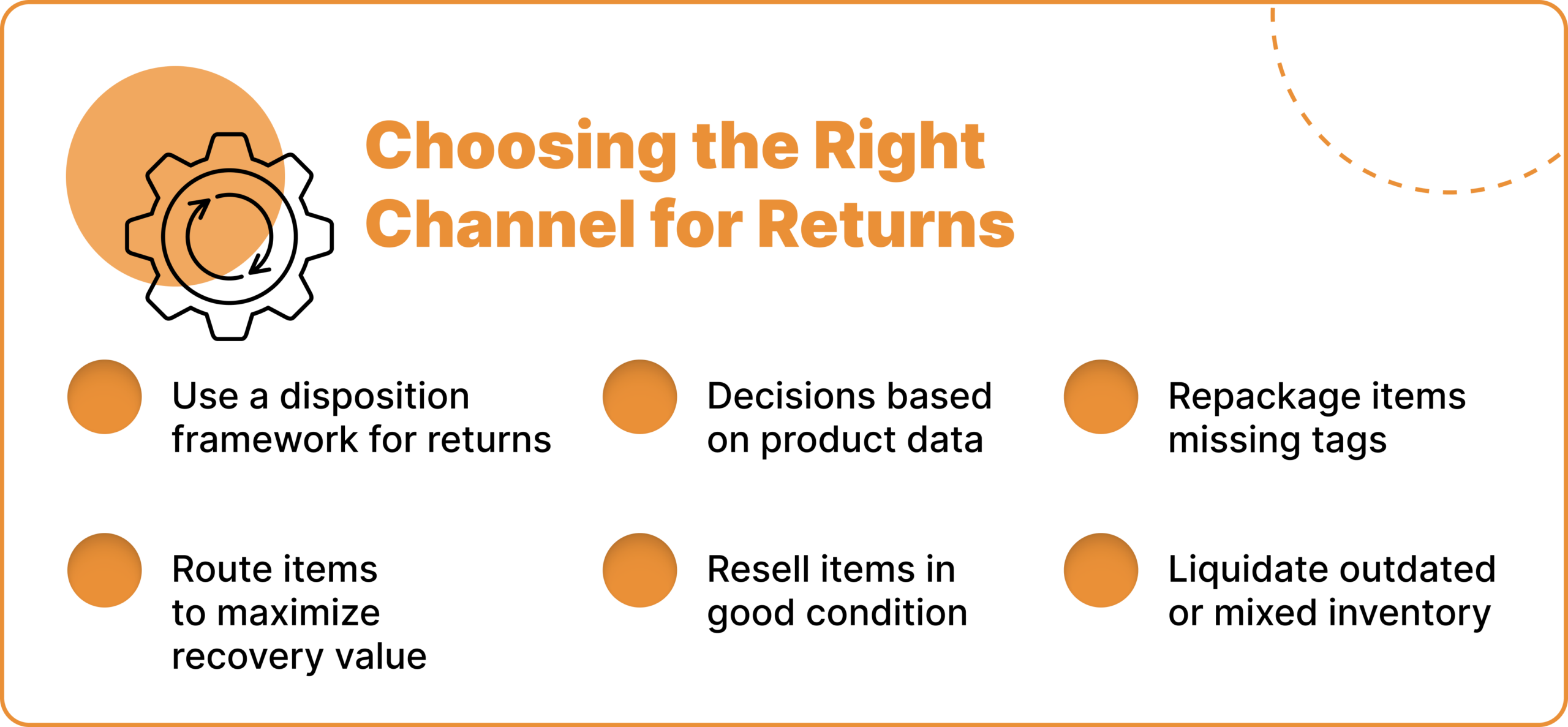
The retailers and manufacturers that get the most money back from returns use a disposition framework. It is basically a decision tree that routes each returned item to the place that will get the most money back.
The inputs are also straightforward: the item’s condition, its original price, its product category, the current demand, and the time of year. If a laptop is returned in working order along with its original packaging, it should go right back on sale. A dress that was returned without a tag might need to be lightly repackaged. However, a pallet of mixed seasonal goods that are no longer for sale is a good candidate for liquidation.
Where data analytics and technology fit
Returns management platforms grade returned items, decide what to do with them, and track how many items are recovered through different channels. For retailers and manufacturers that handle thousands or millions of returns every year, that kind of automation can turn a cost center into a revenue stream.
Stop Treating Returns Like the End of the Sale
It begins with a mindset shift. Returns don’t have to hurt profits if you recognize that they are a stage in the product lifecycle with value that can be recovered if the right steps are taken. Think about it, those handling returns the best aren’t really the ones with the fewest returns. But they have the best recovery strategies. Most of which we have discussed in the course of this article.
You need to be careful with your inventory management, supply chain coordination, and willingness to invest in the returns process rather than just thinking about it later. But the reward is real. When the industry generates $850 billion in revenue a year, even small improvements in recovery can lead to big increases in profit and cash flow. Platforms like ReverseLogix exist precisely because the old way of handling returns (manual sorting, gut-feel disposition, and one-size-fits-all liquidation) leaves too much money on the warehouse floor. Get a demo today to get started.

Frequently Asked Questions
What percentage of returned items can most retailers resell at full price?
Estimates vary by category, but roughly 30% of all returned merchandise makes it back to resale at full price. Items returned unopened and in original packaging have the best chance. Speed matters more than anything here. Retailers with a fast returns process and tight inventory management can improve profitability by getting those returned goods back into sellable inventory before demand fades.
How much money do retailers typically recover from liquidation?
Traditional liquidation yields about 15 to 30 cents on the dollar, according to Optoro. That’s a fraction of the original value, but it still beats a total loss. Structured auction platforms and off price clearing centers can push recovery higher. For most retailers, liquidation works best as the last step in a broader cost recovery method, not the default for every return.
Which returned goods benefit most from refurbishment as a cost recovery strategy?
Electronics, appliances, and furniture tend to deliver the strongest margins on refurbishment. These are higher-value items where the cost of minor repair or repackaging is small relative to the resale price. HP has reported recovery rates of 80% to 100% on refurbished products in strong market conditions. Retailers who invest in refurbishment as part of their supply chain operations can recoup costs from returns that would otherwise flow straight to liquidation or waste.
How do secondary markets and third party logistics companies help retailers recoup costs?
Retailers sell returned or excess inventory in bulk to liquidation buyers through auction platforms, direct sales to discount retailers, or partnerships with third party logistics companies that specialize in reverse logistics. Buyers resell through their own channels: discount stores, e commerce markets, or international distributors. These revenue streams won’t replace sales at full price, but they turn returned items that would sit idle in a warehouse into recovered cash. Data analytics on which products perform best in each channel helps retailers route future returns more profitably.
Get a Demo
Discover how you can jump-start your returns management efforts with ReverseLogix.