How Warranty Management Software Improves Customer Satisfaction

Article Brief
- Faster resolution: Automated eligibility checks and rule-based routing mean claims close in hours, not days.
- Self-service portals: Buyers can submit, track, and manage claims on their own time, reducing effort and building trust.
- Connected warranty data: Claims become a valuable feedback channel for product and quality teams while making supplier recovery routine instead of occasional.
Most companies measure customer happiness at the point of sale, because that is the climax of the entire sales process. But customer interactions now extend far beyond the point of sale, which means that measuring customer satisfaction at the point is now more of a blind spot. An argument can be made that the true test of the relationship is the warranty claim, and most warranty processes fail that test with a slow resolution and zero visibility. Many have zero feedback loop to the product team.
Warranty management software is the system manufacturers, retailers, and warranty teams use to automate and streamline claims, speed resolution, enable self-service submission and tracking, and turn claim data into action for product teams. Warranty management software boosts customer satisfaction right when most companies stumble. Research across industries such as this one has found that a sizable share of consumers will switch brands after a single bad service interaction. For many a buyer, that interaction is at the returns or warranty claim level, and whether your process turns it into a reason to stay or a reason to leave is an operational question, not a branding one.
From there, the article looks at how faster automated claims handling reduces effort, how post-claim satisfaction can be measured, how warranty data supports product improvement, and how stronger supplier recovery and forecasting improve operational efficiency.
The Best Way to Improve Customer Satisfaction is By Faster Claims Resolution
Speed is the most important factor in the claims experience. Someone who has a claim resolved in hours has a totally different perspective of the brand than someone who was stuck in never-ending email threads and follow-ups for even a week. Excellent service, especially in the returns and warranty claim stage, will inevitably get consumers coming back and earn repeat business. In warranty, speed is the most visible measure of service.
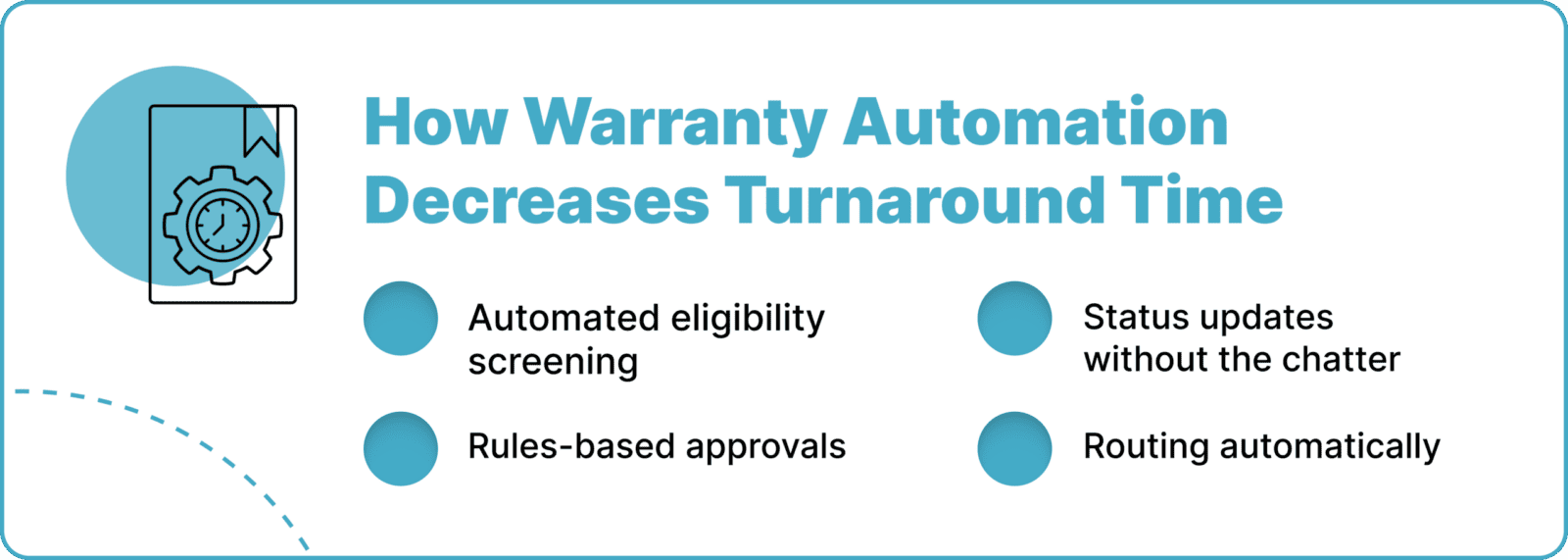
Warranty management software cuts down the warranty timeline by automating the steps that used to take the most time. Eligibility is automatically verified with registration and purchase data prior to presenting the claim to a handler. Approved claims are routed directly to fulfillment, while exceptions are flagged for review. What took the better part of an hour for manual verification can now be done in mere minutes.
Fewer manual steps mean less waiting time, which translates to resolving a buyer’s problems before frustration sets in. That alone changes how people rate the experience and whether they come back to buy from you.
Self-Service Portals Lower Customer Effort Score & Change Customer Experience
Most buyers would rather handle a simple claim themselves than wait on hold or go through the stress of a long email thread. However, with solutions like self-service portals, these customers can file a claim, upload proof of purchase, register a product, and check warranty status at their leisure without calling or writing to anyone. This way, the experience is much more proactive, with the buyer in the driver’s seat.
That ties directly into something called customer effort score. The less effort someone has to go through to get their problem solved, the more likely they are to stick around. By that standard, a portal where a user can file a claim at midnight and check status the next morning beats a process that takes two emails and a phone call during business hours.
There is also a volume advantage for your team. Allowing buyers to take care of everyday submissions and status checks frees your support team up to spend more time on claims that actually require a more personal approach. Structured warranty portals take the easy work off your team’s plate and put it where buyers actually need it.
Feedback from warranty claims informs product teams where to act
All warranty claims include information on what failed and the conditions of the failure, including when it happened. That aggregated data tells your product and quality teams which components are breaking and how often, and if the problem is getting worse. That signal is more specific than what you get from online reviews or social media channels, because a claim is tied to the product’s serial number and a timeline.
Unlike a social media complaint that is rarely verified, a warranty claim has a record of what broke. Analytics that track failure rates and recurring defects can feed that information back to design and engineering, so the next version of the product addresses the real problem, rather than guessing based on sentiment.
That’s where warranty management software turns complaints into product improvements. The same data that processes a claim also recognizes patterns, something a spreadsheet or a CRM custom field was never built to do at scale.
Measuring Customer Satisfaction Levels After a Claim Comes In
The post-warranty claim moment is where opinions shift the most, and measuring there gives you insight into the part of the experience that determines whether someone buys from you again. At that stage, surveys are a common method to measure customer satisfaction.
There are a couple of measuring tools that work well at this point, including post-claim surveys, sent soon after a claim is closed, which can capture the buyer’s reaction while it is still fresh. CSAT is calculated from customer satisfaction surveys using a rating scale, often 1 to 5, that you can track over time across product lines. Net Promoter Score measures customer loyalty on a scale from 0 to 10. The American Customer Satisfaction Index is another annual benchmark for satisfaction, though post-claim teams typically rely on their own direct survey data. Both are useful, and both have more signal when collected after claim than after sale.
Scores do not have the depth of focus groups, though. That’s because a rating tells you how people rated the experience, while a focus group of recent claimants highlights friction points in your process, particularly among those who rated it poorly. Conversations give you the answers to questions like:
- Was it the waiting?
- Was there a mysterious gateway?
- And were there any updates?
By tracking both at the warranty stage, your team can see if process changes are actually moving the needle on how buyers feel about the post-purchase experience.
Importance of customer satisfaction for customer loyalty and customer relationship management
A well-handled claim creates trust at the very moment the buyer has the most reason to be frustrated. Across industries, consumer research shows that most buyers are more likely to buy again from the company that solved their problem quickly and transparently. The warranty claim is the point of resolution.
A positive claim experience makes people more likely to register their next purchase or recommend the brand. Someone who had a bad one will probably never return. Consumer behavior research consistently shows that a large percentage of buyers will switch after just one bad experience, and they don’t tell you why. They just don’t come back.
The difference between companies that retain their buyers and companies that quietly lose them is managing the entire relationship after the sale, not just the transaction. One of the most underappreciated interactions in that chain is the warranty claim. The organizations that see it as a cost to contain, rather than a relationship to protect, are usually surprised when retention numbers drop without a clear reason.
How ReverseLogix Is Making Warranty Claims the Reason Customers Keep Coming Back
The warranty claim is the highest-stakes interaction most manufacturers have with their buyers and the one most likely to run on a process nobody designed on purpose. ReverseLogix is a single platform that unifies warranty registration, claims, repair, and reverse logistics so the claim experience is driven by rules and connected data instead of workarounds and isolated files.
For enterprise manufacturers and retailers, that connection is what makes warranty a reason buyers come back, rather than a point of frustration. If your claims process is still losing time to manual verification and disconnected records, then it is probably a system built for the task. Talk to a specialist today to get started on the solution.

Frequently Asked Questions
Yes. Warranty management software is generally built to connect with CRM, ERP, ecommerce, and finance systems through direct integration, and these integration capabilities improve efficiency by letting the platform use live customer data across systems. This lets claims pull from existing customer records and order data without re-keying, which reduces errors and speeds up resolution. What matters most is integration depth, since eligibility checks and claim routing depend on reading live purchase and product data. Before choosing a platform, confirm it connects to the specific systems your warranty process already touches. Shallow integration leaves your team bridging gaps by hand, which cancels the speed gains.
Yes. Warranty management software flags suspicious claims through automated validation, checking each submission against centralized records in real time. This catches duplicates when the same serial number appears twice, spots eligibility mismatches, and surfaces patterns that suggest fraud. Because checks run automatically on every claim rather than on a manual sample, coverage is far more consistent than human review. The result is fewer improper payouts and cleaner claim data, though validation rules still need periodic tuning as tactics shift over time.
Supplier recovery traces defective-part claims back to the upstream vendor responsible so the manufacturer recovers the cost rather than absorbing it. Warranty management software automates this by linking each claim to part, supplier, and contract records. When a claim matches a supplier-responsible defect, the system flags it for recovery automatically. Done by hand, this step usually gets skipped because tracing one claim to one vendor takes time most teams do not have. Automated recovery turns a cost that quietly leaks into margin that gets recovered.
Connected warranty data gives finance teams a clearer view of future claim costs, recovery amounts, and reserve needs. When claim trends, failure rates, and supplier performance sit in one system, forecasts can draw from actual patterns rather than historical averages. Analytics that surface defect trends and cost-per-claim by product line help predict where warranty spend will climb and where it will drop. This is a step most companies miss when warranty runs on spreadsheets or inside a CRM with limited warranty-specific reporting.
Surveys sent right after a claim closes capture the buyer’s reaction at the moment their opinion is sharpest. The responses produce a score you can track across products, time periods, and resolution types. Focus groups of recent claimants add depth by revealing why buyers rated the experience the way they did, whether the issue was wait time, portal confusion, or lack of updates. Used together, the two methods let your warranty team separate process problems from product problems and act on the right one.
Get a Demo
Discover how you can jump-start your returns management efforts with ReverseLogix.