How Do I Choose Enterprise Warranty Management Software?

Article Brief
- US manufacturers paid $30.37 billion in warranty claims in 2025, and warranty reserves increased by 17%, signaling that the industry is preparing for rising warranty costs rather than lower ones.
- Most warranty expenses are determined after a claim is approved, during diagnosis, repair, disposition, and supplier recovery, stages where many warranty management platforms have little or no operational visibility.
- The most important evaluation criteria for warranty management software include entitlement logic, serialized physical tracking, supplier recovery, and defect signal speed, rather than simply how quickly a claim can be submitted.
Most warranty management software speeds up claims processing while doing almost nothing about where the money actually goes. That distinction gets lost in nearly every buying cycle. A VP of service walks into an evaluation with clear problems, such as claims taking more days than usual, angry dealers, or a backlog. So the requirements document focuses on intake speed, approval workflows, and cycle time.
The vendor demos a clean claims queue, which everyone agrees is much better than the spreadsheet. But then the warranty line on the P&L doesn’t move. What is often missed is that a warranty claim is not a document. It is a physical object that broke, moved, was diagnosed, got fixed, or was scrapped. That physical object costs money, while the claim is just the receipt. So any software that manages the receipt is managing the smallest part of the problem, and enterprise warranty management software that stops at adjudication will leave the majority of your warranty costs completely untouched.
What Is Warranty Management Software, and What Does It Actually Cover?
Warranty management software consolidates warranty registration, coverage checks, claim filing, adjudication, and payment by centralizing warranty information on a single platform, rather than relying on spreadsheets and disconnected tools that most enterprises still use. Manual tracking is opaque, and workflow automation eliminates manual work tied to claims processing. Product data lives in one system while customer data lives in another, so integrating a product warranty workflow with CRM and ERP systems helps keep records synchronized while managing warranties across teams. Even the repair status lives in a technician’s inbox, which limits full visibility.
That is why a centralized platform is so important. Automated validation checks reduce human error in claim processing, business rules handle eligibility without requiring a person to read contract terms sentence by sentence, and self-service portals improve customer communication by letting customers submit claims directly, track claim statuses online, and verify warranty status without creating a support ticket. Automated notifications provide status updates on claims and repairs. By registering the warranty at the time of purchase, you capture serial numbers and product details up front, which in turn eliminates much of the back-and-forth that slows claims down in the first place.
Notice that almost all of this happens before the product moves. The software knows a claim has been approved. But it often has no idea what happened to the real unit. Warranty costs are in that gap.
Why Warranty Claims Cost More Than the Claim Itself
According to APQC benchmarking, manufacturers lose about 2% of annual revenue to warranty management costs, and industry estimates put warranty claims at 2% to 5% of a manufacturer’s revenue when the full picture is considered. For a $2 billion manufacturer, the low end of that range is $40 million, and the high end is $100 million. Very little of that variance is explained by how fast claims get logged.
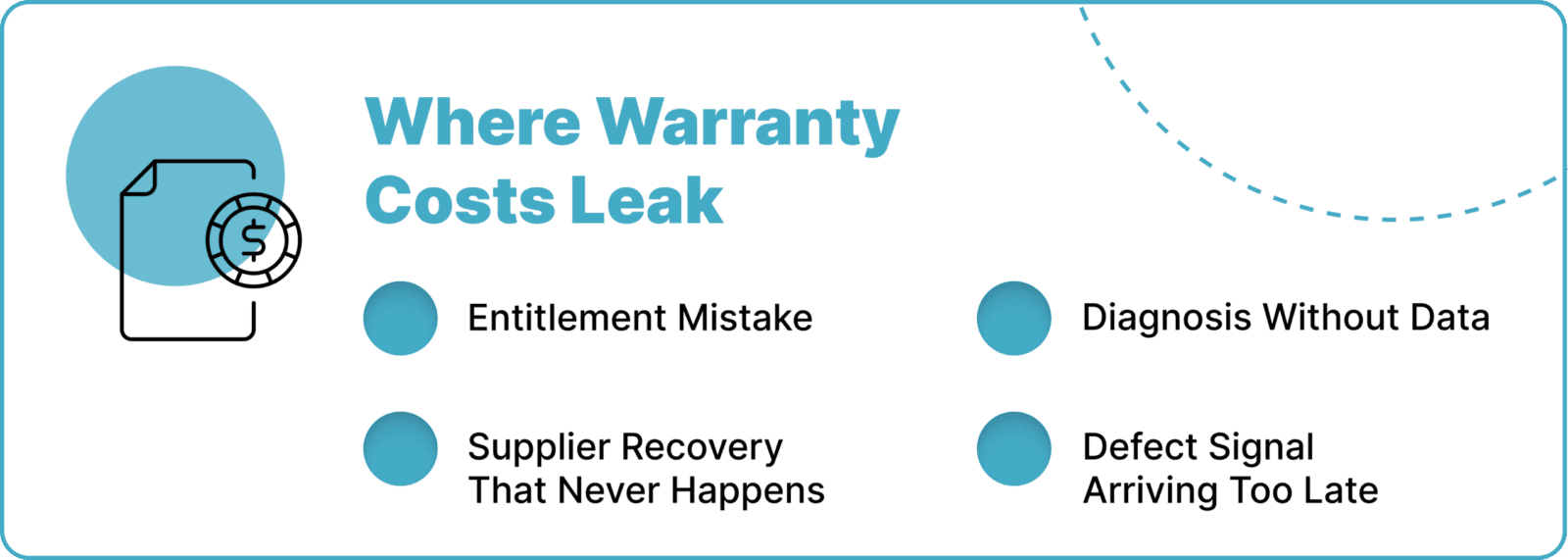
Four leaks account for most of it.
1. Entitlement Mistake
This is when you pay claims you never had to pay. Say, for example, the policy expired, the issue fell outside the product’s warranty coverage, the unit was modified, or the same claim was submitted twice through two different channels. Depending on a company’s aggressiveness in pursuing warranty fraud, the cost can range from 3% to 15% of total warranty spend. Appriss Retail’s annual research found that fraudulent returns and claims cost retailers $103 billion in 2024. People often talk about fraud detection in moral terms. But it is also a margin issue. Automated validation reduces manual errors in claims processing, and AI models can prioritize suspicious submissions for review, so legitimate claims are approved and unnecessary payouts are avoided.
2. Diagnosis Without Data
A product comes back. What looks like a one-off technician call is really a process improvement problem: was repair viable, or was refurbishment a better option? Without a failure history for that serial number and a rule specifying what to do with it, including how related spare parts should be handled, that decision gets made by whoever is standing there. Multiply one wrong decision by ten thousand units and the cost becomes clear.
3. Supplier Recovery That Never Happens
Say a component broke because of a defective part from one of your suppliers. You paid anyway, because to file the counter-claim you have to tie the failure to the right supplier, gather the documentation tied to the contract and chase it down. Warranty management software speeds this up by generating the supplier counter-claim automatically and linking claims to the responsible supplier. Supplier recovery is probably the highest-return activity in most warranty operations, and it is the most consistently neglected.
4. Defect Signal Arriving Too Late
Every warranty claim is a data point about the product’s quality. Warranty analytics can identify recurring defects and monitor failure rates across the same component within a single model year, helping teams spot quality issues earlier. Dashboards and data-driven insights support root cause analysis, improve product quality, inform product design changes, and with predictive analytics can reduce future claims significantly. In a connected system, engineering hears of a failure pattern in days. In a disconnected one, the business pays for the same failure four hundred times before anyone sees it.
How to Evaluate Enterprise Warranty Management Software
Evaluate warranty management systems against what happens to the product, not what happens to the paperwork, because the paperwork is the cheap part. These six criteria separate a warranty tracker from a dedicated enterprise warranty system that controls warranty costs.
| What to test | What breaks without it | What to ask the vendor |
| Entitlement and business rules engine | You pay claims you never owed, and coverage decisions vary by whoever is reviewing | Can it support contract-level, channel-level, and SKU-level rules simultaneously? |
| Serialized item tracking through repair | Nobody can say where a unit is or what was done to it | Can I follow one serial number from claim to inspection to repair to return shipping? |
| Supplier recovery workflow | Defective components stay on your P&L instead of the supplier’s | Does it generate the supplier counter-claim automatically, or just flag it for someone to chase? |
| Disposition logic | Repairable units get scrapped, scrap gets repaired | Is disposition decided by a configurable rule or by the technician’s judgment on the day? |
| Warranty analytics and defect signal | Engineers learn about a failure pattern after they’ve paid for it a thousand times | How fast do failure patterns reach the product team, and in what format? |
| ERP and WMS integration | Warranty numbers and warehouse numbers disagree, and nobody knows which is right | When a warranty replacement ships, does inventory adjust automatically? |
Why Warranty and Returns Belong on the Same Platform
Warranty claims and product returns are the same physical event with different paperwork attached, which is why running them on separate systems creates a data gap that neither system can fill. The warranty claims system knows that a customer has an outstanding repair. The returns system is aware that a box has arrived at a warehouse. Both exist in silos, so a person, an email, and a spreadsheet usually have to link the two.
Finance leaders see the symptoms without the cause: warranty reserves that never add up, or recovery rates no one believes. Those are not two problems. They are one problem showing up in two reports.
Companies using automated warranty platforms have reduced processing times by approximately 30% and costs by approximately 35%. Advanced warranty analytics can reduce total warranty costs by up to 30%, resulting in 2 to 5% improvements in revenue margin over a longer horizon. The second figure comes from finding out what is breaking and stopping it.
Tracking Features That Matter
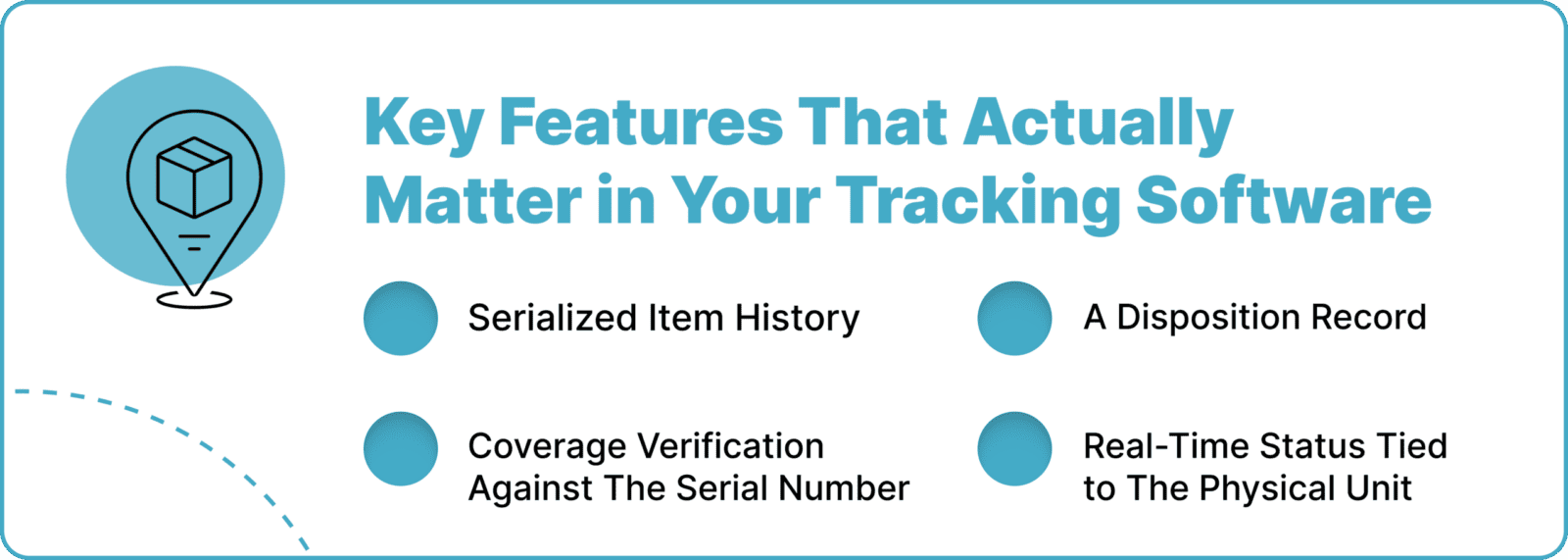
The tracking features worth paying for are those tied to a serialized unit rather than a claim number, because a serial number is the only thing that remains constant from purchase to disposal. Four of them carry most of the weight.
Serialized Item History
This holds a continuous record from product registration to claim, inspection, repair, and final disposition of each unit. You want to know, especially in manufacturing, exactly which component went into which unit and when that component’s coverage started. A system that tracks individual items rather than tracking a claim by pasting a serial number into a field can generate the complete history of a single physical object when needed. Mobile-proof capture tied to assets and work orders further strengthens the record by attaching photos and technician notes to the unit rather than to a loose email. Everything else on this list is only as reliable as this history.
Coverage Verification Against The Serial Number
As soon as a claim is made, the software should compare the warranty status of a product against the purchase date, service contract, and the specific serial number. The most obvious defense against revenue leakage is money paid out on expired or invalid claims. Recent research from Appriss Retail data found that fraudulent returns and claims cost businesses $103 billion in 2024, and weak verification is how a large share of that gets through. Compliance risk is also minimized through serial-number verification, as each approval links back to a documented coverage rule rather than a judgment call.
A Disposition Record
Not just “repaired” but the actual outcome recorded per unit: repaired, replaced, reconditioned, or withdrawn. Without this, the same repairable unit is scrapped in one facility, and an identical unit is refurbished in another. No one can explain the inconsistency because no one documented the decision.
Real-Time Status Tied to The Physical Unit
Real-time tracking answers the question, “Where is the product?” not, “What stage does the ticket say it is in?” B2B partners can check the status of their own product returns in a portal, rather than adding to your team’s administrative overhead. And the status they see reflects the unit’s actual position in the repair pipeline.
Why Spreadsheets Fail at Enterprise Scale
Spreadsheets are not built for the pace of a production line. As output grows, the manual effort needed to keep a workbook accurate leads to stale data and blind spots.
Lack of Real-Time Serialized Tracking
Tracking individual component history and unique serial numbers in a static document is slow and error-prone. In manufacturing, you need to know exactly which part went into which unit and when its specific coverage began. Spreadsheets lack the real-time connectivity to update these records instantly, leaving a gap between high-volume production and slow manual data entry.
Without live visibility into serialized data, your team can’t accurately verify if a specific component is still under warranty, leading to costly errors and missed recovery opportunities from your own suppliers.
Compliance and Audit Risk From Unstructured Data
In regulated industries, producing a clear audit trail from scattered Excel files is a major liability. If a regulator or stakeholder requests documentation, searching through various versions of “Warranty_Final_v2” creates legal and financial risks. Dedicated systems ensure one version of the truth by logging every action, change, and approval automatically.
This structured approach simplifies manufacturing returns and compliance and gives you a defensible record for internal auditors and external regulators.
How ReverseLogix Manages Warranty Claims and Physical Returns on One Platform
ReverseLogix handles the physical movement of returned products and warranty claims on a single platform, linking the claim record to the unit itself.
Here is what that looks like in practice:
- A configurable rules engine that automates repetitive warranty tasks and handles company policies, claims rules, vendor entitlements, and approval hierarchies, including eligibility checks, claim approvals, and the contract-level and SKU-level exceptions that break simpler systems.
- A repairs management module that includes warranty assessment, fault analysis, parts tracking, safety stock, and ticket assignment, so that the repair decision is a rule, not a judgment call.
- Serialized tracking from the time a claim is filed through inspection and repair to return shipping, with a complete history kept for every unit.
- An AI-powered disposition engine that uses inspection data to route each item to its highest-value destination: restock, resell, repair, recycle, or dispose.
- B2B and B2C warranty returns on a single platform. So high-volume consumer claims and contract-governed partner claims don’t require two systems and two sets of numbers.
- Returns analytics tracking recoupment rates, processing times, and failure patterns, with the defect signal reaching your product team while it still has time to matter.
- Integration with SAP, Oracle, Salesforce, and existing warehouse systems, so a warranty replacement adjusts inventory and updates the customer record without anyone retyping anything.
Implementation runs 4 to 6 weeks out of the box. Enterprises including DHL Supply Chain, FedEx, Samsonite, Electrolux, and Amer Sports run their returns and warranty operations on it. If your warranty costs are rising while your claims queue looks healthy, the two facts are probably related. Get a demo to see it in action.

Frequently Asked Questions
Q1. What are the best software platforms for managing product warranties across multiple channels?
The platforms worth evaluating for multi-channel warranty management are the ones that treat B2B and B2C claims as a single workflow rather than two products bolted together, with support for multiple claim types across channels. A warranty management system handling multiple channels needs to reconcile different warranty terms, service contract obligations, approval workflows, and user access while keeping customer and warranty data synchronized across ERP and CRM environments for the same product and serial number, even across multiple languages. If a platform requires separate instances for retail and partner warranty claims, your warranty data will fragment along that seam, and your reporting will never fully reconcile. ReverseLogix runs on one centralized platform with a shared rules engine.
Q2. What are the top solutions for end-to-end warranty and returns management?
End-to-end warranty and returns management means one system covers claim submission, entitlement verification, physical receipt, inspection, coordination of repairs, replacements, and refunds, disposition, supplier recovery, analytics, and related services while centralizing warranty information on a single platform. Very few platforms genuinely span that range. Most warranty management software stops at claim approval, and most returns software starts at the warehouse door, which leaves a handoff in the middle where warranty costs quietly accumulate. When evaluating solutions, trace one claim end-to-end during the demo and identify precisely where the vendor’s system stops knowing what happened.
Q3. What’s the difference between warranty management software and a returns management system?
Warranty management software is built for managing warranty claims: coverage, eligibility, adjudication, and payment. A returns management system administers the product: receipt, inspection, grading, repair, and disposition. They describe the same event from opposite ends. Enterprises running both separately end up maintaining two records of one product and reconciling them manually, which is why the categories have been converging. A returns management system with a built-in warranty module, rather than a warranty tracker with a returns integration, tends to capture the full picture more reliably, improving customer communication and building stronger loyalty and trust.
Q4. What is warranty leakage, and how do you stop it?
Warranty leakage is money lost through invalid claims, duplicate submissions, fraud, defective parts that should be charged back through supplier recovery, missed supplier recovery, and repair decisions made without data. It’s rarely one big loss. It’s thousands of small ones, which is exactly why it survives inside manual warranty processes. Stopping it requires automated validation checks at intake, fraud detection that flags patterns across claim volumes rather than judging claims one at a time, supplier recovery workflows that automatically generate the counter-claim, contract management for related service policies and reconciliations, and disposition rules that remove guesswork from the repair-or-replace call, a combination that reduces unnecessary payouts and leakage across the warranty process.
Repairs and warranty in one flow
How repair intake, warranty entitlement and parts move through a single system.
Get a Demo
Discover how you can jump-start your returns management efforts with ReverseLogix.