How Do I Speed Up Warranty Claim Processing?

In brief:
For the software side of this topic, see warranty management software.
- Warranty automation reduces warranty claim processing time by replacing manual eligibility checks, routing, and status updates with rule-based workflows.
- Automation only speeds up claims it can read correctly, so warranty data has to be clean and connected across ERP, field service, and supplier systems first.
- Beyond speed, automation lowers warranty costs by catching duplicate and fraudulent claims, making supplier recovery routine and reducing administrative hours. Faster claims and self-service portals also improve customer satisfaction.
Warranty automation rarely fails because of the software. It fails because most manufacturers treat slow claims as a headcount problem when the real bottleneck is data. If a claim takes eleven days to close, it is probably caught between a registration record in one system, a proof-of-purchase file in another and a repair note buried in an email thread. Adding people leaves you with the same delays spread across more desks.
This article explains how warranty automation cuts the time it takes to move a claim through your operation, and why the size of that reduction depends almost entirely on how well your data is connected.
What Actually Slows Down Warranty Claims
Most warranty delays come from verification work that has to happen before a claim can be approved or denied. Someone has to confirm that the product still has warranty coverage, that it was registered and that the serial number is linked to a real sale.
Each answer is often in a different place. Multiply that by thousands of claims a month and the queue gets longer than any team can clear.
The manual process has predictable failure points. Claim data arrives from different places and is re-keyed by hand, which causes errors. No one checks the same serial number twice, so duplicate claims slip through. Repair details sit in email threads and never reach the record. A claim can wait for days because the person who could approve it was waiting on a file from someone who was out that week.
There is a quieter cost too. When warranty registration, purchase records and repair history are scattered, data integrity erodes, and you make warranty decisions on records you cannot fully trust. Legitimate claims are denied and fraudulent ones are paid.
How Warranty Automation Decreases Turnaround Time
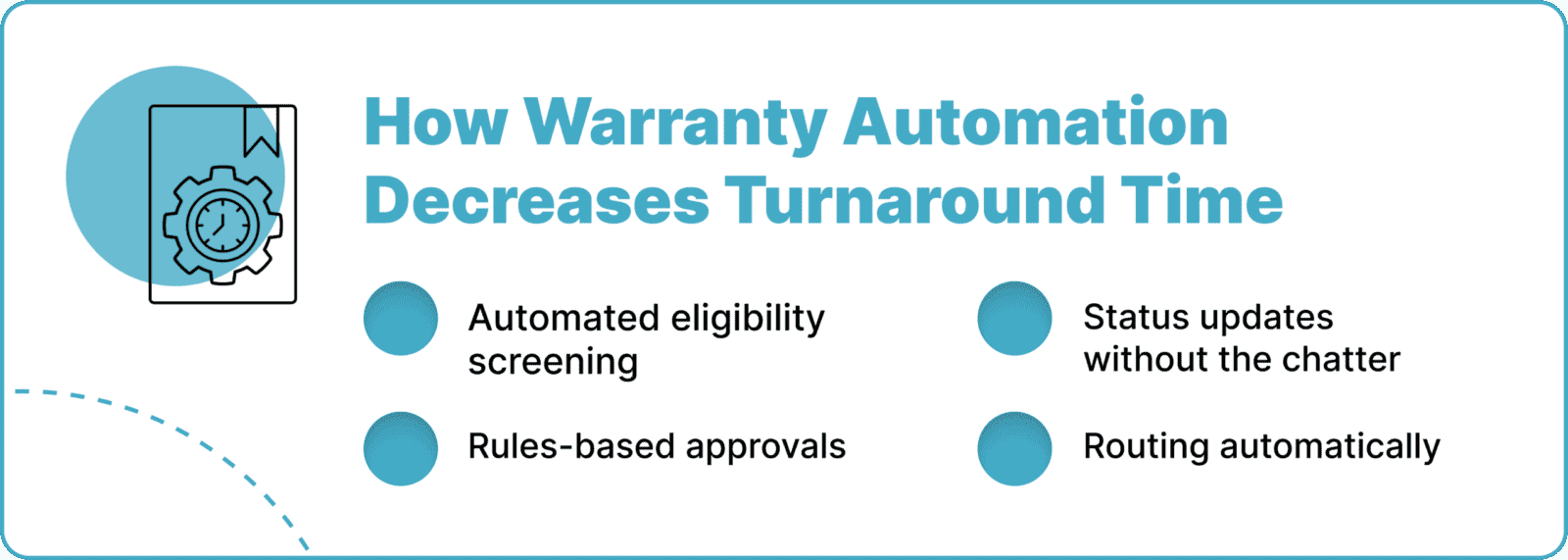
Warranty automation shortens claim cycles with rule-based workflows that handle verification and routing as soon as a claim is submitted. The system checks eligibility against registration and sales records automatically. Rules route the claim to the right handler, or approve it outright when it meets set conditions. Claims that took days can be processed in hours.
The steps:
Automated eligibility screening: Before a human gets their hands on the claim, the system checks warranty coverage, registration status, and purchase validity against your records. That takes out the single biggest source of delay.
Rules-based approvals: Low-value or simple claims that meet set criteria are approved automatically, so your team can focus on the claims that need judgment.
Automatic routing: Claims that need a person go directly to the right one with the supporting data attached, so no time is wasted collecting files.
Status updates: Automated messages tell customers where they stand at each step, which reduces the “where’s my claim” emails that consume handler time.
Most of the recovered time comes from fewer manual steps. How much any operation gains depends on how manual its process was to begin with. A team already using rules-based routing will see less change than one still working from spreadsheets.
Why Data Accuracy Makes Automation Work
Data accuracy is the ceiling on everything else. Automation only speeds up claims it can read correctly. If your registration records are incomplete or your serial numbers are inconsistent, automated eligibility checks will fail or, worse, pass claims they should catch. You will have found a quicker way to make the same mistakes.
This is the part vendors usually skip in the demo. Your warranty data has to be clean before automation can save you money. That means one solid record for each product, consistent serial formatting and registration data that links back to a sale. With that in place, automation quickly identifies duplicate claims and the errors created by re-keying.
This is where intelligent document processing helps. When a customer uploads a receipt or repair invoice, the system reads the document, extracts the relevant fields and matches them to existing records without anyone typing them in. It improves data accuracy and removes a manual step, one of the few places in warranty work where the same change gives you both speed and correctness.
How Warranty Management Software Fits in With the Rest of Your Operation
A claim rarely lives in one place, so warranty management software has to be integrated with the systems around it. The degree of integration separates a tool that speeds up one task from a platform that shortens the whole cycle. If your warranty system cannot talk to your ERP or your supplier records, your team is still bridging those gaps by hand.
The connections that matter most for processing time:
- ERP and sales systems (SAP, Oracle, Microsoft Dynamics and the like) so eligibility checks are run against real purchase data.
- Field service operations to schedule an approved repair claim without a separate handoff, which cuts days off repair-related claims.
- Supplier recovery records, so you can pursue recovery on defective parts instead of absorbing the cost. This is where warranty programs quietly lose margin.
Real-time dashboards sit on top of all this. When your team can see active, expired and expiring warranties in one place and spot failure patterns as they emerge, instead of waiting for a quarterly report, you can address quality issues before they become a wave of claims.
The Impact of Faster Claims on Customer Satisfaction and Cost
Shorter claim cycles improve customer satisfaction and reduce claims costs at the same time, which is rare for a single change. On the cost side, automation catches duplicate and suspicious claims that would otherwise be paid and makes supplier recovery routine. On the experience side, a customer whose claim is closed in hours instead of days comes away with a very different impression of your brand.
Part of it is self-service. When customers can submit and track claims through a portal, the back-and-forth disappears, because people would sooner check a status themselves than wait for a reply. It also frees your team from status chasing so they can focus on the claims that need attention.
Bringing Warranty Data Into One Place With ReverseLogix
If slow claims are a data problem, the fix is to connect the data, and that is what the ReverseLogix platform is designed to do. It brings warranty registration, claims, repairs and reverse logistics together in one system, so eligibility checks, routing and supplier recovery run against a single trusted set of records.
That connection is what lets automation deliver for manufacturers and retailers managing warranty at enterprise scale. Rules can only go as fast as the data they read, and consolidated data is what turns a multi-day claim into a same-day claim. If your warranty claims are stuck between systems, look at where your data lives before you look at headcount. Contact us today to get started.

Frequently Asked Questions
Q1. How much can warranty automation reduce claim processing costs?
Savings vary widely. The actual figure depends on how manual your current process is. An operation still working from spreadsheets and email will see a larger drop than one already using rules-based routing. Most of the savings come from lower administrative hours per claim, fewer duplicate and fraudulent payouts, and more consistent supplier recovery on defective parts.
Q2. Can automation detect warranty fraud and duplicate claims?
Yes. Automated systems can flag suspicious warranty claims using rules and pattern detection, checking each submission against existing records in real time. This catches duplicate claims when the same serial number appears twice, spots eligibility mismatches, and surfaces unusual patterns that suggest fraud. Because the checks run automatically on every claim rather than on a manual sample, coverage is more consistent than human review alone. The result is fewer improper payouts and cleaner warranty data, though rules still need occasional tuning as fraud tactics shift.
Q3. Does warranty management software integrate with SAP, Oracle, or Microsoft Dynamics?
Enterprise warranty management software is generally built to connect with major ERP systems including SAP, Oracle, and Microsoft Dynamics, along with field service and CRM tools. Integration depth matters more than the number of connectors, because eligibility checks and claim routing depend on reading live purchase and product data. Before choosing a platform, confirm it can integrate with the specific systems your warranty process already touches. Shallow integration forces your team to bridge data gaps by hand, which cancels out much of the time automation is supposed to recover.
Q4. How do self-service portals affect warranty claims?
Self-service portals let customers submit and track warranty claims on their own, which reduces the back-and-forth communication that slows claim handling. Instead of emailing for a status update, a customer checks the portal directly. This improves the customer experience and cuts the volume of routine inquiries your team fields, freeing handlers for claims that need judgment. Portals also improve data accuracy at intake, since customers enter their own product and purchase details, and intelligent document processing can validate uploaded receipts against your records automatically.
Q5. What is supplier recovery in warranty management?
Supplier recovery is the process of recovering warranty costs from suppliers when a defective component causes a claim. If a part fails and the supplier is responsible under contract, the manufacturer can recover the repair or replacement cost rather than absorbing it. Done manually, supplier recovery is often missed because tracing a claim back to a specific supplier takes time nobody has. Automation makes it routine by linking claims to part and supplier records, so recoverable costs get flagged and pursued consistently instead of slipping through.
Repairs and warranty in one flow
How repair intake, warranty entitlement and parts move through a single system.
Get a Demo
Discover how you can jump-start your returns management efforts with ReverseLogix.