Operationalizing the EU's 14-Day Right of Withdrawal: What Retailers Actually Need to Get Right
Most retailers that sell to customers in the European Union are aware of the 14-day right of withdrawal. They’ve read about it, and their lawyers have reviewed it extensively. But when a customer in Portugal tries to return something they bought through guest checkout or a shopper in Germany expects a refund within the cooling-off period, things often go wrong. EU digital compliance fails to address the gap between knowing the law and following it across countries, carriers, and systems.
In this article, we explain why the gap in EU digital compliance exists and how to close it. Here is the thing: the rules are easy to understand. However, the real test is setting up the operational infrastructure to run it at scale across the EU.
What the EU’s Withdrawal Regulations Actually Require
European shoppers who buy things online have the right to cancel and return their purchases within 14 days. No questions asked. Now, that’s easy to understand. But the operational demands behind this consumer protection rule go deeper than most retailers expect.
- Brands must offer digital cancellation access that lets customers cancel their orders online without creating an account.
- Guest checkout workflows need to support return registration through simple order lookups
- Every EU member state must have clear and consistent refund timelines. And the whole experience has to feel the same no matter where the customer is, whether it’s France, Finland, or the Netherlands.
There are some exceptions to these rules. The cooling-off period does not apply to hotel reservations, concert tickets, plane and train tickets, car rental reservations, catering services, or sealed audio and digital content once the customer starts downloading. Computer software that has been unsealed is also excluded. But the rule applies to almost all online purchases.
What makes this tricky is that each EU country can add its own laws on top of the directive. So, there are situations where carrier networks differ, and the documentation requirements change. For instance, a retailer or online store that has to deal with returns in eight or ten markets within the EU will suddenly find that the concept of “one return policy” is mostly fiction.
Where Most Retailers Hit a Wall
On paper, the process for managing returns looks easy. A customer asks to return something, gets a return label, sends it back, and gets their money back. In reality, the execution is much messier, though.
Fragmented Country Processes
Many businesses have different return policies for each market they serve. DHL might be used by one country. Another one uses DPD. A third routes returned items back through a regional warehouse that had its own inspection process. When each market has its own rules, the experience is inconsistent. Unfortunately, that level of inconsistency is where compliance risk thrives.
Guest Checkout Returns
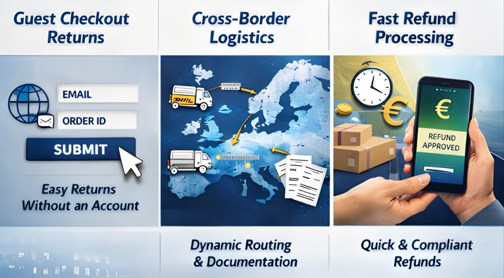
EU digital laws require that businesses let customers cancel their orders without requiring them to log in to an account. This may seem small, but most backend systems were designed to work with account-based workflows. Allowing customers to register for returns with just an email address and order ID is a technical challenge that many online platforms have not yet solved.
Cross-Border Routing and Documentation
When a customer in Austria sends a product back to a warehouse in the Netherlands, the return must be routed dynamically based on geography, facility capacity, and carrier capabilities. It is important to ensure that cross-border documentation is accurately generated. Most order management and ERP systems were never meant to handle this kind of conditional logic across multiple digital markets.
Slow Refunds and Poor Visibility
When the workflows between return initiation, warehouse receipt, and product inspection are disconnected, everything slows down. Customers are frustrated when a refund takes longer than expected, for example, 15 or 20 days instead of the expected timeline. And it creates regulatory exposure. According to EU law, a retailer may be fined if they don’t process a refund within 14 days of getting the returned goods or proof of return shipment.
Why ERP, OMS, and Ticketing Tools Aren’t Built for This
Most retailers operating in the EU already have systems in place to handle support tickets and manage orders. These tools do a great job of what they were made for. But the problem is they weren’t designed for policy-driven reverse workflows that vary by country, product type, and customer situation.
These specific gaps are a real problem. Most order management systems don’t have built-in support for initiating guest returns, and Cross-border compliance logic doesn’t exist in standard ERP platforms. To implement dynamic carrier routing based on geography and facility capacity, you need a technology infrastructure designed for that purpose. And lifecycle disposition decisions, determining whether a returned product gets restocked, refurbished, or recycled, sit outside the scope of traditional digital services tools.
What a Purpose-Built Returns Execution Platform Looks Like
The answer appears to lie in a dedicated layer of technology that sits between commerce systems, warehouses, and carrier networks. A returns execution platform made to specifically handle returns in accordance with EU rules. The solution is the ReverseLogix platform.
It has customizable tools that turn regulatory requirements into operational workflows in many markets.
On the customer-facing side, ReverseLogix supports guest order lookup through API integration, configurable digital cancellation flows, and automated eligibility validation within the withdrawal window. The platform’s region-specific policy logic enables a retailer to enforce different rules across countries without manual intervention.
Behind the scenes:
- Withdrawal requests trigger automated workflows.
- Eligibility checks are conducted by region and product type.
- Approval routing takes care of exceptions.
- Conditional return shipping rules choose the right carrier and return label based on the customer’s location.
- And label generation happens without any human involvement.
As more retailers stop offering unconditional free returns, the platform also lets you charge conditional return fees based on when and why customers return items. Cost allocation follows the rules set by policy, and enforcement happens without any manual review. This is necessary for protecting profit margins while still complying with consumer rights laws.
ReverseLogix works with shipping companies like DHL, DPD, and SwissPost on the logistics side. It handles dynamic facility routing, automated carrier selection, and paperwork for cross-border returns shipping. The goal is to have a single workflow across all distributed logistics networks, which is very hard to achieve with general-purpose tools.
Event-driven workflows connect the start of a return to the inspection and the processing of the refund. This is probably the most important thing. Customers can see their status updates in real time. When certain conditions are met, refunds happen automatically. This kind of openness is what makes a long process into something that really builds trust with customers.
The Bigger Picture: Returns as Digital Compliance Infrastructure
EU withdrawal regulations and the broader push from the Digital Services Act and Digital Markets Act are part of a larger shift in how the European Union views online platforms and what they are responsible for. Returns are becoming regulated digital experiences that must be handled in a certain way.
Retailers who keep treating returns like a warehouse problem will probably have a hard time keeping up with what EU digital compliance now requires. However, there is a real opportunity here. The brands investing in structured returns execution can turn a regulatory burden into a value recovery process, safeguard margins, and build the kind of trust that keeps customers coming back.
ReverseLogix is the execution layer that connects regulation and operations. And that bridge is becoming less of a nice-to-have and more of a need for retailers that sell across Europe. Get a demo to get started.
Frequently Asked Questions
1. What is the EU’s 14-day right of withdrawal, and which products does it apply to?
The 14-day right of withdrawal gives European consumers the legal right to cancel and return most online purchases within 14 days of receiving them. No reason is required. The rule covers the vast majority of physical goods bought through e-commerce. There are specific exceptions, though. Hotel bookings, concert tickets, plane and train tickets, car rental reservations, catering services, and sealed audio or digital content that a consumer has started downloading are all excluded. Computer software with a broken seal also falls outside the rule. If you sell physical products online to EU customers, this regulation almost certainly applies to your business.
2. Does the 14-day cooling-off period include weekends and holidays?
Yes, calendar days count. Weekends and public holidays are included in the 14-day window. The one exception is this: if the cooling-off period expires on a non-working day, the deadline extends to the next business day. So if day 14 falls on a Sunday, the customer has until Monday to submit their withdrawal request. Retailers need to embed this logic into their returns management process to avoid mistakenly rejecting valid return requests.
3. How quickly must a retailer process refunds under EU withdrawal rules?
Once a retailer receives the returned goods or receives proof that the customer has shipped them back, the refund must be processed within 14 days. If a seller fails to meet this timeline, the business may face penalties under EU legislation, and the specific consequences may vary depending on the customer’s national law. Slow refunds are one of the most common sources of regulatory exposure for retailers operating across multiple EU markets. Automating the connection between return receipt, inspection, and refund triggers is one of the most effective ways to stay within the required window.
4. Do retailers have to accept returns from guest checkout customers who don’t have an account?
Yes. EU digital laws require that consumers can register a withdrawal regardless of whether they created an account during purchase. If a customer bought through guest checkout using only an email address, the retailer must still provide a way for that person to initiate a return. This is where many online platforms run into trouble, because most backend systems were built around account-based workflows. Supporting identity-light return registration, where the customer looks up an order with just an email and order ID, requires purpose-built infrastructure that standard order management tools typically don’t offer.
5. Can retailers charge return shipping fees under the EU’s right of withdrawal?
It depends on what the retailer communicated before the purchase. Under EU consumer rights rules, retailers can require customers to pay return shipping costs, but only if they clearly informed the customer about this before the order was placed. If the retailer did not provide that notice, they are responsible for covering the cost. Some retailers are now moving toward conditional return fees based on timing or return reason, as long as the terms are disclosed upfront and applied consistently. The key is transparency. If the terms were clear at the point of purchase, charging for return shipping is within the bounds of the regulation.
Get a Demo
Discover how you can jump-start your returns management efforts with ReverseLogix.