Why You Can't Optimize Your Supply Chain Without Fixing Returns Management

In brief:
- Returns are a supply chain function, not a customer service afterthought. Companies that treat returns as a separate business function end up with distorted inventory, hidden costs, and inefficient processes that undercut every forward-supply-chain investment they make.
- Fixing returns improves more than operations. When return data feeds into demand planning, supplier reviews, and inventory management software, organizations can reduce costs, respond faster to customer demand, and make smarter decisions about product quality across a broad range of categories.
- Integration creates compounding results. Companies that bring returns management into their supply chain strategy gain a competitive advantage through better cost visibility, faster recovery on returned goods, and stronger customer relationships built on a dependable customer experience.
When optimizing their supply chain operations, most retailers and manufacturers will ultimately focus on the forward flow. To deliver products to customers faster, cheaper, and with fewer errors, they invest heavily in demand planning, supplier performance, warehouse automation, and last-mile delivery. They rarely consider returns management, which is a mistake.
Returns are not a byproduct of the supply chain. The companies that treat them as a back-office cleanup job are usually the ones that leak margin, distort inventory and cap the performance of every forward-flow investment. This article covers what changes when you bring returns management into the supply chain.
How Returns Became the Blind Spot of the Supply Chain
Over the past two decades, supply chain resources have been heavily directed toward demand planning, strategic sourcing, distribution operations, and order fulfillment. Each of these functions had its own software, leadership, and performance indicators. But returns were left to the customer service and warehouse teams to process while the finance team reconciled the credits. Nobody owned the entire process, and nobody measured the impact of returns on the wider supply chain.
E-commerce widened the gap. Online return rates are two to three times higher than in physical stores. That volume increase revealed how unprepared most supply chains were for the reverse flow. Costs began to emerge in areas companies hadn’t anticipated, including inventory distortion, warehouse congestion, delayed restocking, and unpredictable write-offs.
George Mason University associate professor of operations management, Mehmet Sekip Altug, has been studying retail return policies for more than a decade. In an interview with CNBC, he explained the change. “When I first started researching this, I used to say upfront, ‘pricing is the main decision, returns are just something to deal with.” But now it is becoming a key problem for retailers. The problem of returns has always been a part of the supply chain. It was just separate on the org. chart.
The True Cost of Treating Returns as a Separate Function
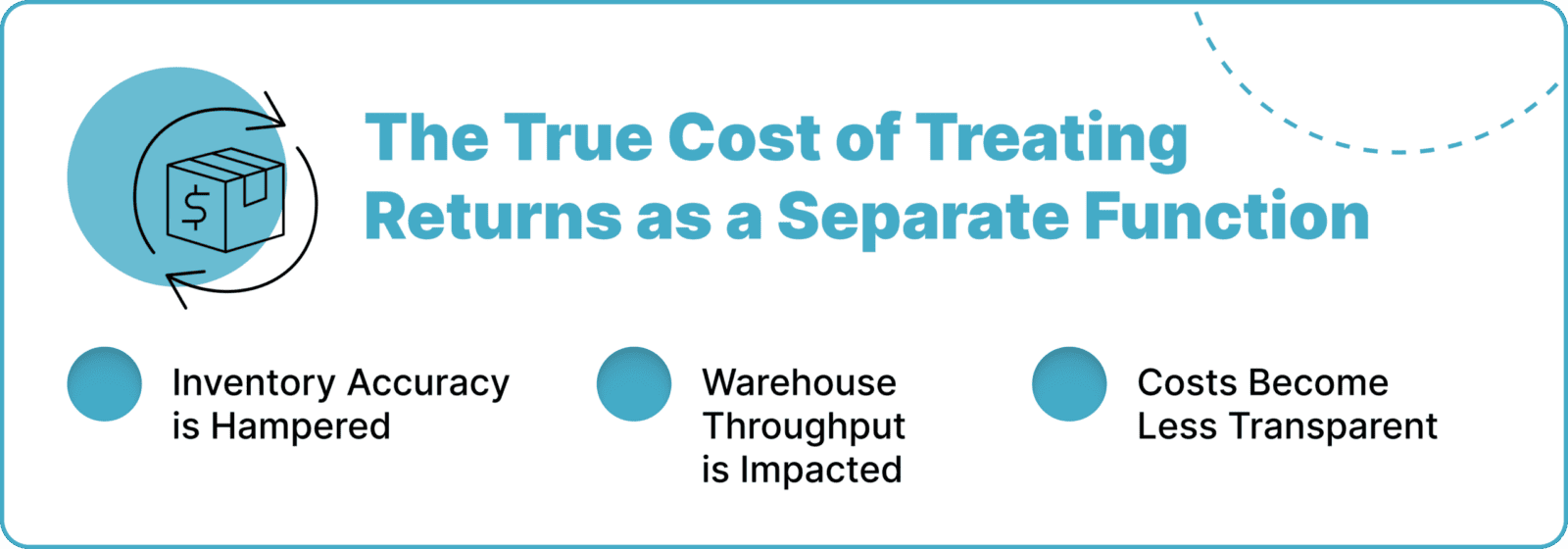
When returns are outside the supply chain, three things start to fall apart. Each of them diminishes the performance gains you are making in the forward flow.
1. Inventory Accuracy is Hampered
Items returned and sitting in a processing queue for days or weeks are invisible to your demand planning systems. Your warehouse management systems have one set of numbers. The physical shelves have a different story to tell. That mismatch can make you reorder products that are already on the dock, waiting to be restocked, leading to excess inventory. The result is tied-up capital and warped inventory levels.
2. Warehouse Throughput is Impacted
Returns compete for the same space, labor, and dock doors as inbound shipments. If scheduling is not coordinated, the reverse flow will interfere with the forward flow. For instance, if a distribution center is running at 95% capacity inbound, it can’t absorb a spike in return volume without something slowing down. Without integrated planning, returns create unplanned work that uses the resources you budgeted for receiving, put-away, and outbound operations.
3. Costs Become Less Transparent
When return costs are distributed across customer service budgets, shipping accounts, and warehouse labor, no one sees the real per-unit cost of a return. This means no one can make informed decisions about return policies, disposition paths, or vendor recovery claims.
What Changes When You Treat Returns as a Supply Chain Function
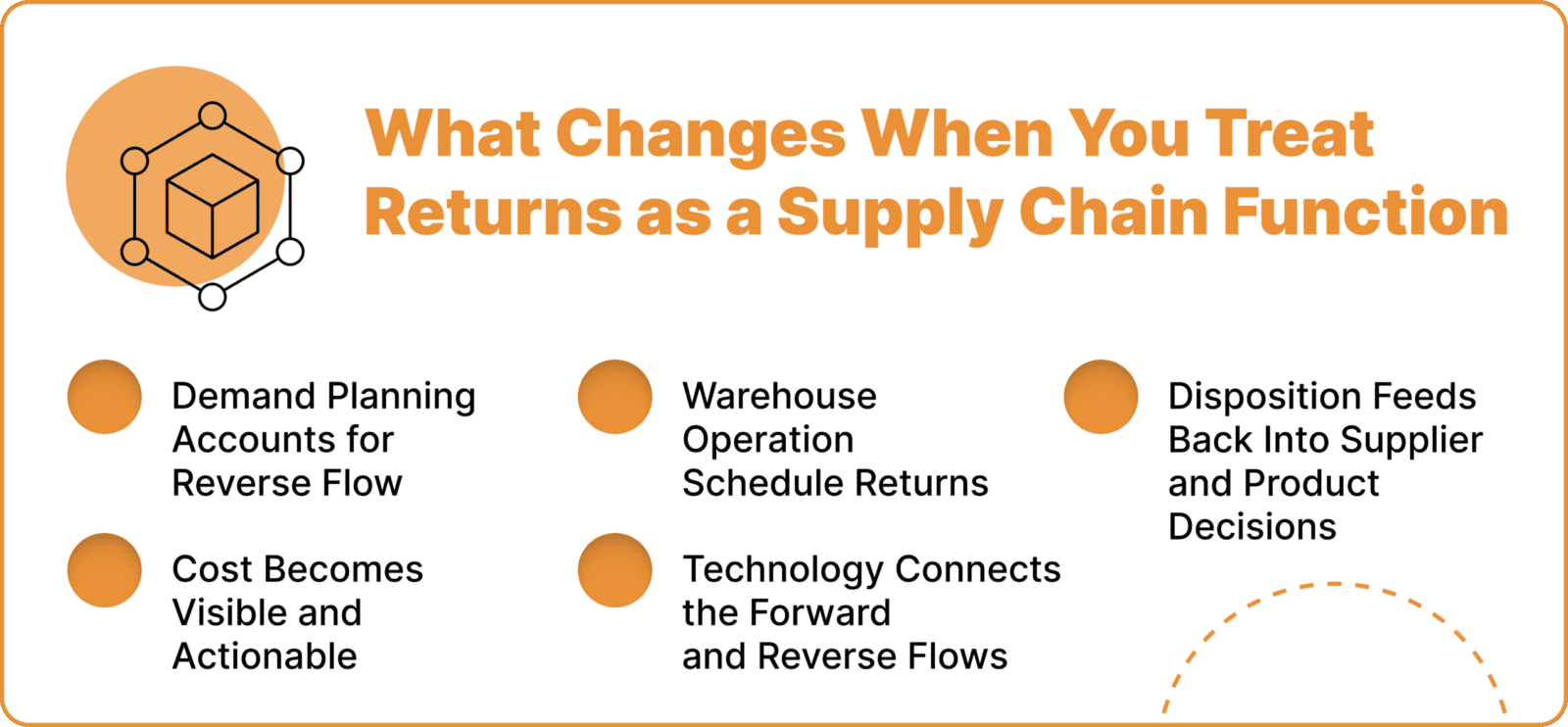
The idea is not to hand returns to the existing supply chain team without support. Returns need the same process design, technology investment and performance measurement that the forward supply chain already has.
Here is how that works in practice.
1. Demand Planning Accounts for Reverse Flow
When return data is used to forecast demand, companies stop over-ordering products that are already coming back. A product with a 25% return rate does not have the same replenishment logic as a product with a 5% return rate. Planning with return rates and return requests in mind helps to reduce excess inventory and free up working capital. It helps you plan for seasonal spikes in customer returns so your warehouse is staffed and staged properly, rather than scrambling when volume hits.
2. Warehouse Operations Schedule Returns
Unplanned returns create bottlenecks. But if the warehouse sets aside dedicated receiving windows, labor, and staging areas for return handling, it can handle both flows without one interfering with the other. Some distribution centers have separate return processing shifts to protect inbound throughput. However, that is only possible when returns are part of the conversation about supply chain operations.
3. Disposition Feeds Back Into Supplier and Product Decisions
Patterns begin to emerge when return data is linked with the supply chain. For example, a product line with a high return rate due to defects becomes a conversation about supplier performance and quality control, not just a warehouse problem. The reverse flow starts to influence forward decisions on raw materials, product quality, and sourcing. That feedback loop is not possible if the returns data is in a silo that supply chain management professionals don’t see.
4. Cost Becomes Visible and Actionable
When the cost structure of returns is built into the supply chain, leadership can compare the total cost of the return with the profit margin on the original sale. That visibility changes how companies determine return policies, choose disposition paths, and negotiate contracts with vendors. A company that knows a return costs 30% of the item price has a compelling reason to invest in a returns management platform that cuts that number. Without that visibility, returns become a cost center that no one can measure or fix.
5. Technology Connects the Forward and Reverse Flows
A returns management platform like ReverseLogix sits inside the supply chain tech stack. It integrates with warehouse management, ERP and order management to give operations teams a single view of inventory moving in both directions. When a customer makes a return, the system creates the authorization, routes the item and updates inventory levels in real time.
That connection means you track returns with full visibility, consistent data, and automated processes that don’t depend on manual handoffs between departments.
The Compounding Effect of Getting This Right
The benefits of including returns in the supply chain are cumulative over time.
- Better data on returns improves demand planning and thus reduces overstock.
- Faster dispositions free up warehouse space, increasing inbound throughput.
- Smart return policies and lower return rates are driven by visible cost data.
- Lower return rates also help reduce pressure on the reverse logistics operation, which, in turn, feeds back into a more stable forward supply chain.
Each improvement makes the next one easier.
Frequently Asked Questions
Q1: How does return data improve demand forecasting?
Return data shows you which products come back, how often, and why. When you feed that information into demand planning, you stop ordering based on gross sales alone and start ordering based on net demand. A product with a 20% return rate needs different replenishment logic than one with a 3% return rate. Advanced analytics applied to return trends can also surface seasonal patterns, helping supply chain professionals adjust inventory levels before a spike in customer returns arrives.
Q2: What is the difference between reverse logistics and returns management?
Reverse logistics refers to the physical movement of goods from the customer back through the supply chain. It covers return shipping, receiving, sorting, and routing. Returns management is broader. It includes the entire returns processing, such as customer communication, return authorization, return processing, inventory control, disposition, refund or store credit processing, and feeding return data back into business processes like demand planning and supplier performance reviews. Logistics providers may handle physical transport, but the returns management process determines what happens to the product and connects that decision to the rest of the supply chain.
Q3: How do returns affect warehouse capacity and store traffic?
Returns compete for the same dock doors, floor space, and labor as inbound shipments. When returns are not scheduled into warehouse operations, they show up as unplanned work that disrupts receiving, put-away, and outbound fulfillment. That is why adistribution center can lose 10 to 15% of its productive capacity to unplanned returns handling during peak periods. In physical retail, returns also affect store traffic patterns.
Customers returning e-commerce purchases to brick-and-mortar stores create additional transactions that staff must process, which can slow down service during busy hours. Scheduling dedicated returns windows and staging areas keeps the forward and reverse flows from colliding, whether at a warehouse or a storefront.
Q4: Can improving returns management increase customer satisfaction?
Yes. When customers have visibility into their return status, receive fast refunds, and can choose from multiple return options, their experience with the brand stays positive even after a failed purchase. Increasing customer loyalty or satisfaction through a reliable returns process protects relationships and encourages repeat buying.
Customer complaints about slow or confusing returns are among the fastest ways to permanently lose a buyer. According to the NRF, 71% of consumers say they would stop shopping with a retailer after a poor return experience. Companies that invest in improving their returns process are not just managing returns cost-effectively. They are protecting revenue.
Q5: What should companies consider when choosing returns management software?
Look for management software that integrates with your existing warehouse management systems, ERP, and order management platforms. The tool should automate return authorization, apply disposition rules consistently, provide real-time return status updates to customers, and generate reporting that connects return data to broader supply chain metrics.
Companies operating at a global scale or across multiple distribution centers need a solution that enforces consistent rules everywhere while still allowing for regional differences. Inventory management software that only tracks the forward flow leaves a gap in your data. A returns-capable platform closes that gap by giving operations management teams one view of products moving in both directions. It is also worth evaluating how the platform handles customer requests, since the returns process is one of the few post-purchase interactions that directly shape whether a customer comes back.
Get a Demo
Discover how you can jump-start your returns management efforts with ReverseLogix.