After the Returns Process: Where a Damaged or Open-Box Major Appliance Actually Goes
In this article:
For the software side of this topic, see appliance returns management software.
- For returned major domestic appliances, value depends on choosing the right recovery channel: open-box resale, scratch-and-dent, refurbishment or liquidation.
- Grading speed matters more than any other factor. A returned product graded within 48 hours might recover 50 to 60% of retail. The same unit graded after three weeks may liquidate at 10 to 15%.
- Recommerce is growing as a sales channel for returned appliances, but it only works if the returns process delivers graded products before the value window closes.
Retailers manage product returns in many different ways. Some have a clear returns process that moves a product from delivery back to a warehouse, through inspection and into a resale channel in days. Many have no established process, which is costly with returned major domestic appliances (MDA). The money is lost between “we got the product back” and “we got value back from it.”
How your company handles returns has a direct effect on profitability and the customer experience. Disposition decides what happens to a returned product: restocked, resold, refurbished, liquidated or recycled. The channel largely decides whether 10% or 70% of the value is recovered. This article covers grading tiers, channel decisions, and why inspection speed matters more for value recovery than the severity of the damage.
What Happens to Returned Items After They Arrive at The Warehouse
The first step is to inspect the returned product for cosmetic damage, functional defects, missing parts and packaging condition. The inspection shows how much value you can recover and which disposition tier fits.
Begin as soon as you receive the product. Enter it into a returns management system such as ReverseLogix and check it against the return authorization and warranty claim data on file. Major retailers also track how often consumers return items and flag patterns that suggest abuse. Once the unit clears intake, the inspection covers cosmetic condition (dents, scratches, scuffs), a functional test (does it power on, do all features work) and a completeness check for missing parts or accessories.
The inspection result determines the disposition code assigned to the unit: resale, repair, refurbishment, recycling, donation or disposal. The right code depends on the product’s condition at the time of grading.
Appliance return rates range from 5% to 10%. That is low compared with apparel or consumer electronics, but appliance returns create real financial pressure because each returned product costs more. From transport to inspection to refurbishment, the cost of a return can reach or exceed a thousand dollars per unit, so each disposition decision carries far more weight than it does for a $15 apparel return.
Return policies for end customers on major appliances also differ from those on smaller items. Consumer electronics or apparel can be mailed back or returned to the store. Major appliances need a scheduled pickup and sometimes a service agent, which adds cost before the unit reaches the warehouse for inspection.
Disposition Tiers: How Returned Appliances Move Through the Reverse Supply Chain
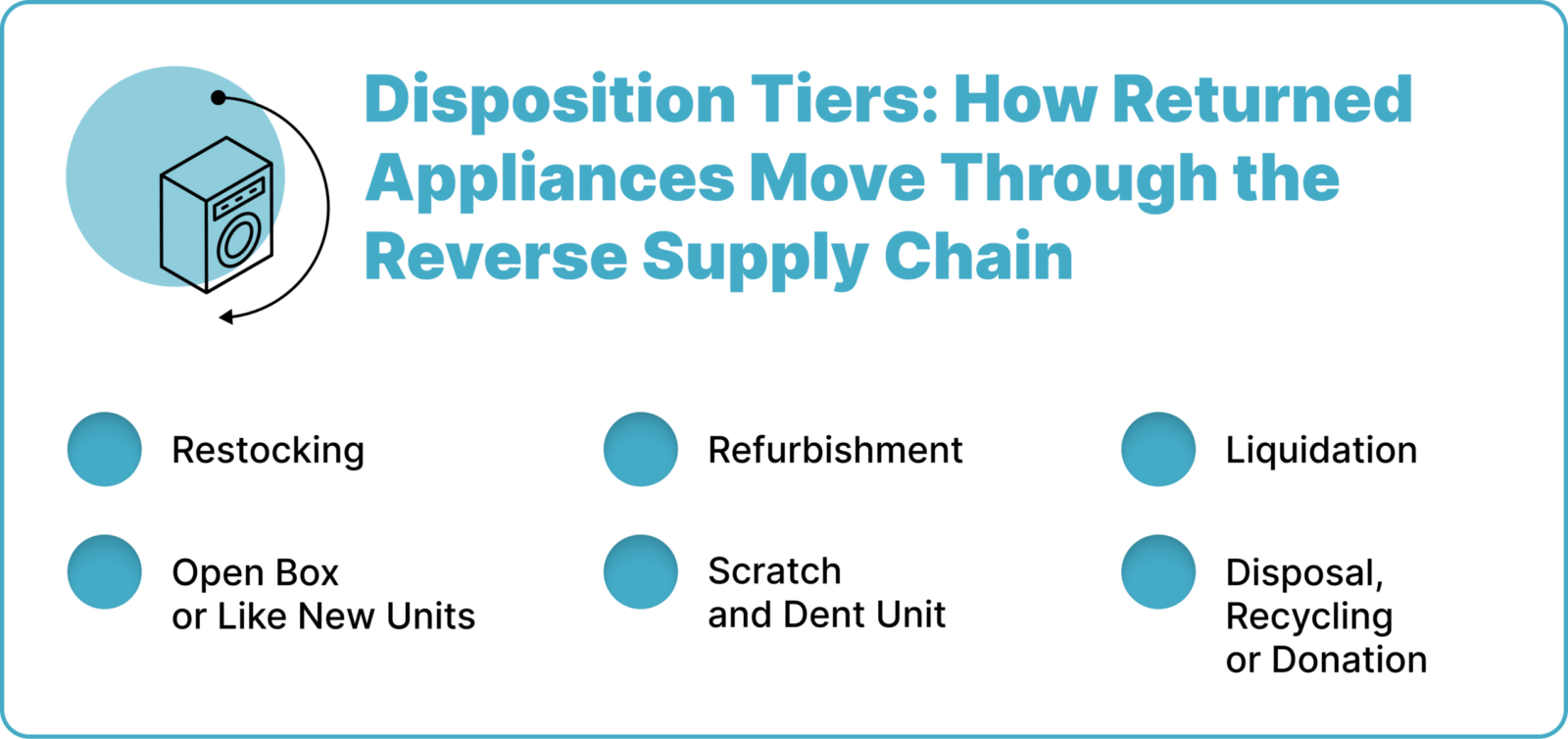
After grading, there are usually six disposition actions for major appliances:
1. Restocking
Restocking is the preferred outcome and the least likely one for major appliances. It means the unit goes back on the shelf undamaged, complete, tested and in its original packaging. Transport makes that hard to achieve, and even a pristine unit often cannot be restocked because the packaging was damaged in transit.
2. Open Box or Like New Units
This is the next best outcome. If the product is functional and complete with all accessories but lacks packaging, it can be resold through a manufacturer’s outlet or a recommerce channel at 70-85% of retail, as customers increasingly look there for discounted brand-name appliances. Open box is a high recovery tier, but most MDA returns do not come back in this condition.
3. Scratch and Dent Unit
The appliance is cosmetically damaged but works properly. These units are sold through outlet stores or direct-to-consumer discount channels at 40-60% off retail. Buyers accept a minor cosmetic issue for a working appliance at a lower price. This is the most common tier for returned appliances and the one where fast grading has the biggest effect on the value you recover.
4. Refurbishment
This is the best option when a unit has a functional defect that can be repaired. Refurbishment includes diagnosis, replacement of failed components, quality testing, deep cleaning, and repackaging. The refurbished item then gets sold through resale channels at 30-50% of retail. Refurbishment services require labor, parts inventory, and testing equipment, but if you route the unit fast enough, recovery can offset costs.
5. Liquidation
Liquidation is a bulk sale to wholesale buyers or export channels. Recovery is low, usually 10-20% of retail. It is the default for products that have sat too long, have damage that costs more to repair than the unit is worth, or lack documentation, which happens more often than you would think.
6. Disposal, Recycling or Donation
This is the end of the line: products so damaged or unsafe that they cannot be sold at any tier. Sometimes it is the only option left after every other channel has closed.
Why Grading Speed Matters More Than Damage Severity For Inventory Management
How quickly an appliance is inspected and graded has more effect on its tier than how damaged it is.
Take a recently launched refrigerator that is returned with a dented side. Graded quickly, it goes into the scratch-and-dent channel and recovers perhaps $1,100 on a $2,200 unit, because the model is still new and in demand. If it sits for three months while the warehouse catches up, that window is missed and it goes to refurbishment or liquidation, both of which recover less.
Now consider a manufacturer processing 3,000 MDA returns a year. Missing the grading window on even 20% of units leaves hundreds of thousands of dollars of recoverable value on the table. The units also take up storage space while they lose value every day.
Missed grading windows can happen for many reasons, including warehouse backlogs, disconnected systems that don’t pass warranty data to the inspection team, missing field documentation, and seasonal spikes in returns that exceed capacity. Every gap between steps, from initiating the returns process to assigning the final disposition, is a place where value leaks out.
How Recommerce Changes The Math For End Customers and Manufacturers
A good disposition strategy directs products to recommerce channels where businesses recapture real value.
The category has grown rapidly in recent years. What began with electronics trade-in programs in the mid-2000s has expanded to include appliances, furniture, and industrial equipment. For returned major appliances, recommerce means selling open-box, refurbished, or scratch-and-dent units through dedicated sales channels, rather than dumping them into bulk liquidation. End customers also win because they get name-brand appliances at a lower price, delivered and often with a limited warranty on the refurbished item.
For manufacturers, the numbers are clear. A unit resold through a recommerce channel at 50% of retail recovers five times as much as the same unit liquidated at 10%. That revenue helps offset the cost of processing returns that cannot be salvaged. Recommerce also reduces the volume going to landfill, which matters for companies with recycling and waste-reduction targets.
But recommerce only works if the returns process provides graded, documented products to the channel before the value window closes.
How ReverseLogix Connects The Returns Management Process to The Right Disposition Channel
ReverseLogix provides a returns management platform for manufacturers and retailers that puts the grading decision and the channel decision in one workflow. The same system that handles return authorization, warranty triage and inspection also assigns the disposition tier and routes the unit to the right sales channel. Disposition codes are configurable, so rules can reflect your product line and channel structure. Contact us today to get started.

Frequently Asked Questions
Q1. What is recommerce and how does it apply to returned appliances?
Recommerce is the resale of previously purchased products through dedicated channels. For returned appliances, it means selling open-box, refurbished, or scratch-and-dent units at a discount rather than liquidating them in bulk. The category started with electronics trade-in programs in the mid-2000s and has since expanded into appliances, furniture, and industrial equipment. Recommerce recovers more value per unit than liquidation, reduces the volume of returned goods reaching landfills, and gives end customers access to brand-name appliances at a lower price.
Q2. What does refurbishment involve for a major domestic appliance?
Refurbishment takes a returned appliance with a functional defect and restores it to sellable condition. The process involves diagnosing the defect, replacing failed parts, running quality tests, deep cleaning, and repackaging the unit. Refurbished appliances typically sell at 30-50% of the original retail price through resale channels. Refurbishment services require labor, spare parts inventory, and testing equipment, but the recovery can offset the cost when units are routed quickly enough.
Q3. How do return policies affect the disposition process for appliances?
Return policies outline the rules and conditions for returning or exchanging items, including time limits, condition requirements, and whether a refund, replacement, or store credit gets issued. For appliances, the typical returns process often starts with checking the manufacturer’s or retailer’s policy, then scheduling a pickup. The policy determines when the product enters the reverse supply chain. But the disposition decision, which determines where the product goes after it arrives at the warehouse, is a separate process entirely. A generous return policy paired with a slow disposition process means more products reaching the warehouse but fewer reaching the right resale channel in time.
Q4. Why do so many returned appliances end up in landfills?
Returned appliances reach landfills when the disposition process can’t move fast enough to route them to a resale, refurbishment, or recycling channel. Every channel has a time window. When grading takes weeks instead of days, the product misses each window in sequence: open-box, then scratch-and-dent, then refurbishment. By the time it reaches the front of the queue, liquidation or disposal is the only option left. Each appliance that reaches a landfill is a unit that could have been resold, refurbished, or at minimum recycled if the returns process had moved faster.
Get a Demo
Discover how you can jump-start your returns management efforts with ReverseLogix.