
Implementing modern reverse logistics solutions is now a priority for manufacturers facing a volatile global supply chain and rising operational costs. While traditional manufacturing focuses heavily on the forward journey of a product, the return journey (i.e., Return Merchandise Authorization (RMA) process), is often left as a manual, fragmented afterthought.
Manufacturers are under pressure to replace these inefficient workflows with digital systems. Modernizing the RMA process will allow your organization to reclaim lost revenue, eliminate data silos, and turn a difficult logistical burden into an advantage.
Key Takeaways
- The significant financial drain caused by manual data entry and spreadsheet tracking.
- How automated workflows and centralized data ecosystems eliminate black holes in your inventory.
- The role of specialized software in plugging warranty leakage and strengthening B2B partner trust.
The Financial Burden of Legacy Returns Systems
Outdated, manual RMA processes actively erode your profit margins and slow you down. When manufacturers depend on fragmented systems, labor costs rise and warehouse efficiency falls.
Why Manual RMA Processes Drain Resources
Relying on spreadsheets and email chains for RMAs drives up overhead. Companies using manual supply-chain processes spend 15% more on labor because of constant data entry and error corrections. These slow manual cycles waste time and also tie up valuable warehouse space with goods waiting to be processed. Frequent human errors in data entry further impact the bottom line by causing shipping mistakes and delayed inventory turnover, preventing parts from being refurbished or resold quickly.
The High Price of Limited Returns Visibility and Data Silos
Without a unified system, manufacturers often cannot see what inventory is currently in transit. This lack of returns visibility prevents leaders from performing root cause analysis on product defects. When customer service and warehouse teams work in silos, they end up doing duplicate work and creating problems. These data gaps make it impossible to track trends, leaving the company blind to recurring quality issues that could have been addressed at the source.
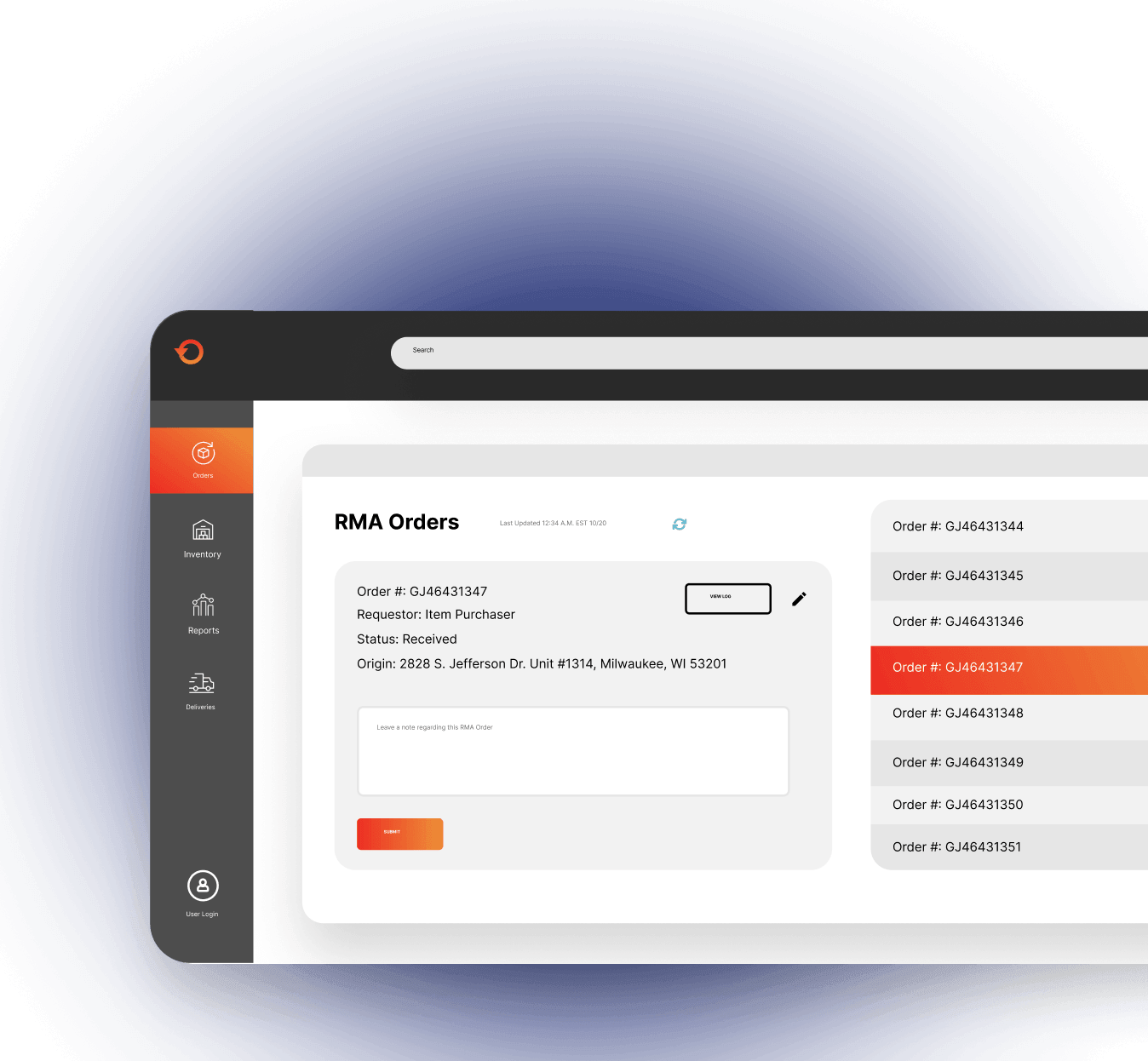
Defining Modern Reverse Logistics Solutions for the Manufacturing Sector
Specialized returns management software lets you replace reactive, broken processes with proactive, rules-based systems that scale alongside production growth.
Transitioning from Spreadsheet Tracking to Automated Workflows
Instead of waiting for manual approval, returns management software triggers automatic shipping labels and specific routing instructions the instant a request is initiated.
This rules-based logic ensures every return follows a standardized, compliant path. Unlike spreadsheets, which break under the pressure of high volume, automated workflows provide the scalability needed to handle seasonal surges or rapid business expansion without adding headcount.
Centralizing Data Across the Supply Chain Ecosystem
For the best efficiency, returns data can’t sit in a separate system. It needs to be integrated with your existing ERP, WMS, and TMS systems to create a single source of truth. This centralization allows for much more accurate financial forecasting and inventory planning, as finance teams can see exactly what value is sitting in the return pipeline. Having a unified view of the entire reverse supply chain ensures that every department is making decisions based on the same real-time data, eliminating guesswork and cross-departmental issues.
Strategic Benefits of Implementing Returns Management Software
Adopting specialized returns management solutions gives manufacturers digital tracking and a competitive edge. When you automate validation tasks and improve the partner experience, you’re able to protect your margins and build stronger industry relationships.
Enhancing Warranty Validation and Serial Number Tracking
One of the biggest drains on manufacturing revenue is warranty leakage, where claims are paid out on expired or invalid products. Using specialized returns management solutions lets you automatically verify coverage against original purchase dates and serial numbers. Advanced analytics and AI-driven validation can actually reduce warranty spend by 3% to 6% by plugging leakage and tightening claim controls. This serialized tracking is also vital for compliance, recalls, and repair histories, while automated validation significantly speeds up the inspect-to-credit timeline.
Improving Distributor and Dealer Relationships Through Branded Portals
A professional returns experience is a major factor in partner loyalty. Branded, self-service portals let B2B partners initiate returns without calling support, providing real-time status updates that reduce “where is my credit” inquiries. According to a 2025 study, digital-portal driven service models can increase on-time delivery Net Promoter Score (NPS) by more than 40 points. When you provide this level of transparency and efficiency, you improve channel-partner trust and long-term loyalty.

Steps to Modernize Your Manufacturing Returns Management Strategies
Modernizing your operation requires a shift from reactive troubleshooting to proactive planning. Implementing clear returns management strategies lets you identify exactly where your current process is failing and build a roadmap for long-term improvement.
Conducting a Root Cause Analysis of Current Inefficiencies
The first step is auditing the physical and digital path of a returned part. You should trace the journey from the moment a customer or dealer requests an RMA until the item arrives back at the factory. Also, pay close attention to common bottleneck points where paperwork sits untouched, or items get lost in the warehouse. It’s essential to gather direct feedback from your warehouse staff as well; they can often point out the most time-consuming manual tasks that could be automated.
Establishing KPIs for Returns Processing Time and Cost Recovery
Manufacturers must define key metrics, such as Days to Inspect and Total Cost of Process, to gain a clear picture of how they’re doing. It is equally important to track the Net Recovery Value for refurbished or repaired items to see how much revenue is actually being reclaimed. Establishing KPIs lets you create a data-backed foundation that makes it easy to justify the ROI of a technology investment to executive leadership.
Using Technology for Returns Visibility and Analytics
A modernized RMA system produces data. With real-time data, you can move away from guesswork and begin making data-driven decisions that optimize both warehouse labor and future product quality.
Using Real-Time Dashboards for Warehouse Volume Forecasting
Real-time dashboards let managers anticipate incoming warehouse volume before the truck even arrives. When you can see exactly how many RMAs are in transit, you’re able to staff labor more effectively based on projected arrivals rather than reacting to a sudden backlog. This level of visibility is essential for preventing warehouse floor congestion, ensuring that receiving docks remain clear and that returned goods are moved into inspection or recommerce workflows without any holdups.
Utilizing Return Reason Data for Product Quality Improvements
Beyond simple logistics, Return Reason data serves as a direct feedback loop for your engineering and production teams. By identifying manufacturing defects or recurring part failures early, you can inform product design changes that reduce future warranty claims.
The U.S. recommerce market is projected to grow from $63.25 billion in 2026 to $92.55 billion by 2032, driven by industrial-scale refurbishment and sustainability programs. Using visibility ensures you make the best decisions for these items, whether they should be repaired, recycled, or resold to capture maximum value.
Future-Proofing Operations with Scalable Returns Management Solutions
As your business grows, you must choose a system that can scale with international expansion and handle increasingly sophisticated global trade requirements. Looking ahead, emerging trends like AI-driven routing and the use of digital twins in the warehouse will keep changing how manufacturers manage their reverse supply chain. Investing in a flexible, future-proof platform now keeps you ready to adapt to whatever new challenges or technologies come next.
How to Standardize Returns Across Multiple Facilities
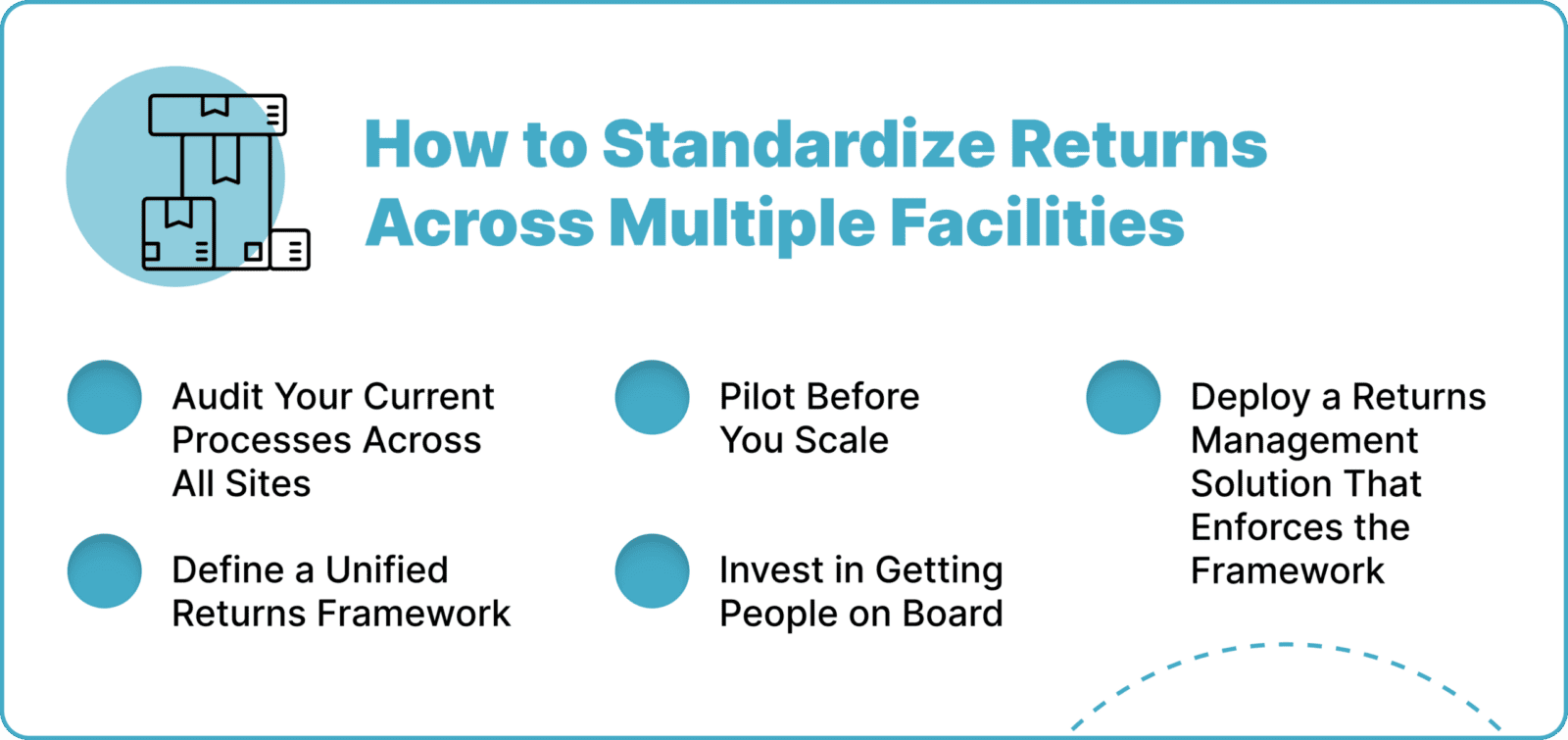
All workflows may not be the same. But it is possible to set up a returns management framework that works the same across multiple facilities. That way, you get consistency where it matters most: in the data, the decisions about what to do with it, and the financial results.
Here is how to go about it:
1. Audit Your Current Processes Across All Sites.
You can’t fix a problem you don’t know about, which is why mapping out the entire process across the different facilities is necessary. Start by writing down how each plant and distribution center currently handles returns. Where does the return request come in? Who authorizes it? What grading standard do they use? And how do they keep track of the final outcome?
You will probably notice that no two sites do it the same way, and some of the differences will surprise you. The audit shows you exactly where the biggest gaps are and which inconsistencies are costing you the most.
2. Define a Unified Returns Framework
Create a single returns framework that includes four parts: authorization rules (who can approve a return and under what conditions), grading standards (how returned items are assessed and categorized), disposition paths (restock, refurbish, liquidate, or scrap), and data requirements (what gets captured at each step and in what format).
All of your facilities will use this framework as a common language. It should be specific enough to address the major differences you found in the audit, but flexible enough to accommodate real differences.
3. Pilot Before You Scale
Choose one or two facilities to try out the new framework. But run the pilot long enough to identify friction points, because some steps that looked good on paper may fail in real life. That’s exactly what you want to fix before rolling them out to the whole network.
4. Invest in Getting People on Board
Whatever the current processes are, they were set up by people trying to solve a problem as best they could. They also know why certain workarounds exist. Getting them to abandon the process that they believe works without explaining why will trigger pushback.
A better approach is to get them involved early on. Show them the audit data, such as the extra work, lost supplier credits, return rates, recovery ratios, and inventory distortions. When people see the real costs of inconsistency, they tend to be less resistant.
5. Deploy a Returns Management Solution That Enforces the Framework
Technology is how you enforce the framework. ReverseLogix is an example of a returns management solution that ensures the same rules are followed across locations, from the initiation of a return to the system’s decision on how to handle it.
With ReverseLogix, your operations teams see returns in real time across all sites. This way, leaders don’t have to manually compile reports from five different facilities to make sense of the operations. In reverse logistics, technology doesn’t replace the framework; it is the mechanism that keeps every location following it.
Next Steps
A digital-first RMA process lowers labor costs and gives partners the transparency they want. Consider these next steps:
- Audit your current journey to identify manual bottlenecks.
- Centralize your RMA data by integrating it with your ERP and WMS.
- Implement self-service portals for your B2B distributors.
- Track processing KPIs to measure your ongoing improvement.
To see what your manual RMA process costs you, try our returns ROI calculator.
What are the 5 Rs of reverse logistics?
The 5 Rs represent the core pathways for returned goods: Returns, Reselling, Repairing, Replacing, and Recycling. These categories help manufacturers determine the most cost-effective and sustainable way to handle a product once it enters the reverse supply chain.
What are the four types of reverse logistics?
The four primary types include consumer returns (defective or unwanted products), B2B commercial returns (overstock or end-of-life items), repair and maintenance services (warranty work), and end-of-life disposal or recycling (sustainability-driven material recovery).
Why is reverse logistics so hard?
Unlike forward logistics, which follows a predictable path from factory to customer, reverse logistics is non-linear. The unpredictable volume, varying product conditions, and manual documentation requirements create challenges and high labor costs for manufacturers.
What are the key elements of a reverse logistics system?
A robust system requires centralized data management, automated RMA initiation, real-time tracking, and integrated rules-based routing. These elements ensure that every returned part is accurately identified, validated, and processed through the correct workflow without manual intervention.
How does reverse logistics impact the environment?
Efficient reverse logistics supports the circular economy by reducing landfill waste through refurbishment and recycling. By optimizing transportation routes for returns, you can also significantly lower your carbon footprint and improve overall resource sustainability.
Get a Demo
Discover how you can jump-start your returns management efforts with ReverseLogix.