Why Enterprise Warranty Software Is Replacing Legacy CRM Workflows

In brief:
For the software side of this topic, see warranty management software.
- Enterprise warranty software is replacing legacy CRM workflows.
- CRMs were built to manage customer relationships, not to validate warranty claims, verify coverage, route replacements, or recover costs from suppliers.
- Dedicated warranty management software runs the full warranty lifecycle through business rules, automates eligibility checks and claim routing, and connects warranty data across ERP, ecommerce, finance, and inventory systems.
- The bigger payoff is turning claim data into supplier recovery and warranty analytics that feed quality and design, while self-service portals and faster resolution improve the customer experience.
Customer records sit in the CRM, so for many manufacturers it made sense to run warranty inside the CRM. But a CRM is set up to win and retain customers, track deals and log conversations. It cannot validate a purchase date against a claim, route a replacement or recover costs from the supplier that made the defective part. So teams created workarounds, and the workarounds became the process.
This article explains why dedicated warranty management software is replacing those legacy CRM workflows, and what changes when warranty gets a system built for the job.
Why Warranty Claims Never Belonged in the CRM
Adjudicating warranty claims is a different job from tracking customer relationships and the sales pipeline. When a claim comes in, questions need answers. Does this item still have coverage? Is the serial number linked to a legitimate sale? Was it registered? Who supplied the failed part? A CRM has no built-in answer to any of these, so someone answers them by hand from spreadsheets, order systems and emails.
That gap shows up as manual effort everywhere. Claim validation happens in somebody’s head or in a side spreadsheet. Warranty status sits in custom fields the CRM was never meant to hold. Replacement routing is a chain of emails between support, the warehouse and finance. As warranty volume grows, this approach breaks, because every claim still has to be handled by a person.
There is also a cost angle. Claims-to-sales figures reported by Warranty Week show warranty claims usually consume between 2 and 5% of a manufacturer’s revenue. When that spend is managed through CRM workarounds, you lose money two ways: paying claims you should have caught, and missing supplier recoveries you were owed.
What Dedicated Warranty Management Software Does Differently
Dedicated warranty management software runs the whole warranty lifecycle on business rules instead of manual steps. A CRM stores a customer record. A warranty management system cross-references registration and purchase data, validates the claim, routes it to the right handler or approves it outright, and tracks status from submission to settlement.
The mechanics that a CRM cannot replicate:
- Automated eligibility checks: The system checks warranty coverage, registration and purchase validity before a person touches the claim.
- Rule-based claim routing: If a claim meets the specified conditions, it is approved or routed automatically, so the queue moves on without someone having to assign each one.
- Replacement routing: When a claim is resolved as a replacement, the order is raised against inventory directly, not by a support agent emailing the warehouse.
- Coverage and contract logic: Warranty contracts, extended warranty programs, and service contract administration are governed by rules that are enforced by software, not tribal knowledge held by two people on the support team.
How much time this saves depends on how much manual work it replaces. The verification and routing steps, which take the longest by hand, are the ones the software does automatically.
How Enterprise Warranty Software Integrates With Your Warranty Data
The real value of enterprise warranty software is that it brings warranty data together and connects it to the systems around it. A claim never lives in one place. It touches purchase records in the ERP, order data from your ecommerce platform, inventory for replacements and finance for credit notes. Run warranty in a CRM and your team fills those gaps by hand. Run it in purpose-built software with integration and the data moves on its own.
That is what makes the rest work. Automated eligibility checks need live purchase data from the ERP. Ecommerce integration syncs order data, so a registration and a claim can be tied to a real transaction without a manual lookup. The link to finance and inventory means credit notes and replacement stock are updated without a separate handoff. And everyone works from one set of numbers instead of reconciling three.
This is the practical reason separate tools lose to a single platform. Every disconnected system is another place where data must be re-keyed, and every re-key is a chance for error and delay.
Turning Warranty Data into Supplier Recovery and Quality Insight
Once warranty data is in one place, it can do things a CRM never could, starting with supplier recovery. Supplier recovery traces defective-part claims back to the responsible upstream vendor so the manufacturer recovers the cost instead of absorbing it. Done by hand, this was often skipped, because tracing a claim to a particular supplier takes time nobody has. Automated, every eligible claim is flagged and pursued.
Warranty analytics is the other payoff. Connected claim data shows claim trends and product failure rates that CRM reports cannot. Quality and design teams can see which components fail, how often and where, and which suppliers drive claim volume.
A CRM tells you who your customers are. Warranty analytics tells you why your products come back.
What the Shift Means For Customer Experience
Moving warranty off the CRM improves the customer experience, because resolution is faster and more transparent. Customers can register products, submit claims and track warranty status online through a self-service portal without waiting for a support agent. Many would sooner handle a simple claim themselves than sit on hold.
Speed matters too. Automated claims can be resolved in hours, not days. A slow, frustrating claim is one of the fastest ways to lose a customer you already paid to acquire.
The Key Benefits of Moving Off Legacy CRM Workflows
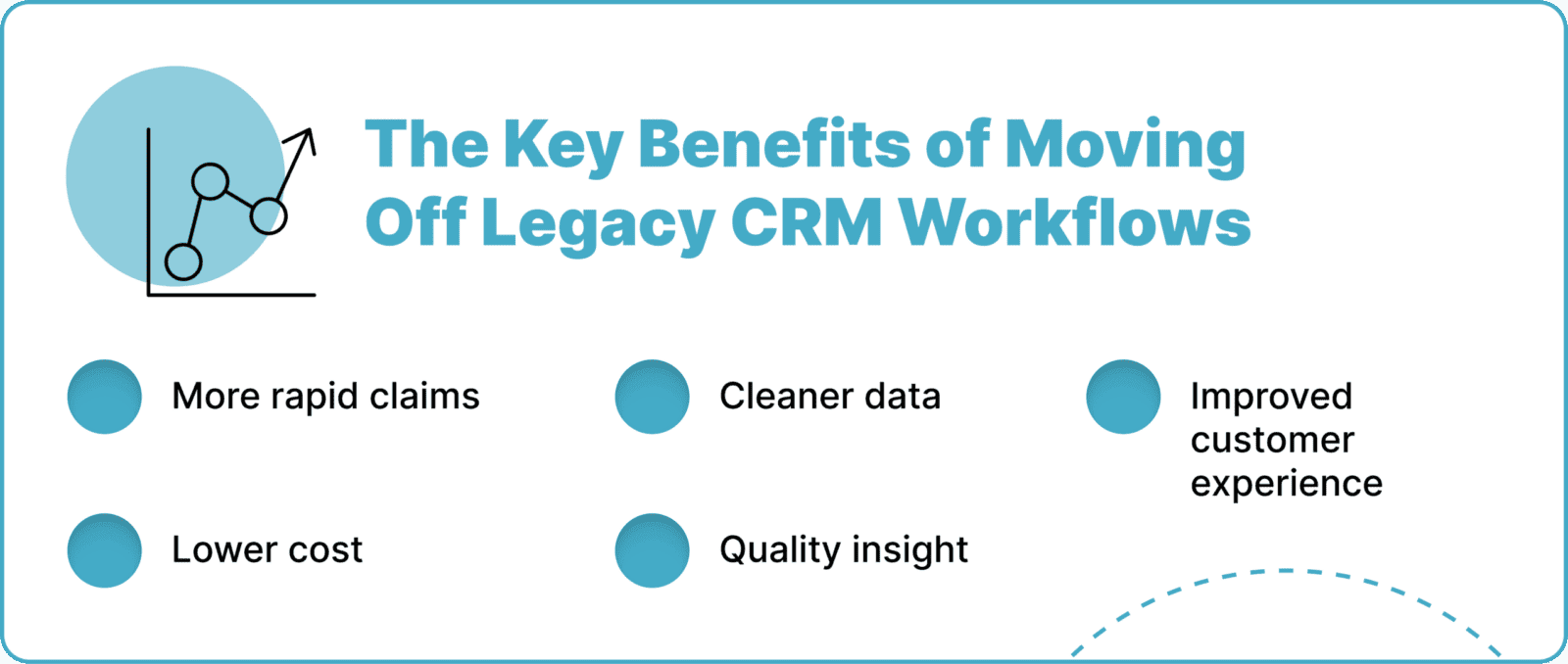
For a manufacturer considering the switch, the benefits come down to five things:
- Faster claims: Automated eligibility checks and claim routing cut resolution time from days to hours.
- Lower cost: Fewer manual hours per claim, fewer improper payouts, consistent supplier recovery and earlier fraud detection.
- Cleaner data: One set of warranty records instead of reconciling separate tools.
- Quality insight: Warranty analytics that inform product design and root cause analysis.
- Better customer experience: Faster resolution and self-service portals help retention.
ReverseLogix: A Platform Built for Warranty
ReverseLogix brings warranty registration, claims, coverage, supplier recovery and reverse logistics into a single warranty management platform built for enterprises. It connects to the ERP, ecommerce and finance systems where the supporting data already lives, and automated workflows link warranty claims to finance and inventory.
For enterprise manufacturers and retailers with high claim volumes, that consolidation is what makes warranty an enterprise process and not a CRM afterthought. Rules run on a single trusted data set, every valid claim is checked for supplier recovery, and warranty analytics show the failure patterns your quality team needs.
If your warranty process is still stitched together inside a CRM, ask how much that is costing you in missed recovery and slow claims. Contact us today to get started.

Frequently Asked Questions
Q1. Can warranty management software integrate with existing enterprise systems?
Yes. Enterprise warranty software is generally built to connect with ERP, CRM, ecommerce platforms, finance, and inventory systems through direct integration. This connection lets automated eligibility checks run against live purchase data and order information sync without manual entry. Integration depth matters more than the number of connectors, since claim validation and routing depend on reading real data from the systems your warranty process already touches. Before choosing a platform, confirm it connects to your specific ERP and ecommerce systems, because shallow integration leaves your team bridging data gaps by hand.
Q2. How much does warranty management software cost?
Warranty management software cost varies with claim volume, integration needs, and operational complexity, so pricing ranges from mid-market tiers to enterprise agreements. Rather than a fixed sticker price, most vendors quote based on your warranty volume and the systems you need connected. The more useful question is what manual warranty management already costs you: the administrative hours per claim, the improper payouts a CRM cannot catch, and the supplier recovery you miss. Weighed against 2 to 5% of revenue typically consumed by warranty claims, dedicated software often pays for itself through recovery and lower handling costs.
Q3. Does warranty software help detect fraudulent claims?
Yes. Warranty management software can flag anomalous claims before approval using rules and pattern detection, checking each submission against centralized records in real time. This catches duplicate claims, eligibility mismatches, and patterns that suggest fraud, running automatically on every claim rather than a manual sample. A CRM has no equivalent, since it stores customer records but does not validate warranty logic. Automated fraud detection reduces improper payouts and keeps warranty data cleaner, though the rules still need occasional tuning as fraud tactics change over time.
Q4. What is supplier recovery in warranty management?
Supplier recovery is recovering warranty costs from the supplier when a defective component causes a claim. If a part fails and the supplier is responsible under contract, the manufacturer can recover the repair or replacement cost instead of absorbing it. Handled manually, supplier recovery is often missed because tracing a claim back to a specific supplier takes time most teams do not have. Warranty software makes it routine by linking claims to part and supplier records, so recoverable costs get flagged and pursued on every eligible claim rather than slipping through unnoticed.
Q5. What is the best warranty management software for high claim volumes?
The best warranty management software for high claim volumes is one built to run the full warranty lifecycle through automation and to integrate directly with your ERP and ecommerce systems. At high volume, manual CRM workarounds break down, so automated eligibility checks, rule-based claim routing, and centralized warranty records matter more than any single feature. The right choice should match your operational complexity: a business with serialized industrial equipment has different needs than a consumer electronics brand. Prioritize integration depth, supplier recovery, and warranty analytics over a long feature list that looks impressive but goes unused.
Repairs and warranty in one flow
How repair intake, warranty entitlement and parts move through a single system.
Get a Demo
Discover how you can jump-start your returns management efforts with ReverseLogix.