Why Warranty Management and Reverse Logistics Should Live in One Platform

Article Brief
- Warranty management and reverse logistics operate on separate systems in most enterprises because they evolved within different departments, not because the separation improves efficiency.
- Disconnected systems create costly handoffs, resulting in lost data, slower processes, and higher operational expenses.
- The National Retail Federation (NRF) estimated US retail returns reached $850 billion in 2025, highlighting the scale of the returns challenge.
- Appriss Retail estimates that return fraud accounted for approximately $103 billion, adding further pressure on warranty and returns operations.
- Managing warranty claims, returns, repairs, and reverse logistics on separate platforms increases administrative complexity and reduces visibility across the product lifecycle.
- Consolidating these functions onto a single platform is primarily an organisational alignment initiative rather than simply a technology upgrade.
- Executive teams often delay consolidation because it requires cross-functional ownership, budget alignment, and process redesign.
- Building a strong business case requires demonstrating measurable improvements in operational efficiency, cost reduction, customer experience, and data accuracy.
In most enterprises, warranty management sits on one system and reverse logistics on another. Warranty started in finance and service, because a warranty is both a liability and a promise to the customer. Reverse logistics started in supply chain and operations, because a returned product has to be physically moved.
Both functions touch the same product in different ways. The result is two budgets and two software purchases, made years apart by people who were not in the same room, and the business pays for the fragmentation.
A failed product must pass through both systems because it is both a warranty claim and a reverse logistics event. Once your systems treat them as two separate things, every handoff between them becomes a place where money, data, and customer goodwill fall through the cracks. A better tool on either side does not fix this. It is structural, and the fix is less about upgrading technology and more about making an organizational decision.
Why Warranty Management and Reverse Logistics Ended Up Apart
Companies that operate warranty management and reverse logistics as separate systems do so because they were designed to serve different departments, not because the workflows require it. Warranty management administers a product’s warranty lifecycle, including warranty policies, product registration, warranty claim processing, and the associated financial reserves. That work sat with service and finance.
Reverse logistics involves the movement of a product back through the supply chain from a customer return for repair, refurbishment, resale, recycling, or disposal. Traditional logistics pushes goods out to the end consumer. Reverse distribution runs the other way. That work sat with supply chain operations. Both are big enough to be their own discipline now, and reverse logistics alone is a market that is projected to reach roughly $1.16 trillion by 2032, though estimates vary widely across firms.
Running both separately results in two teams optimizing two different scorecards. The warranty team monitors claim costs, adjudication speed, and fraud, while the reverse logistics team tracks return cycle time, transportation costs, and asset recovery throughout the supply chain.
Each team does its own job, and no one owns the whole because it was never assigned to anyone. When a defective unit is returned, it moves from one team’s system to another, and the coverage, repair, and disposition decisions are made in three places that have no record of each other. Customer returns move through both worlds as a single object, while the systems that track them never meet.
What the Split Costs
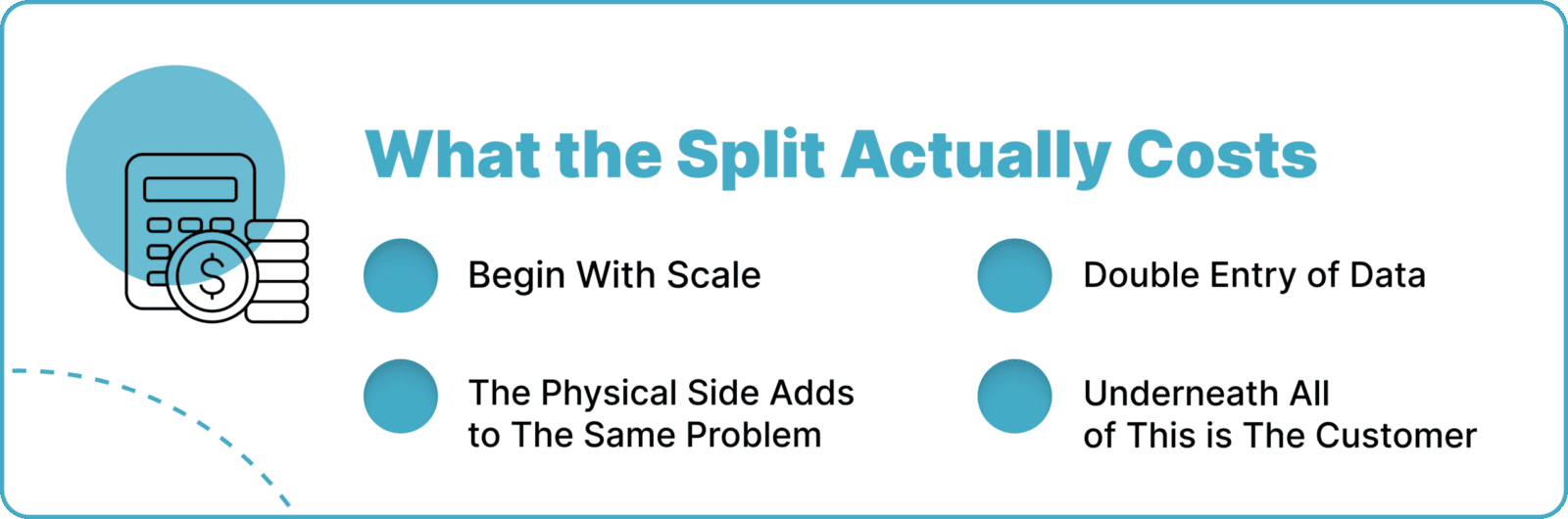
The two-system split is expensive in ways that don’t show up as a line item, which is what makes it so durable. There is no invoice called “cost of warranty and reverse logistics being disconnected”. The cost is hidden in other numbers.
Start With Scale
NRF estimates that U.S. retailers will process about $849.9 billion in returns in 2025, or 15.8% of annual sales, and that about 19.3% of online sales will be returned, far above the overall return rate. Manufacturers alone are estimated to spend 2% to 4% of revenue on warranty claims, and reverse logistics costs, including transport, handling, and processing, can take up a significant share of gross sales. These are the budgets the gap drains, in specific ways.
Double Entry of Data
When neither the claims system nor the returns system reads the other, the same unit is keyed into each. Each re-entry is a chance for a mismatch, and every mismatch is a reconciliation task at month-end. Then there is the invalid claim that gets paid because the coverage verification was in the warranty system, the product was in the returns system, and no one connected the two before issuing the refund.
There is also the supplier recovery that never happens because you have to join claims data to returns data that live in different databases to prove which supplier’s part failed. And there is the defect signal that arrives a quarter late because the returns team saw the failure pattern first, while the warranty and product teams were looking at a different screen.
The Physical Side Adds to The Same Problem
A returned product that reaches the warehouse without its warranty context is handled blindly. That is why you have issues like a delivery refusal or failure that should trigger a specific return category instead of landing in a general queue; packaging management is skipped, so packaging materials go unrecorded when they determine resale value, and the repair department can’t tell if a unit has useful life left or has reached end of life.
Sorting centers accumulate units as excess inventory or unsold goods because no single system knows whether to repair them, resell them, or strip them for raw materials. Warranty work and returns handling face many of the same challenges here, yet each of those is a decision the warranty record could have driven, made instead by whoever is standing at the dock.
Underneath All of This is The Customer
A person with a broken product experiences one event, not two, and when the warranty and logistics sides don’t share status, that person gets conflicting updates, slower resolution, and a reason to shop elsewhere.
Customers expect one coherent answer, and customer expectations around returns are only growing, so fast and transparent claims processes matter for customer loyalty. A poor warranty and returns process shows up first in the customer experience as complaints and lost loyalty long before it shows up in a quarterly report, and by then, it reads as poor sales rather than a systems failure.
Why “We’ll Just Integrate the Two Systems” Usually Fails
The obvious first answer is to integrate the two systems. This usually disappoints, because an integration keeps two sources of truth in sync most of the time rather than unifying them. “Most of the time” is the problem. The cost sits in the gaps between two data models, and an integration bridges those gaps without removing them. Since reconciliation is never really finished, upgrading either system risks breaking the connector. And both teams still have two tools, two roadmaps, and two versions of the record, so the organizational split that caused the problem remains very much in place.
When a service leader proposes consolidation, the reflexive counter from IT is “we can integrate what we already own.” On paper, that looks cheaper and protects the investments already made. But imagine the warranty platform and returns system only sync overnight. A claim approved at 2 p.m. may not reach the warehouse until the following morning, leaving teams to work from different information in the meantime. The integration connects the systems, but it does not remove duplicated records, delayed updates, reconciliation work, or divided ownership. It preserves the original operating model instead of fixing it.
What One Platform Changes
One platform gives you one source of truth. Instead of a claim record in one system and a return record in another, you have one record per product that both reads from and writes to. Coverage is verified against the same data that drives disposition, and automated systems can validate warranty eligibility in real time. Because there is only one history, a repair decision reads the unit’s entire history. The counter-claim can be assembled without a data-joining project, as existing claims and returns data already coexist, making supplier recovery feasible. The returns management team and the warranty team are looking at the same screen, so defect patterns reach the product team before the product team has to change the design.
The financial case is based on that one record, as the single system eliminates reconciliation, duplicate entry, and the blind handoffs inherent in the two-system model. Automation also reduces processing time and errors.
The point to bring to the executive conversation is that consolidating warranty management and reverse logistics is an organizational decision that takes the form of a software purchase. It provides ownership of the entire journey a product takes when it is returned to a single team, or at least to a single system.
This way, a solid reverse logistics plan is not a separate initiative, but part of how warranty runs, with a single reverse logistics strategy for both. Its business processes include policy formulation, registration, claim processing, and data analysis. Shared data enables regular audits that uncover issues across the entire warranty claim lifecycle, helps manage inventory aligned with what returns actually recover, and supports monitoring key performance indicators for continuous improvement. It also provides supply chain partners with one accurate view. The technology is the easy part. The real change is holding someone accountable for the gap that no one owned.
The Four Handoffs, and Where Each One Leaks
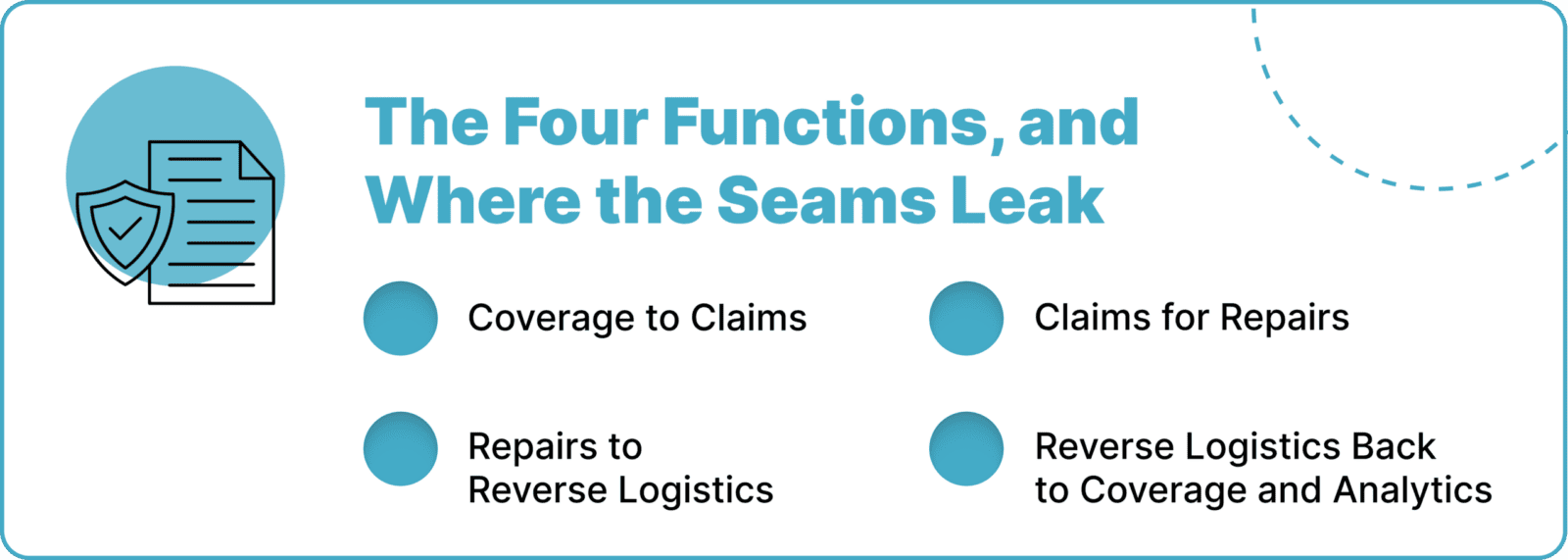
Warranty claims cost is determined less by any one function than by the handoffs between them, since each handoff is a point where data is re-entered by hand and context is lost. Here are the four in order.
Coverage to Claims
When coverage verification is disconnected from claim intake, invalid claims get paid. For instance, someone approves a claim without a live check against the purchase date, service contract, and serial number, because that check lives in another system nobody has open. This is straightforward revenue leakage, and it compounds: fraudulent returns and claims cost businesses $103 billion in 2024. Weak verification at the intake seam is exactly how much of it gets through.
Claims to Repairs
Once the claim is approved, there is a decision to make about the physical unit: repair, replace or refurbish. If the repair decision is made without the unit’s failure history, because the history lives in the claims system and the technician, dealer or other service provider is working in a different tool, the safe default is to replace. Replacing a repairable unit is one of the most common and least visible warranty costs.
Repairs to Reverse Logistics
The physical movement of goods has to match the repair path. Otherwise units get lost, dispositions go unrecorded, and a reverse logistics process that should recover value adds cost. Reverse logistics is the process that takes place after a product has been returned by a customer, including refusal of delivery at the door, reverse distribution, and final disposition. When that flow is decoupled from the repair decision, packaging management, transport, and disposition must all be handled blind. This means the packaging materials and condition of the returned unit are not recorded, even though they matter most for resale value.
Reverse Logistics Back to Coverage and Analytics
This is the handoff almost no one closes: return data, including what failed, how often, and from which batch, must feed back into coverage rules, supplier recovery, and product design to maximize cost recovery. Analytics capabilities should track claim frequency and identify failure trends by batch, part, or supplier. When it doesn’t, root cause analysis runs on partial data, defect patterns surface quarters late, and supplier recovery features that manage supplier claims and reimbursements never happen because no one can prove which supplier’s part failed. The loop stays open, and the same failure gets paid for again and again. Predictive analytics can estimate future liabilities from historical warranty data once this loop is closed.
How ReverseLogix Unifies Warranty Management and Reverse Logistics
ReverseLogix runs warranty management and reverse logistics on a single platform, with one record per unit, including coverage, claims, repairs, and the entire physical return process. The platform was designed as a single system for managing the entire life cycle of a returned product, which is why it can close a gap that integration alone narrows. Get a demo to see how one platform would work for your operation.

Frequently Asked Questions
Q1. What’s the difference between warranty management and reverse logistics?
Warranty management is the administration of a product’s warranty claim lifecycle: policy, product registration, claim submission and resolution, warranty claim processing, adjudication, and reserves. Reverse logistics refers to the physical return process that moves a returned product back through the supply chain for repair, resale, recycling, or disposal. They are two halves of a single event, which is why splitting them across systems incurs handoff costs. A returned unit under warranty is both a warranty claim and a reverse logistics activity, and treating it as a single case on a single platform makes sense.
Q2. Why do most companies keep warranty and reverse logistics in separate systems?
Mostly history, not strategy. Warranty management is reported to service and finance because it’s a liability and a customer commitment; reverse logistics operations are reported to supply chain management because they’re a goods-movement problem. Each side bought its own warranty management software or logistics tool at different times, and the org chart hardened around the split. Because no single role owns the combined cost, the separation persists even after it no longer makes sense, which is why consolidation usually has to be championed deliberately rather than emerging on its own.
Q3. Can one platform really handle both warranty claims and returns management?
Yes. A reverse logistics system that includes warranty management on the same record, covering coverage rules, claim processing, repair, and disposition in one place for both B2B and B2C. The important aspect to check is whether warranty and returns share a single record or are two separate modules stitched together, since only a shared record eliminates the need for reconciliation and duplicate entries. When done right, a single platform manages a consumer electronics equipment claim and an industrial equipment return using the same logic, improving efficiency across the entire return category.
Q4. Isn’t integrating our existing systems cheaper than replacing them?
On paper, usually. In practice, integration keeps two sources of truth loosely synced rather than making them one, so reconciliation never closes and every upgrade risks breaking the link. It also leaves divided ownership intact, the root cause rather than a symptom. The honest comparison isn’t integration cost versus replacement cost. It’s the ongoing cost of the gap, including duplicate data entry, invalid claims, and missed recovery on defective products, weighed against the cost of consolidating once. For many manufacturing companies, the gap costs more each year than the platform does to reduce costs for good.
Q5. How does unifying warranty and reverse logistics strategy help customers and sustainability?
Customers experience a return or warranty claim as a single event and expect a coherent response, whether they bought online or in-store. A shared platform gives the end user consistent status and faster resolution. It also helps improve sustainability: shared data across the product life cycle makes it easier for the manufacturer and suppliers to route returned products toward repair or resale rather than disposal, extending useful life and helping reduce waste. This supports circular economy goals, and warranty management improves product quality through feedback loops while warranty data can inform R&D to prevent recurring issues. Fewer units written off as unsold inventory means recovered value and a smaller footprint, two benefits at once.
Repairs and warranty in one flow
How repair intake, warranty entitlement and parts move through a single system.
Get a Demo
Discover how you can jump-start your returns management efforts with ReverseLogix.