

Returns Management Software for Finance Teams for the people who have to prove the number
Every credit memo, write-off and recovery tied to a return you can trace, with the proof ready before the auditor asks.
A credit memo request lands for an RMA nobody received. Two days later a second one arrives for the same order. Month end comes, and your team builds the write-off report from three trackers and an inbox. ReverseLogix is returns, repair and warranty management software that gives finance one record for each return: what was authorized, what was received, what was graded, what was credited and where the unit went. Credits are released against the goods, not the email, and the record posts to the ERP you already run.

Returns teams using ReverseLogix include:











Where Does Return Fraud Cost and Other Leakage Hide Before Finance Sees It?
Most of the cost of a return is decided before finance is in the room. Someone approves a credit, someone else receives the box, and the ERP hears about it last. These are the four leaks finance teams tell us about.

Fraud and abuse cost real money every month
A box arrives with no RMA. A serial number gets used twice. The same claimant returns again and again. By the time anyone looks, the credit has already gone out.

Credits go out by hand, late, twice or wrong
Someone keys the credit memo into the ERP. A second email creates a duplicate. The credit uses the net price when finance wanted the invoice price. Each fix is a manual retrigger.

Credit is released before anyone checks the goods
A customer with five SKUs gets five credits for one return. A short-shipped B2B box gets credited in full. In some ERPs the goods receipt has to exist before the credit memo can, so the order of steps matters.

Finance reconciles after the fact, with no clean proof
Write-offs come from trackers. The same unit is written off twice. The auditor asks for documented proof and the trail is an email thread. A weekly check by one person cannot keep up.
How Does Credit Memo Returns Software Turn a Return Into a Credit, Write-Off or Recovery?
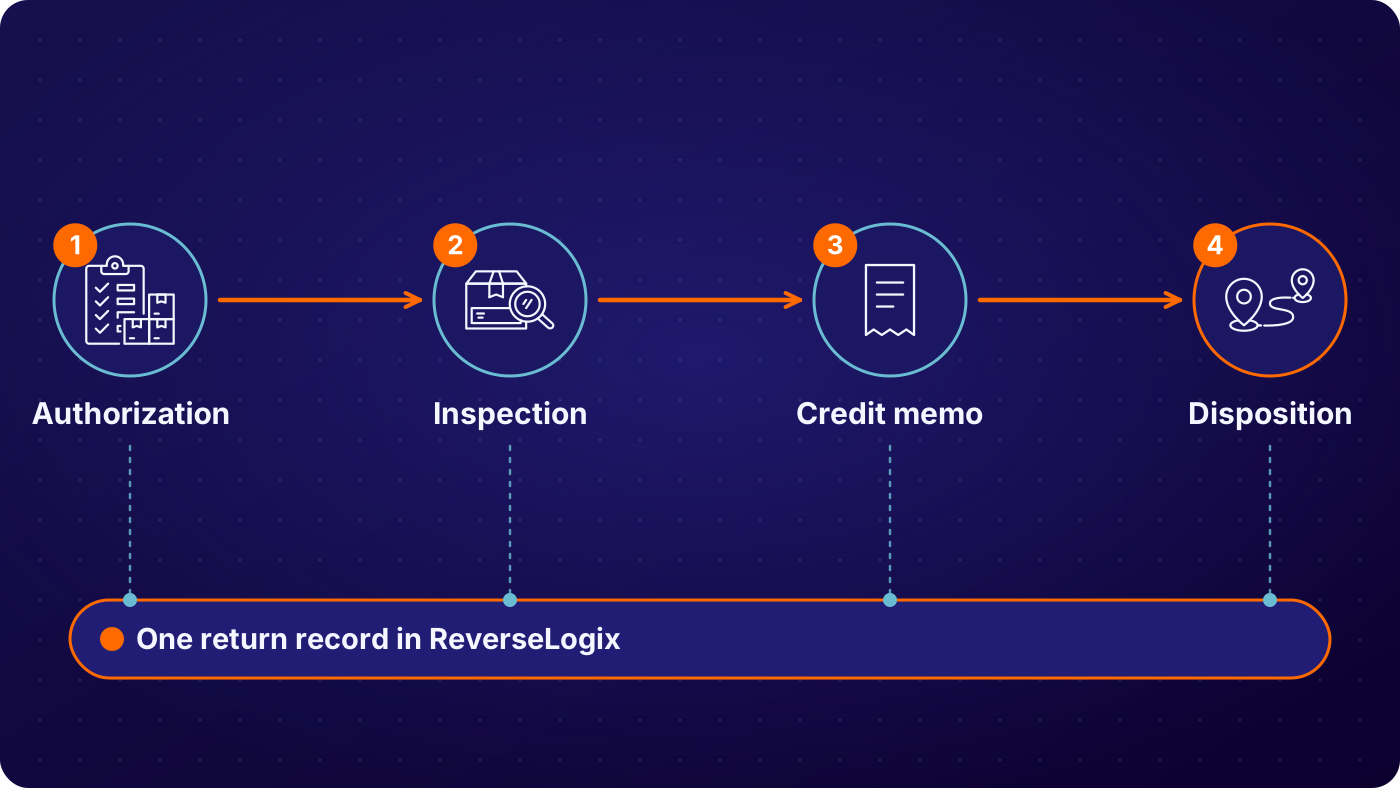
Authorize with the money rules attached
The customer, dealer or agent starts the return and the system applies your rules: return window, entitlement, price basis, refund or credit type and any approval limit. A return with no RMA is flagged as a blind return instead of slipping through. The rule that was applied is written to the record.
See: returns initiation, RMA software
Check the goods, then release the credit
The unit is received against its RMA, inspected and graded. The credit, refund or replacement is released from that result, one credit for the return and not one per SKU. Short shipments and closed-without-receipt cases are held for a person to review before money moves.
See: returns processing
Post to the ERP the way finance expects
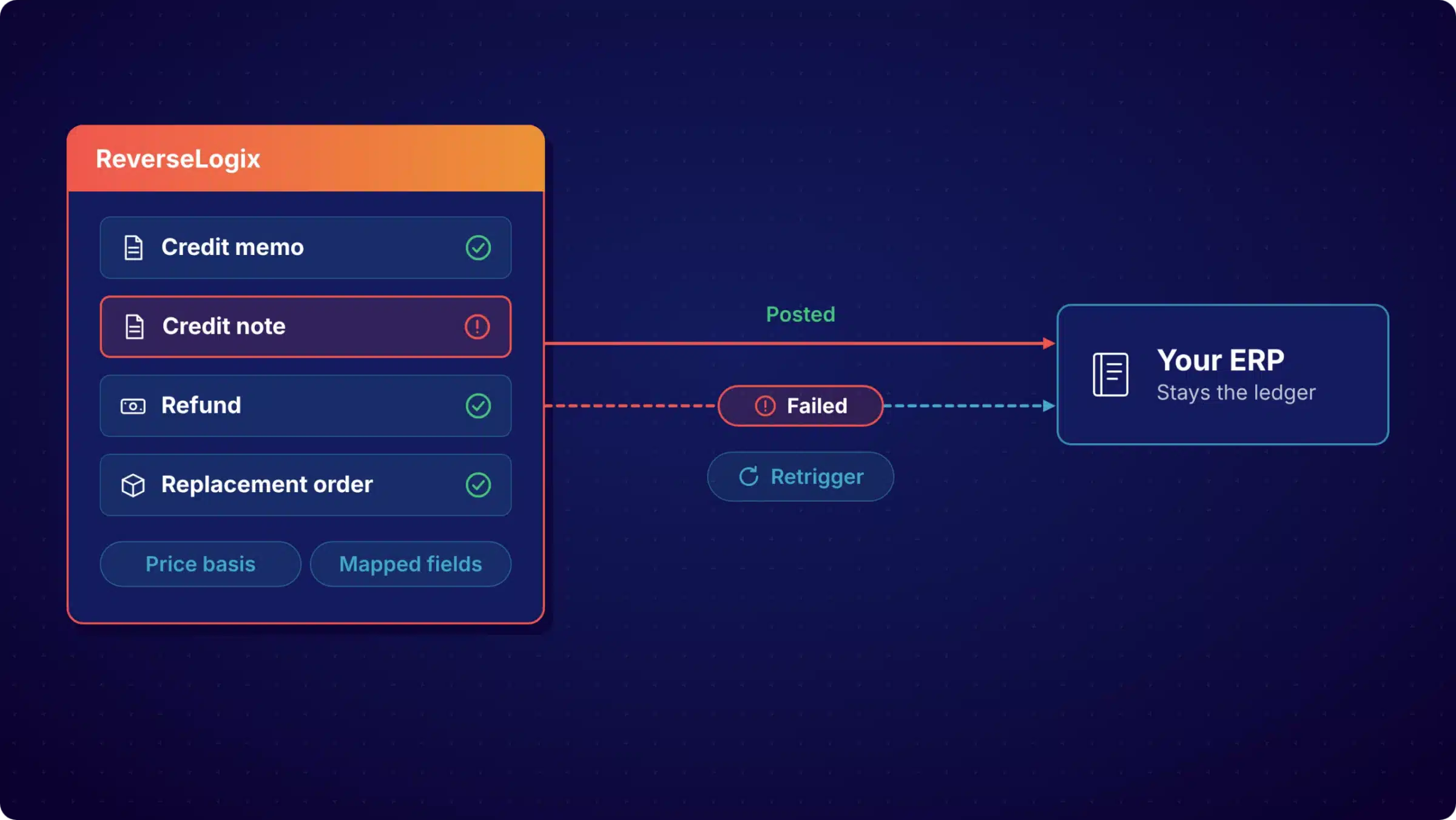
The credit memo, credit note, refund or replacement order posts to your ERP, with the price basis and the fields your team mapped. A failed post is visible and can be retriggered, so nobody hunts for the missing credit. Your ERP stays the ledger.
See: integrations

Recover value, or write it off with evidence
Each unit gets a route: restock, open-box, resale, repair, return to vendor, scrap or destroy. Disposed and resold are recorded as different outcomes. A unit that cannot go back to stock leaves with a reason, a grade and photos, ready for the write-off report.
| Condition at inspection | Typical route | Recorded on the return |
|---|---|---|
| Box arrives with no RMA | Held as a blind return, matched or rejected before any credit | Receipt, photos, match result, reviewer, timestamp |
| Credit requested before the goods are received | Credit held until receipt and grade are recorded | Request, hold reason, receipt, release, timestamp |
| Second credit attempted for the same return | Blocked, and the existing credit shown to the user | Original credit, attempt, user, timestamp |
| Unit damaged and cannot go back to stock | Grade, disposition and write-off flag applied | Grade, photos, route, value, timestamp |
| Customer told to scrap the unit on site | Scrap authorized with proof, cost and recovery tracked | Authorization, proof of scrap, cost, timestamp |
Example configuration. Programs set their own approval limits, price basis and routes.
Who Else Touches a Return, and What Does Finance See of Their Work?
A credit is the last step of a chain finance does not run. Operations receives and grades the unit. Customer service promises the refund or the exchange. IT keeps the ERP posting alive. Each of them adds to the same record, so finance reads one history instead of asking three teams for theirs.
One record, four sets of hands
- Operations: receipt, grade and disposition, so finance sees what was in the box before the credit
- Customer service: refund, credit or exchange promised to the customer, with any override and who made it
- IT: posting status to the ERP, so a failed credit memo is a visible error and not a missing entry
- Finance: approval limits, price basis and holds, so rules change in one place
- Auditors: the full history of each return, with who did what and when
What Can Returns Management Software for Finance Show Without Asking Another Team?
Appriss and Deloitte’s 2026 research puts about 2 percent of return value at outright fraud and about 12 percent at policy abuse. Neither line shows up in a general ledger on its own. ReverseLogix surfaces the signals and keeps the record, so your team can size the leak before deciding what to do about it. It does not prevent fraud or guarantee detection. Analytics reads from the same record the credit came from, so the numbers do not need a reconciliation first.
- Credit memos and refunds by status: pending, released, posted to the ERP, failed and retriggered
- Credits released against goods received, and credits held with the reason
- Fraud and abuse flags by claimant, SKU, serial and region, including blind returns
- Write-offs and dispositions by route and reason, with disposed and resold shown separately
- Cost of returns and value recovered by route, as a baseline you can measure savings against
Your ERP Stays the Ledger, and the Reporting Stays the Same
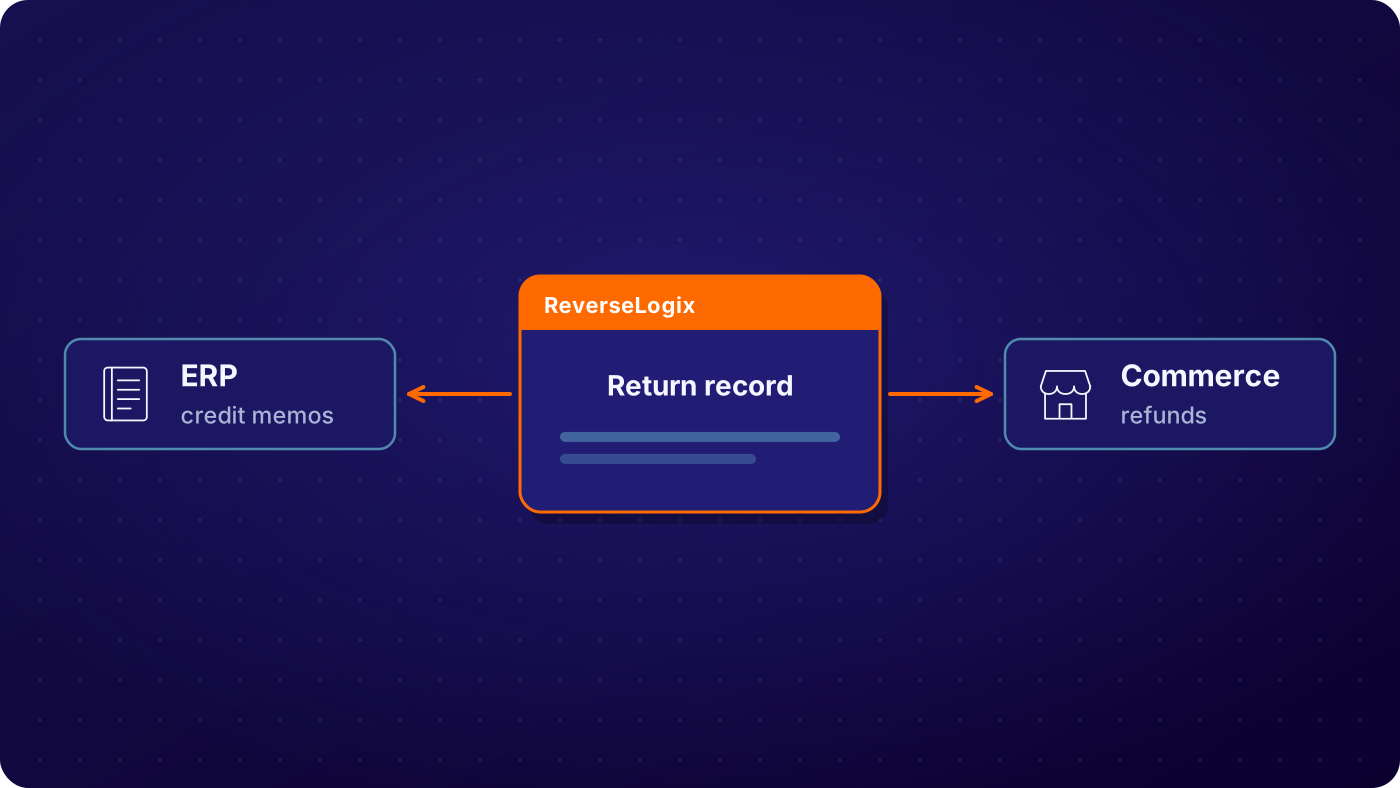
ReverseLogix posts credit memos, credit notes, refunds and replacement orders to SAP, NetSuite, Dynamics 365 and Oracle, and reads orders from Shopify and Salesforce. It does not replace the ledger. Finance rules such as invoice price against net price, or goods receipt before credit memo, are set in the mapping. The integration takes mapped fields, a sandbox, user acceptance testing and a go-live plan. Your finance team signs off the mapping before anything posts.
See: integrations
A Returns Audit Trail You Do Not Have to Build by Hand
Every return keeps a full history: who requested it, who approved it, what was received, what was graded, what was credited, what was posted to the ERP and when. Photos and notes stay attached to the record. When an auditor asks for proof that a unit was inspected or a credit was approved, the evidence is on the record and not in an inbox.
Role-based access decides who can approve a credit, override a rule, change a price basis or close a return without receipt. Each of those actions is written to the history with the user and the time. ReverseLogix does not give accounting, tax or audit advice, and it does not claim your program is compliant. Your finance and audit teams own the controls. The system runs them and records the result.
See: the platform
Your next questions, answered

Article
The True Cost of Free Returns
Read the article →
Calculator
How much are returns costing you? Run the ROI calculator
Run the numbers →

Product
Returns analytics for finance and operations
See the analytics →

Product
Return fraud prevention
See the fraud signals →

Guide
Returns Management Software for Operations Teams
See the operations view →

Industry
Electronics and computer parts
See the industry page →

Industry
Fashion, apparel and sporting goods
See the industry page →
Compare
How does ReverseLogix compare with other returns platforms?
See how we compare →
Returns management software for finance: questions and answers
It is software that gives finance one traceable record for every return, from authorization to credit memo to write-off or recovery. Finance sees what was received and graded before money moves, and the credit posts to the ERP. It replaces the trackers and email threads that finance otherwise reconciles by hand at month end.
By keeping one record per return and checking it before a credit is released. If a credit already exists for that return, a second attempt is blocked and the original is shown to the user. A failed post to the ERP shows as an error and can be retriggered, so nobody re-enters the credit by hand.
Yes. Credit release can be tied to receipt and grade, so a refund or credit memo does not go out on an email alone. Cases such as short shipments or closing a return without receipt can be routed to a person for review. Your team sets the rules, and every release is recorded with the user and time.
Start with a baseline. ReverseLogix records cost, credits, dispositions and recovery on each return, so you can compare the same measures before and after a change. The ROI calculator gives a first estimate from your own volumes. Savings figures you take to leadership should come from your data, not from a vendor average.
No. Your ERP stays the ledger. ReverseLogix keeps the returns record and posts credit memos, credit notes, refunds and replacement orders to SAP, NetSuite, Dynamics 365 or Oracle. Your finance team signs off the field mapping first, so existing reporting stays the same. The integration needs mapped fields, a sandbox, testing and a go-live plan.
Each return keeps its history: who requested it, who approved it, what was received and graded, what was credited, what posted to the ERP, and when. Photos and notes stay attached. Role-based access limits who can approve or override, and each action is logged. This gives auditors documented evidence instead of an email thread.
It surfaces signals but does not prevent fraud or guarantee detection. Blind returns, serial mismatches, repeat claimants, empty boxes and units authorized but never received are flagged, with photos and history kept on the record. Your team decides what to do with each case. Vision AI can check photos at initiation.
Compared with ecommerce-only returns portals, ReverseLogix covers the whole chain finance pays for: RMA management, receiving and inspection, disposition, repair and warranty, and B2B bulk returns, not just the customer-facing request. That gives finance the receipt, grade and disposition behind each credit, not only the refund that was requested.
Further reading: National Retail Federation research on retail returns.
See Where Your Returns Money Leaks, and How to Prove It
A specialist walks through your credit, write-off and recovery flow and shows where money leaves without proof. Bring a recent credit memo or write-off report and we will trace it.


