

Returns Management Software for Operations Teams for the people who own the dock
Every box received against an RMA, every unit graded, every outcome posted to the WMS and ERP.
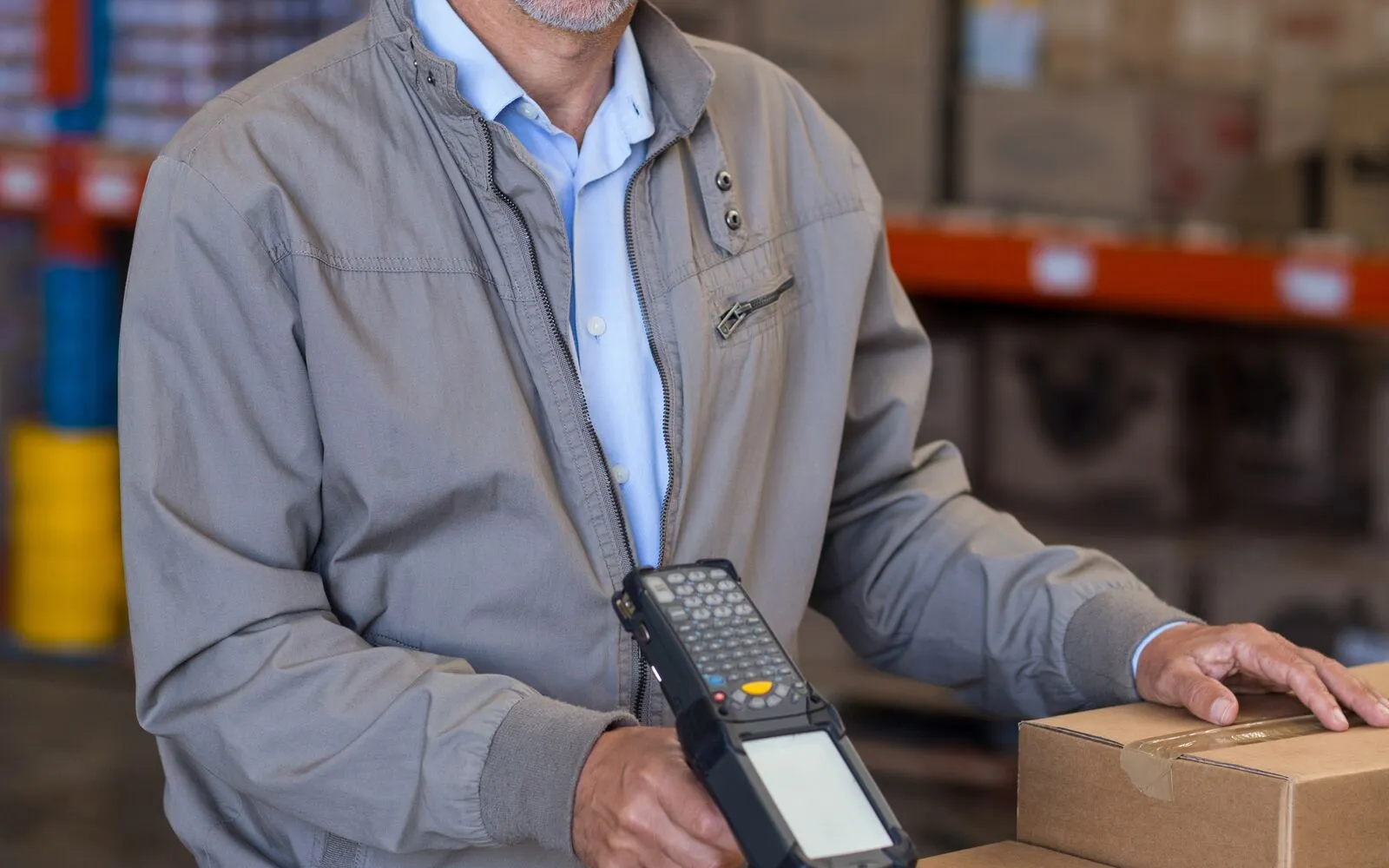
A box lands on the dock. No RMA, no packing slip, a SKU that is not in the item master. Someone opens it, types it into a spreadsheet and carries it to a shelf nobody will check for a week. Meanwhile the backlog grows, customers call about their refunds and the WMS says one thing while the ERP says another. ReverseLogix is returns management system for supply chain, distribution, warehouse and reverse logistics leaders at manufacturers, retailers and 3PLs. It runs receiving, inspection, grading and disposition in one system and posts the result to the systems you already run.
Returns teams using ReverseLogix include:











Why Is Returns Work Still Manual Without Warehouse Returns Processing Software?
Forward flow has a system for every step. Returns get a spreadsheet, a shared inbox and whoever is free. The work is real, the volume is real and the team is not getting bigger.
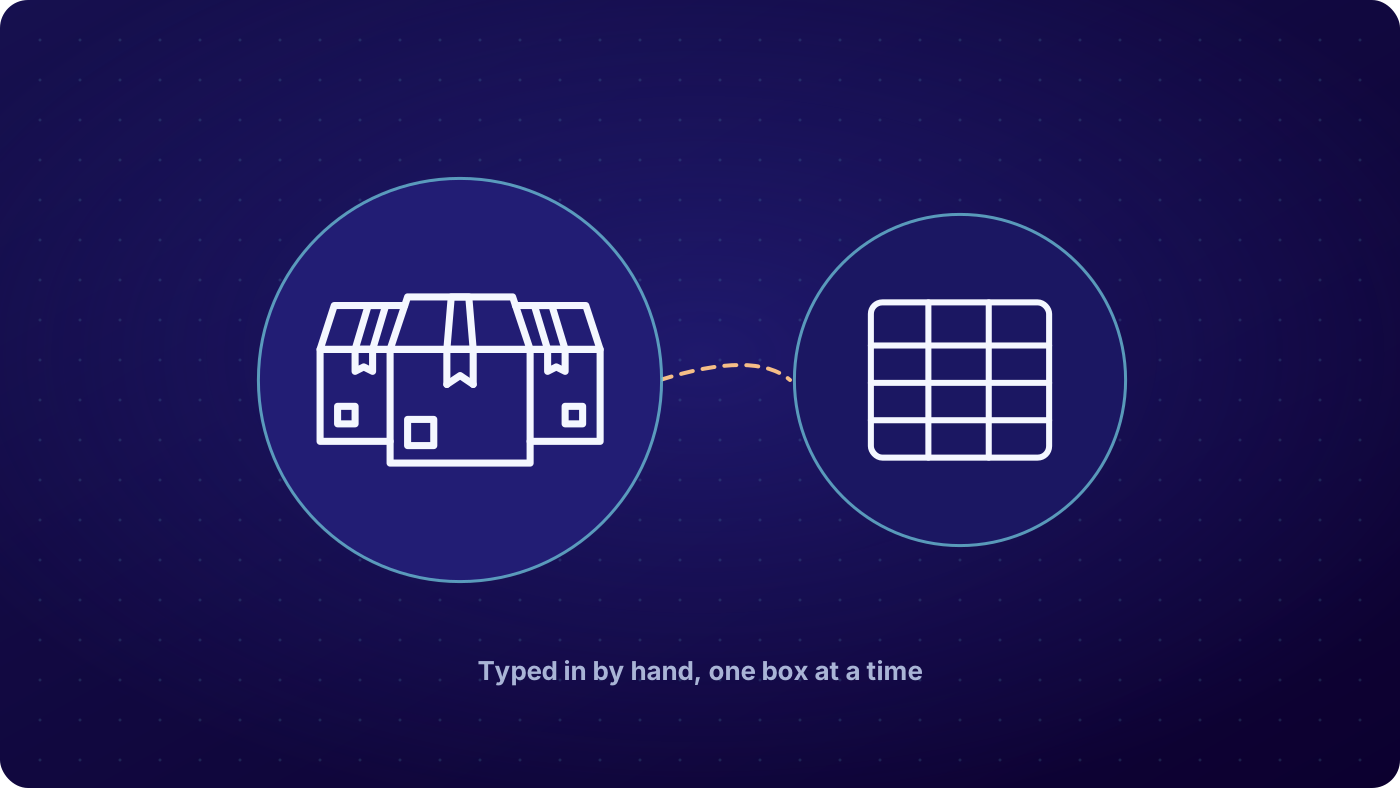

It all runs on a spreadsheet
Disposition lives in an Excel file. Refunds get issued by hand once the goods are in. CSV uploads fix the inventory counts afterward. Throwing labor at it works until peak, then it stops working.

Nobody can say where a return is
A unit leaves the customer, spends days in a carrier network, lands in an unmarked pallet box or waits for a put away that never happens. Ask where it is and the honest answer is that it is in a black hole.

A box with no RMA and a SKU nobody knows
The carton has devices in it but no return order. The serial number is missing or the SKU does not exist in your item master. You still have to receive it somehow, so a person decides on the spot.

Every unit gets touched too many times
Copy the SKU from one screen, paste it into the scanner, receive, verify, hand it to someone else for put away. Each touch costs labor, and each hand off is a place for the unit to disappear.
How Does a Return Move From the Dock to Good Stock?
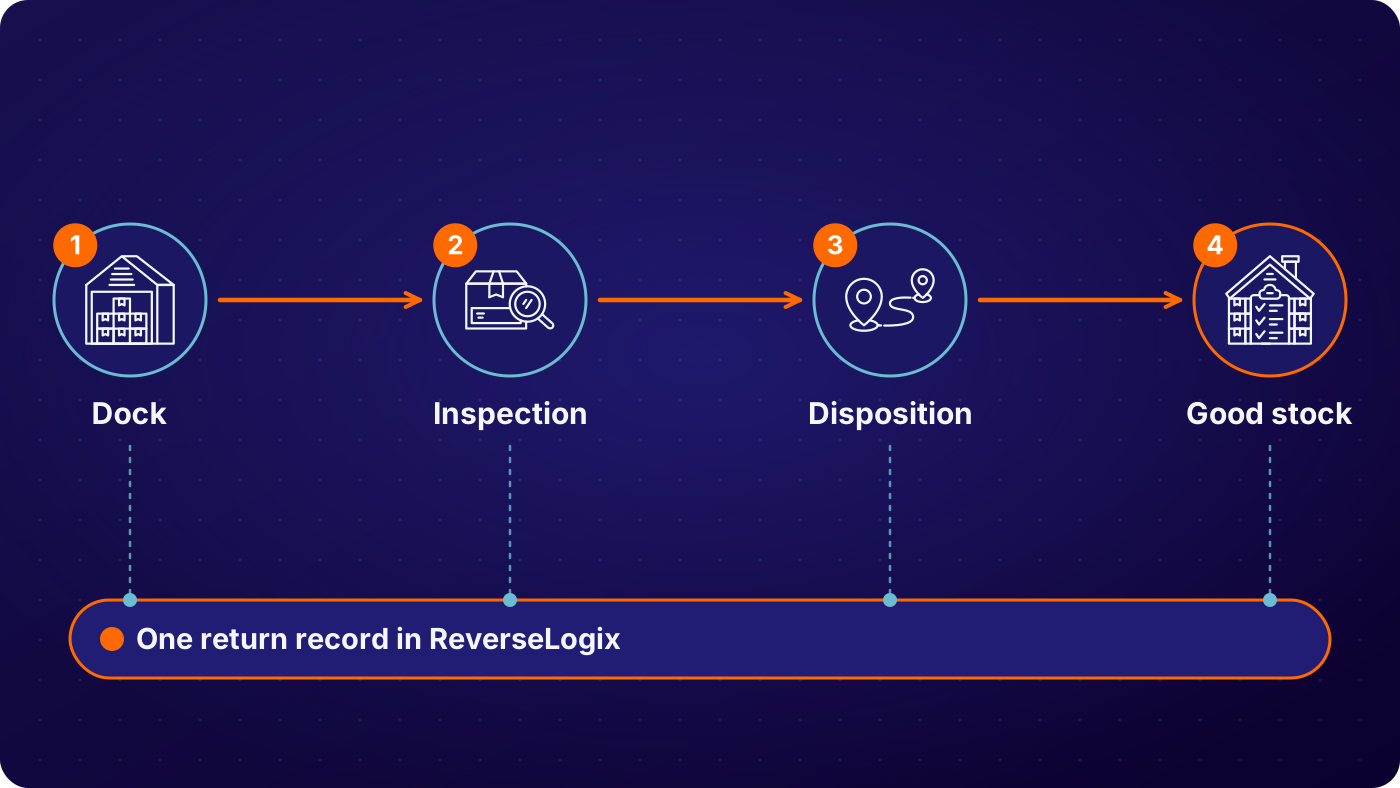
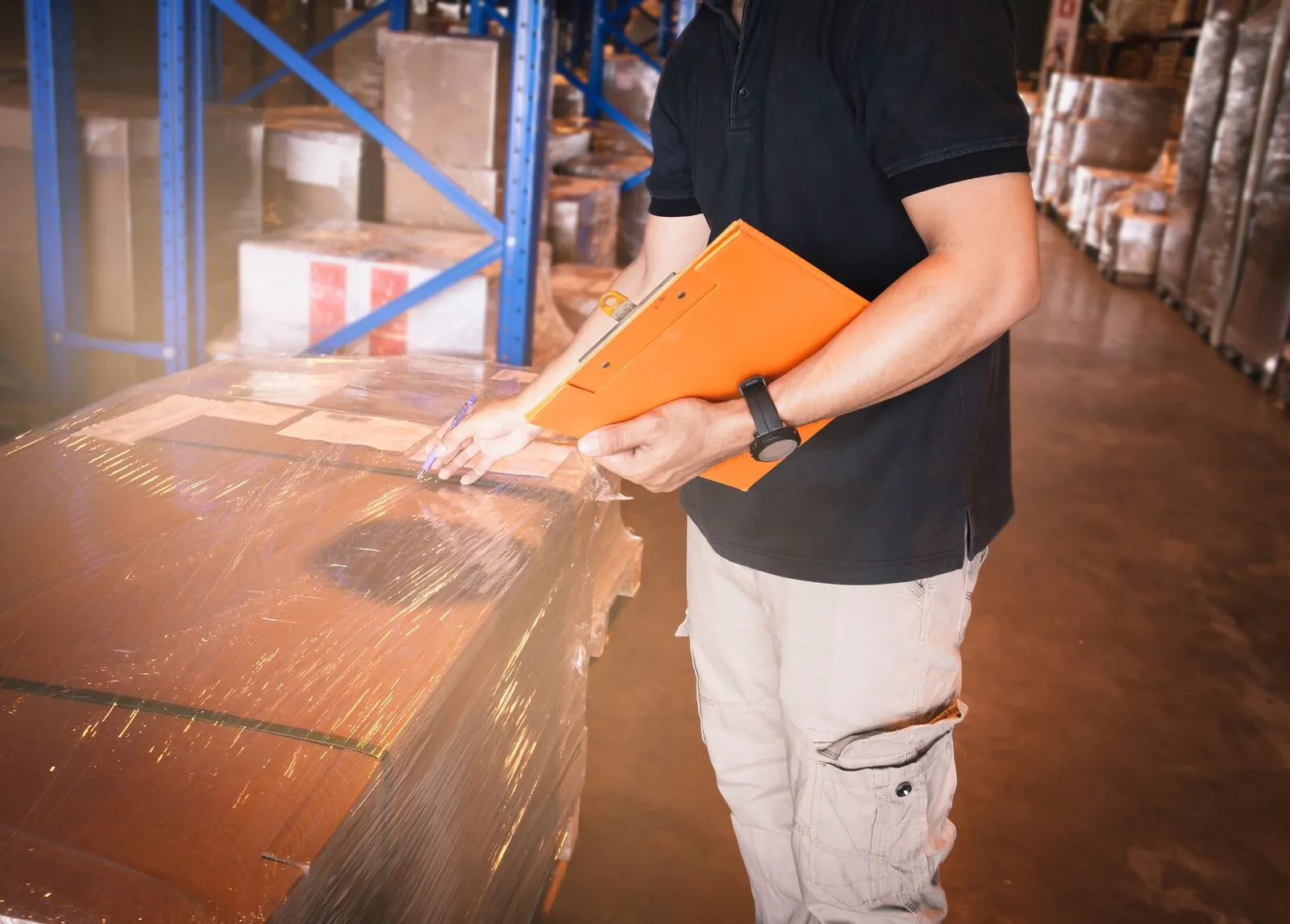
Receive and verify against the RMA
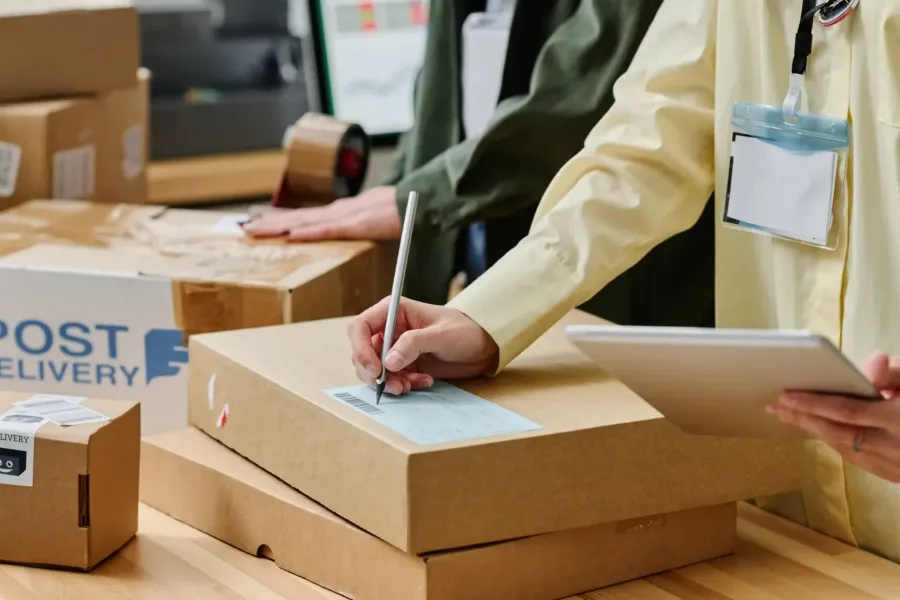
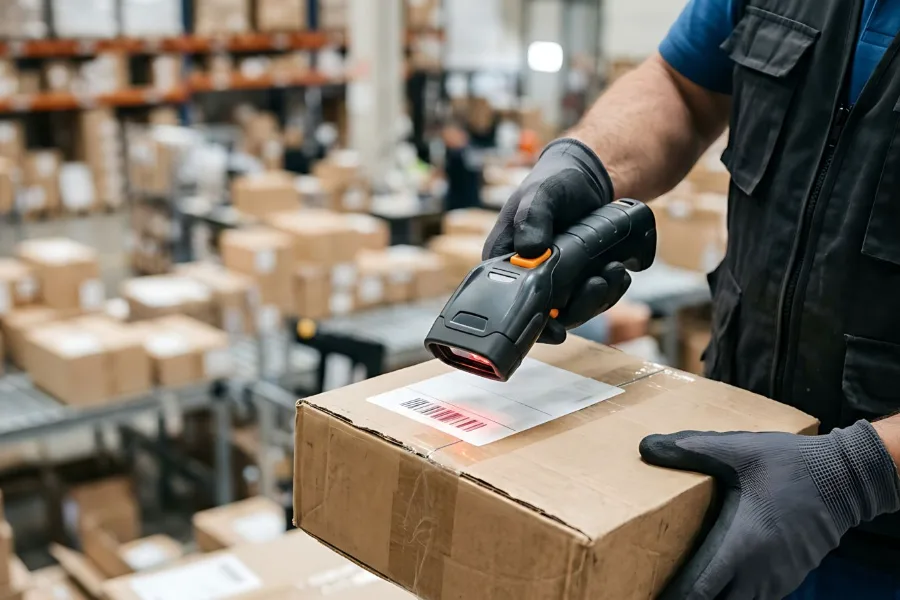
The RMA exists before the box does, so the dock scans the label and the system pulls up what was expected: SKU, quantity, serial, reason. Anything that does not match is flagged at the bench, not found a week later. A box with no RMA is received as a blind receipt with its own hold, photos and match step.
See: RMA management, returns processing
Inspect and grade with proof
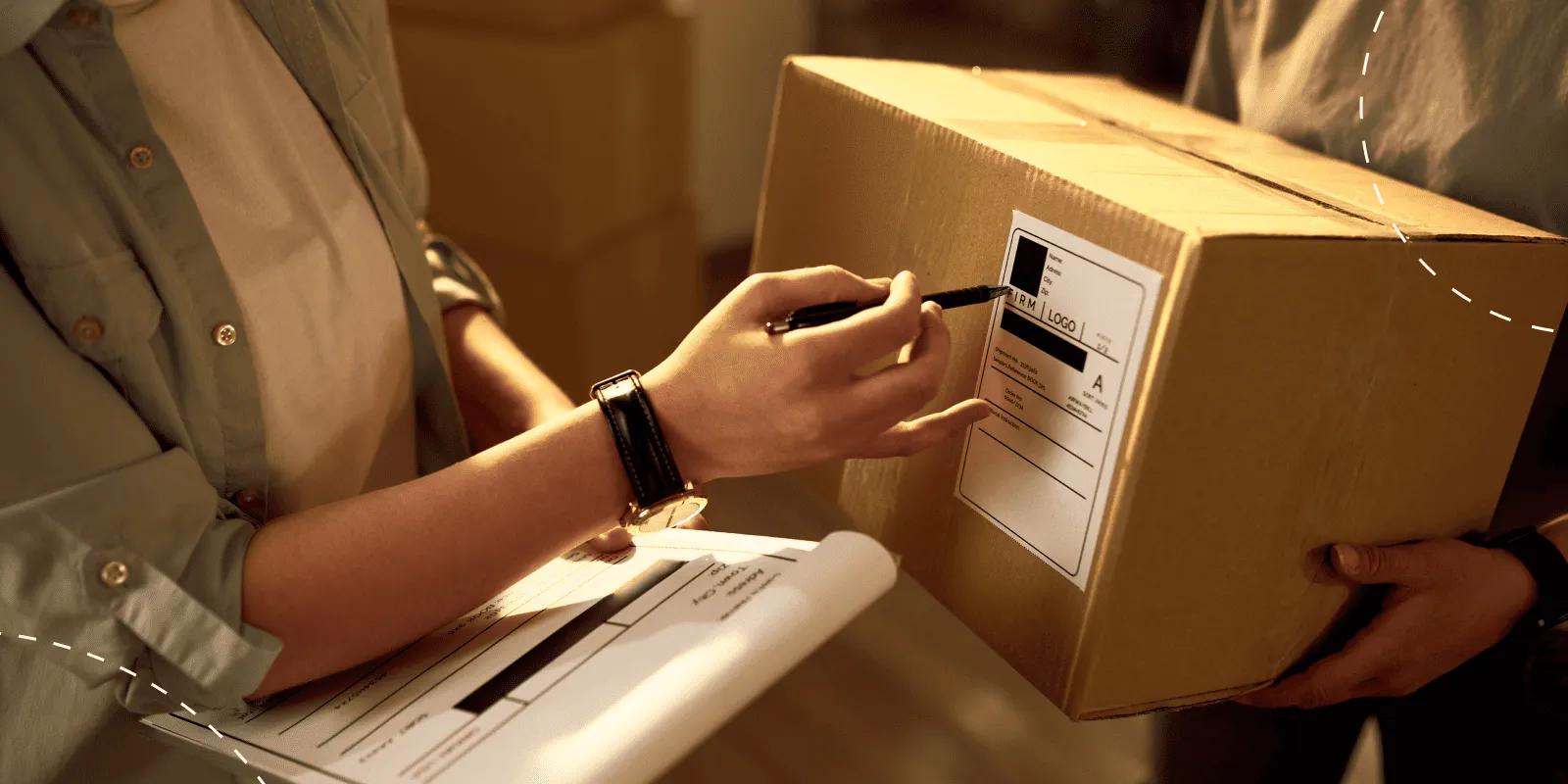
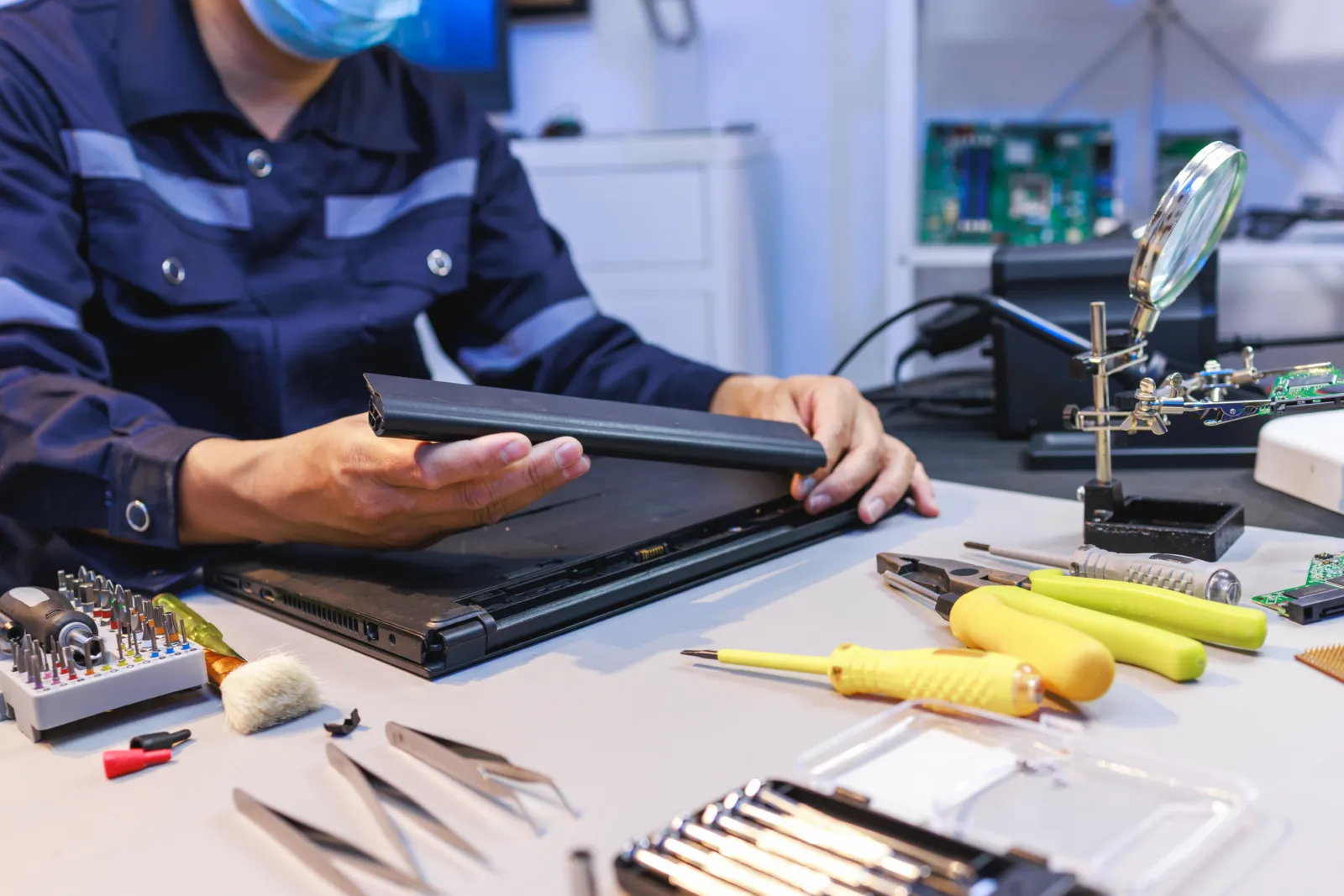
Grades are set by SKU, so the person at the bench answers the same questions every time. Is the seal broken? Is the accessory bag complete? Photos and the serial attach to the record, which is the evidence when you downgrade a unit. Vision AI can read photos to support the grade.
See: returns processing, Vision AI
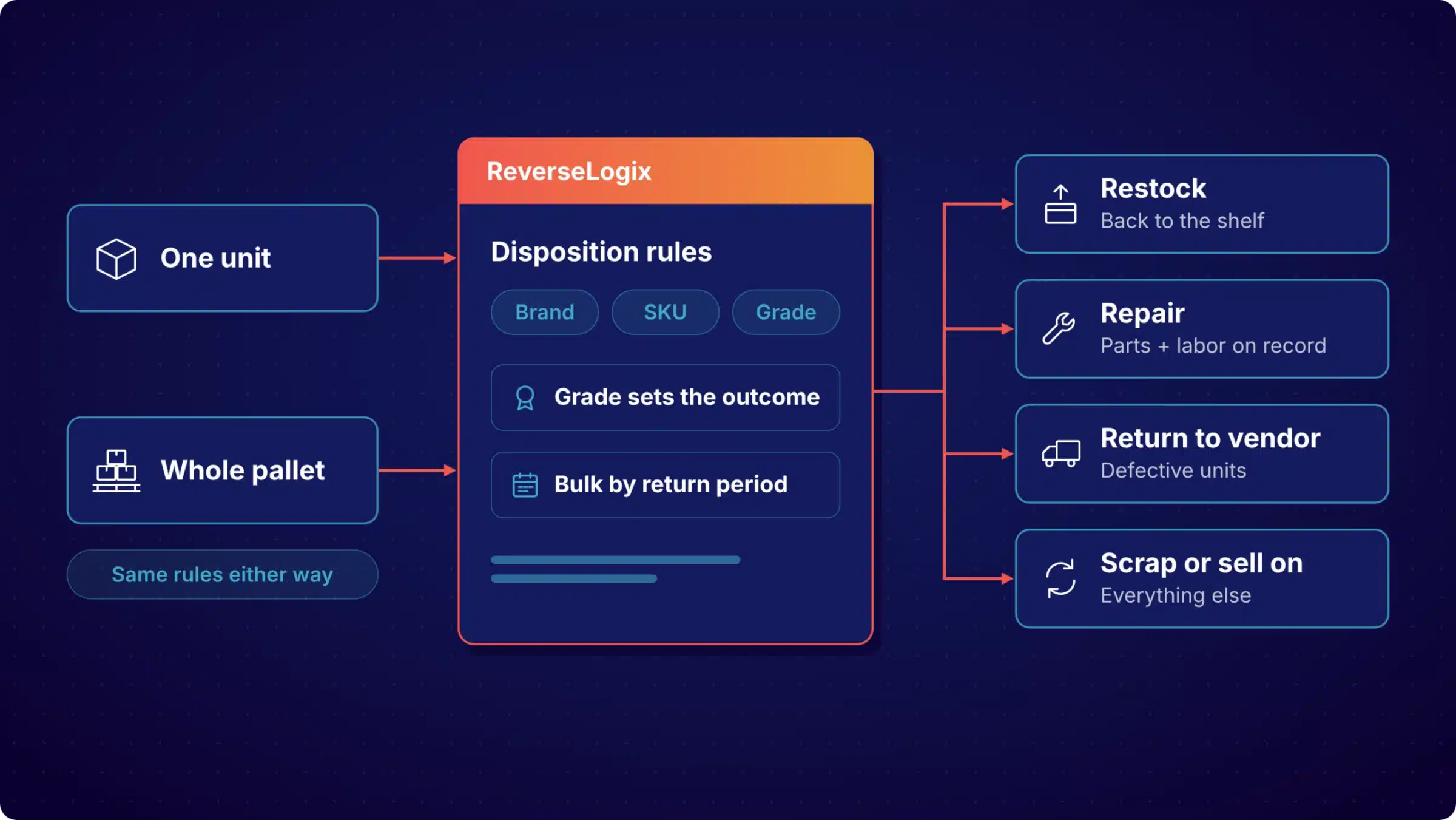
Disposition by rule, one unit or a whole pallet
The grade sets the outcome. Good stock goes back to the shelf, rework and refurbishment go to repair, defective units go back to the vendor, and the rest is scrapped or sold on. Rules run by brand, SKU and grade, and disposition can run in bulk across a period of returns. Repair orders track parts and labor on the same record.
Post to the WMS and ERP, then release the money
The receipt, the put away instruction and the inventory transaction post to your WMS and ERP from the same record. The refund or credit is released on your rule, for example after inspection, so it does not go out before the goods are checked.
See: integrations, analytics
| Condition at inspection | Typical route | Recorded on the return |
|---|---|---|
| Box arrives with a valid RMA and the contents match | Receive against the RMA, verify, send to inspection | Receipt, receiver, SKU, serial, quantity, timestamp |
| Box arrives with no RMA | Blind receipt, hold, match by serial or SKU, open an exception if none | Blind receipt flag, photos, receiver, match result, timestamp |
| SKU is not in the item master | Hold, request to the item data owner to add it, then release | Unknown SKU, photos, request owner, release time |
| Sealed, complete, grade A | Good stock, put away location sent to the WMS | Grade, location, inventory transaction posted, timestamp |
| Damaged or grade C | Rework, return to vendor or scrap by rule, carrier claim flagged if damaged in transit | Grade, photos, disposition, approver, claim flag, timestamp |
Example configuration. Programs set their own grades, holds and routes.
Who Else Touches a Return, and What Does Each Team See?
A return is not only an operations job. Customer service answers the phone when a refund is late. Finance needs the credit memo to match the receipt. IT gets the ticket when a message fails. In most companies each team asks operations for the answer. In ReverseLogix they read the same record, each through their own role, so the dock stops being the help desk.
See: customer service, finance, IT
One return, four views
- Operations: the receipt, the grade, the disposition and the backlog by stage
- Customer service: status from received to inspected to refunded, without a call to the dock
- Finance: the credit memo and refund tied to the receipt and the grade, released on your rule
- IT: integration messages, errors and retries, plus role-based access for 3PL and warehouse staff
- 3PL partners: work in the same record with their own permissions, so you see what they see
What Can Reverse Logistics Software Show You Without Walking the Floor?
The questions you get asked all week are the ones the system should answer. How big is the backlog? How old is it? Where is that unit? ReverseLogix keeps a timestamped history on every return, so these are views you open, not spreadsheets you build.
- Backlog by age and stage, from arrived to inspected to dispositioned
- Cycle time from arrival to final outcome, by site, SKU or 3PL
- Blind receipts and unmatched boxes, and how long each stayed on hold
- Units authorized for return but not yet received, and where they sit in the carrier network
- Posting errors between the returns record, the WMS and the ERP
Your WMS and ERP Stay the Systems of Record
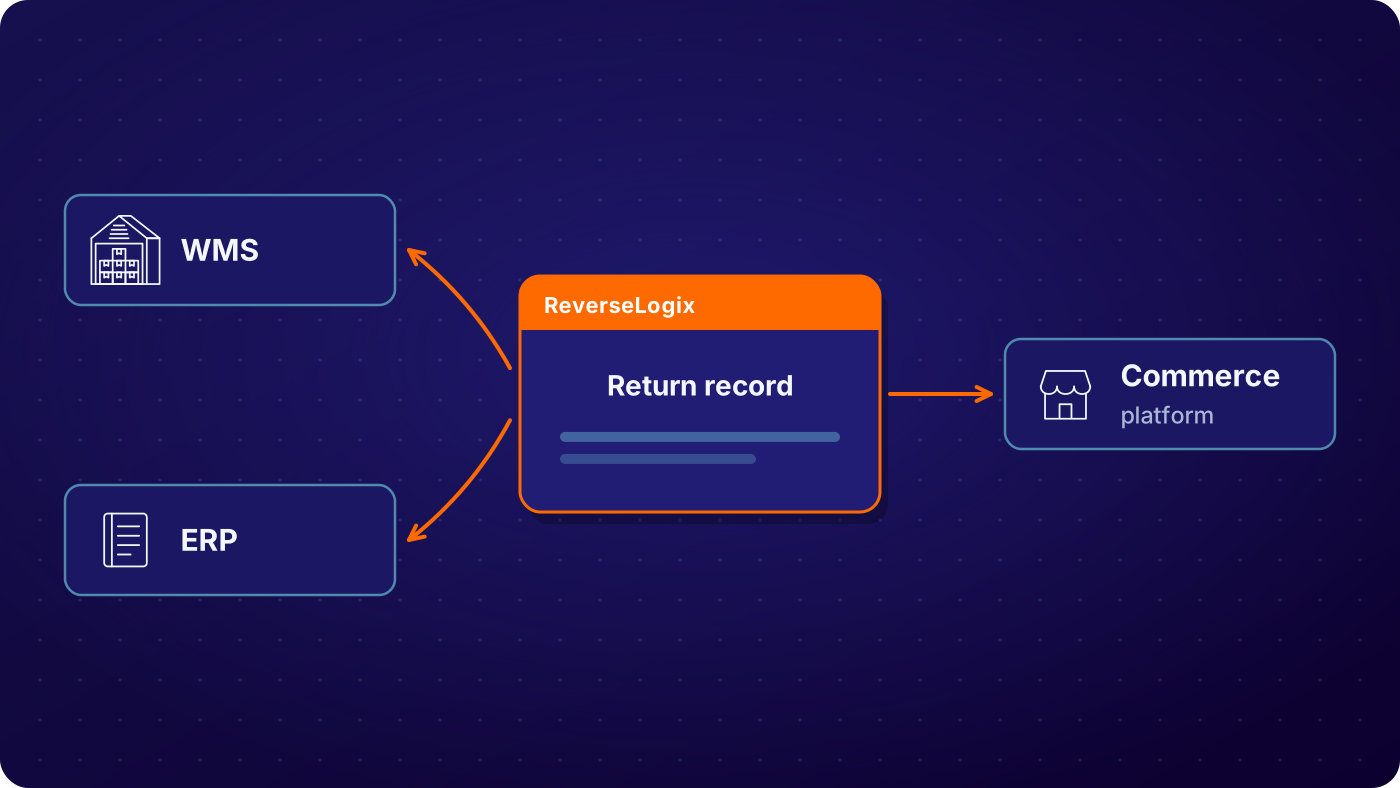
ReverseLogix does not ask you to replace the WMS, and it does not ask your floor to learn a second way to receive everything. It holds the returns record and posts receipts, inventory and credit transactions to SAP, NetSuite, Dynamics 365 and Oracle, and to your WMS, OMS, commerce and CRM platforms. Integration takes work. Fields are mapped, a sandbox is built, UAT is run and a go-live plan is agreed, and that plan respects your peak season and any WMS freeze. Over 400 carriers in more than 100 countries connect through one integration.
See: integrations
Who Did What, When, and With What Evidence?
Every receipt, grade, disposition, override and inventory posting carries a user, a timestamp and a status. When someone asks why a unit was scrapped, or why a return was received without an RMA, the answer is on the record with the photos and serial attached.
Access is role-based, so a warehouse associate, a 3PL supervisor and a finance approver each see and change only what their role allows. That gives you a trail you can hand to an auditor and a clear line between who can grade a unit and who can approve a write-off.
See: the platform
Your next questions, answered




Returns management software for operations: questions and answers
It is a system that runs the physical side of a return: receiving against an RMA, inspection, grading, disposition and put away. It gives the warehouse, distribution and reverse logistics team one record instead of spreadsheets and email. ReverseLogix posts the results to your WMS and ERP, which stay the systems of record.
The dock receives it as a blind receipt, with a hold, photos and the serial or SKU captured. The system tries to match it to an open RMA or order. If it cannot, an exception is opened and the unit is not released to stock until someone decides. Every step is time stamped and tied to a user.
It depends on your setup. Receiving, inspection and disposition happen in ReverseLogix, and the receipt and inventory transactions post to your WMS, so staff do not key the same data twice. Where your WMS must stay the tool for all receipts, the integration is scoped with your team during design.
Yes. Every return has a timestamped history, so you can view backlog by age and stage, and cycle time from arrival to final outcome. You can split it by site, SKU or 3PL. Analytics shows blind receipts, holds and units authorized but not received, so you see problems before customers call.
Yes. ReverseLogix posts to SAP, NetSuite, Dynamics 365, Oracle and to WMS, OMS, commerce and CRM platforms. It is still a project. Your team and ours map the fields, build a sandbox, run UAT and agree a go-live plan that avoids your peak season and any WMS freeze.
Yes. Grades are set by SKU, and the grade drives the route: good stock, rework, repair, return to vendor, scrap or resale. Locations can follow the grade too, so a poor grade does not head to the wrong bin. Disposition can also be run in bulk by brand across a period.
A WMS is built to move forward inventory, and returns need extra steps: RMA matching, grading rules, evidence, repair, vendor claims and refund timing. ReverseLogix handles those and posts to the WMS. Compared with ecommerce-only returns portals, it also covers the receiving dock, repair and B2B returns.
It tracks the return through the carrier network and flags units authorized but not received. When a unit arrives damaged, the grade, photos and carrier reference sit on the record, so a claim can be filed with evidence. The refund rule can wait for inspection, so credit does not go out before the goods are checked.
Further reading: Reverse Logistics Association.
See Where Your Returns Process Loses Time
A specialist walks through your dock, your inspection steps and your disposition rules, and shows where touches and delays can come out. You will see it on your own flow, not a generic demonstration.


