

Returns Management Software for Customer Service Teams so agents stop chasing every return
One return record your agents can see, act on and explain, from the first call to the refund.
The phone rings. A customer wants to know where their refund is. Your agent opens the order system, then the portal, then a ticket to the vendor, and still cannot say if the box has arrived. Then comes a label, built by hand, saved as a PDF, renamed and emailed. ReverseLogix is returns management system for customer service and customer care teams. Every return, exchange, repair and warranty claim lives in one record. Customers start it themselves, agents see the same record, and the refund can be set to go out when the item is received, not when someone remembers.

Returns teams using ReverseLogix include:








Why Do Customers Keep Calling About Returns?
Every manual step in a return turns into a call, a chat or a ticket. Your team ends up as the glue between the shopper, the warehouse, the finance team and the platform.
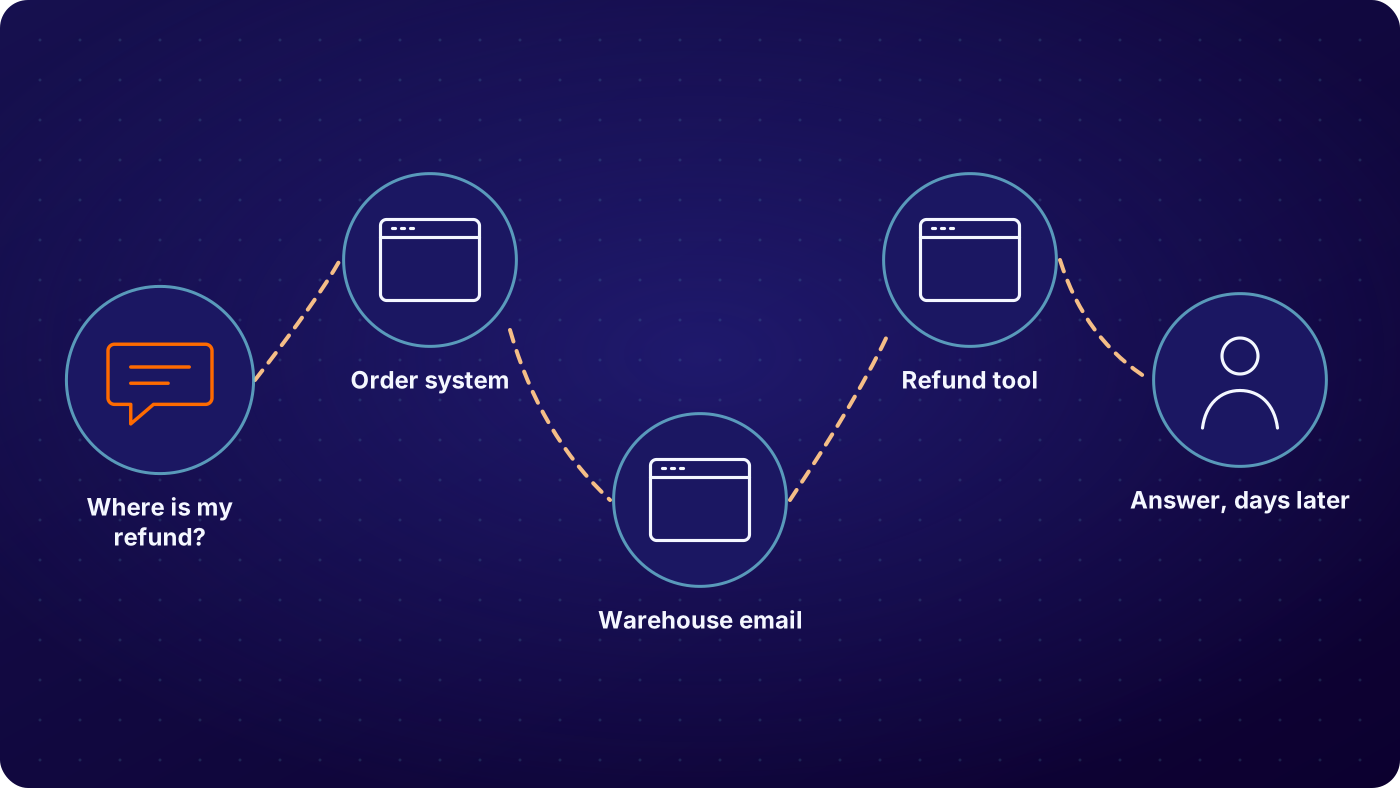

“Where is my refund?”
Refunds that do not fire on their own get done by hand, every day, often in Shopify. The customer waits. Then they call. The amount is sometimes wrong, and someone has to catch it.

“I can’t see what happened to it”
The agent cannot see the reason code, whether shipping was waived, or whether the box has landed. Save the case and the detail is gone. The customer cannot tell either, so they ask you.

“We build the label by hand”
Download the PDF, rename it to the RMA, attach it, email it. A refund and a replacement on one order become two RMAs. Exchanges get managed outside the system. Hours go on set-up work.

“Self service breaks, so they call”
A wrong email address looks like a system fault. A rule the customer cannot get past sends them to the phone. A delayed email brings “where is the rest of my order”. Volume goes up when the portal falls short.
What Does an Agent Do in Customer Service Returns Software, From First Contact to Refund?
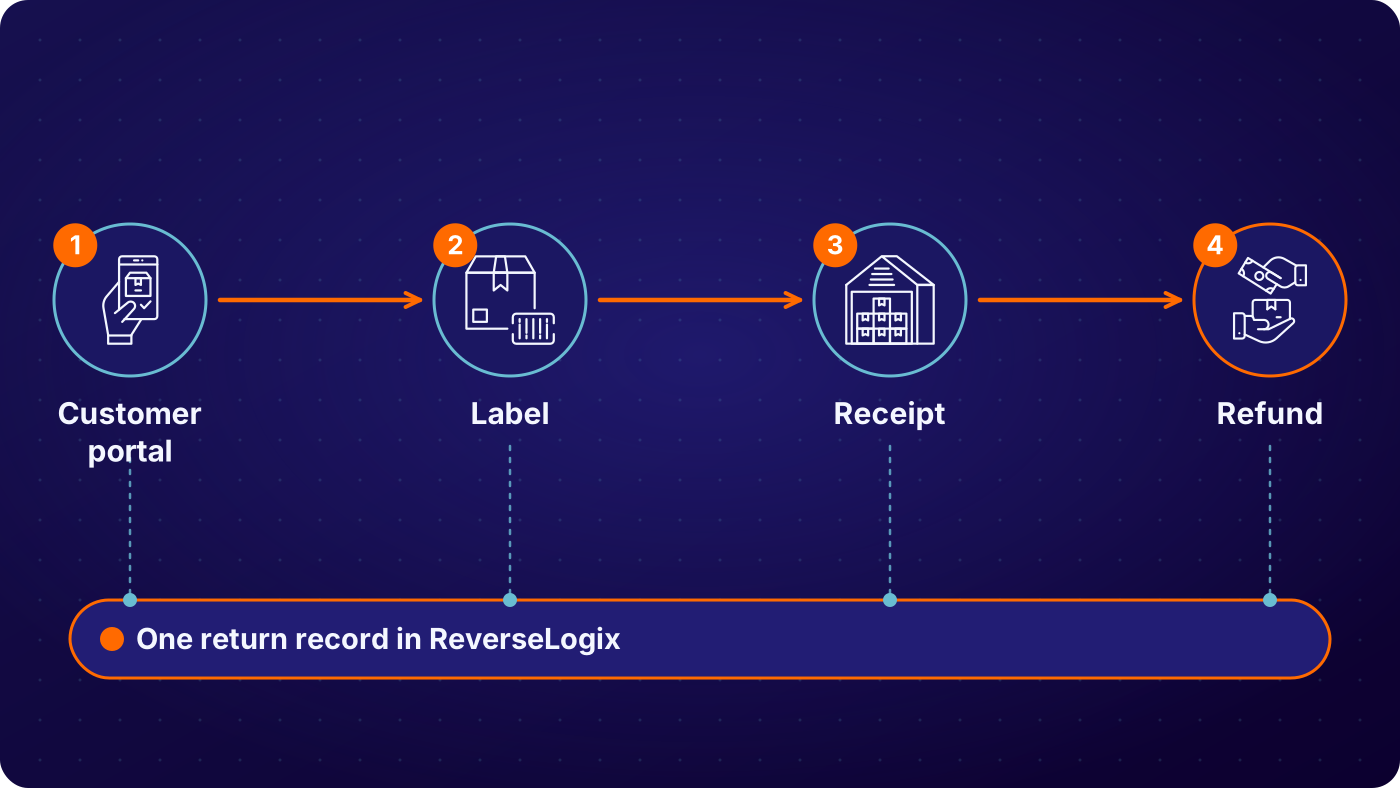
Start it, by the customer or by you
The customer opens a branded portal and starts the return. Your agent can start it too, from the back office, for phone and chat cases. Rules block items that cannot come back, such as freight. Agents follow configured rules, not memory.
See: returns initiation, RMA software
Set it up without building anything by hand
The label is created and emailed with the RMA. Exchanges, advanced exchanges and replacements are set up in the same record. Warranty and repair cases start with the agent, who runs the checks and decides the path.
Follow it, and let the customer follow it
Status is on the record for the agent and the customer: label sent, in transit, received, inspected. Customers get emails at each step in your brand voice. Agents stop hunting across systems to answer one question.
See: returns processing
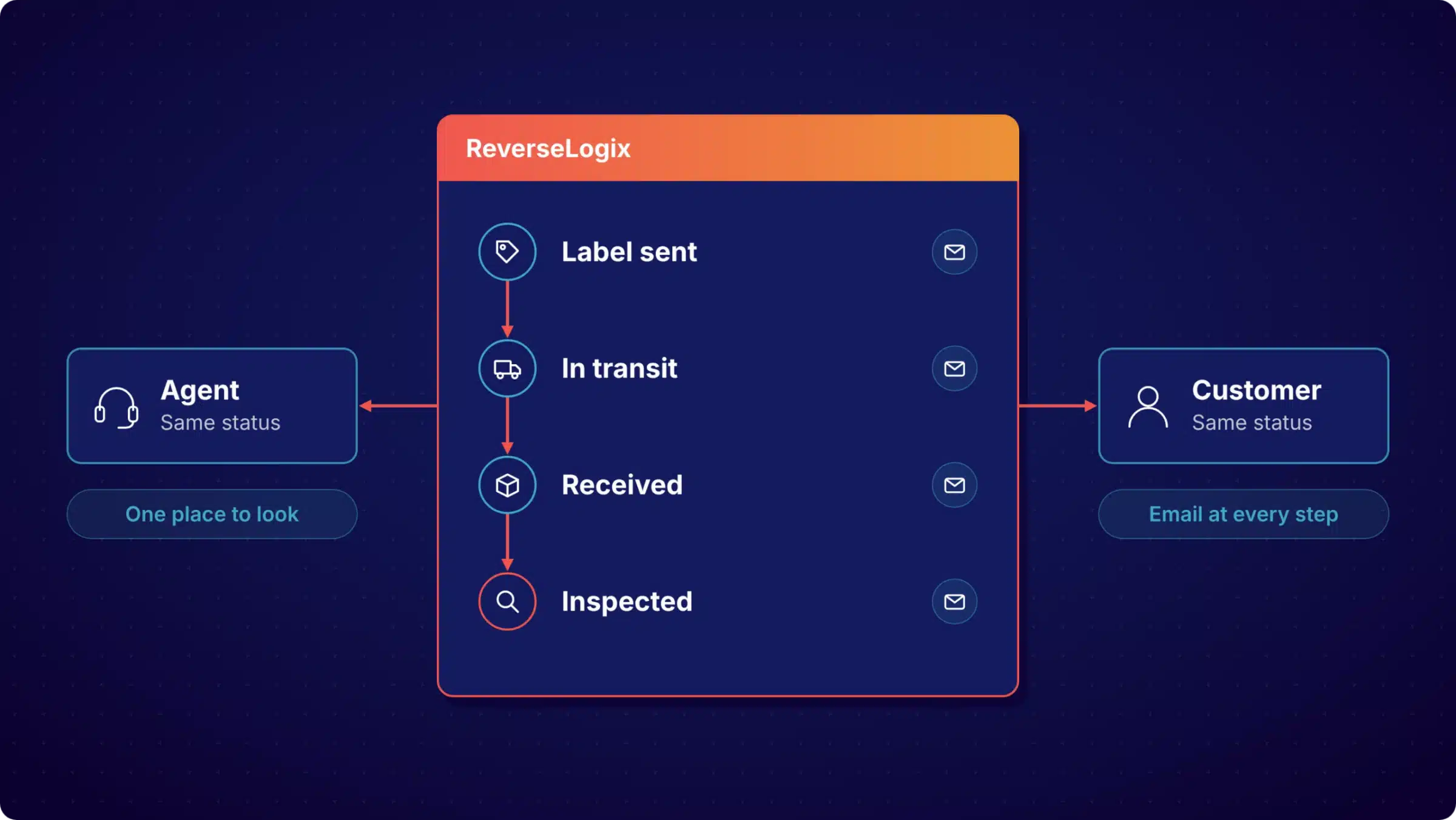

Close it with the right money and the right note
When the warehouse records receipt and inspection, the refund, credit memo or replacement is triggered under your rules. A held refund tells the agent why. The result posts to Shopify or your ERP and stays on the record.
See: analytics, integrations
| Condition at inspection | Typical route | Recorded on the return |
|---|---|---|
| Good customer, item just outside the return window | Agent overrides eligibility with a reason code, within the role’s permission | Who overrode, which rule, reason, timestamp |
| Refund on one item and a replacement on another, same order | One RMA with both outcomes, no second case to open | Each line’s outcome, linked order, status by line |
| Defective unit and the customer needs a replacement now | Advanced exchange: replacement ships before the bad unit comes back | Exchange order, card authorization, return due date, receipt |
| Box arrives damaged, or with the wrong item | Refund held at inspection, agent alerted to contact the customer | Grade, photos, hold reason, agent note, decision |
| Customer says the label or email never came | Agent resends from the record, with the address on file visible | Email sent, address used, resend time, agent |
Example configuration. Programs set their own rules, roles and routes.
Who Else Touches This Return, and What Does Each Team See?
A return crosses four desks. Customer service takes the call, operations gets the box, finance moves the money and IT keeps the systems talking. Each team works from the same record, so nobody rings another team to ask what happened. Reason codes travel forward. Inspection results travel back.
See: operations team, finance team, IT team
One return, four views
- Operations: the reason and sub reason you chose reach the dock, and the inspection grade and photos come back to your screen
- Finance: you see whether a refund or credit memo is issued or held, and finance sees which overrides you made and why
- IT: portal access, login and integration errors are watched by IT, so a system fault is not blamed on a wrong email address
- The customer: the same status you see, by portal and email, before they think to call
- Supervisors: queue and case views with more access than an agent, without an admin role
What Can a Returns Portal for Agents Show Without Raising a Ticket?
Your team should not have to export a sheet, ask the warehouse or open a vendor ticket to answer a customer. These are the views service leads ask for first. Refund and credit memo status sit next to the case, so the answer to “where is my refund” is on your screen.
- Where each return is: label sent, in transit, received, inspected, refunded
- Refund and credit memo status, issued or held, and the reason for any hold
- Return reason and sub reason, as chosen by the customer or the agent
- Overrides by agent, rule and reason, so supervisors can see patterns
- Open exchanges and warranty claims waiting on the customer, the warehouse or an approval, with age
Your Helpdesk, Commerce Platform and ERP Stay the Systems of Record
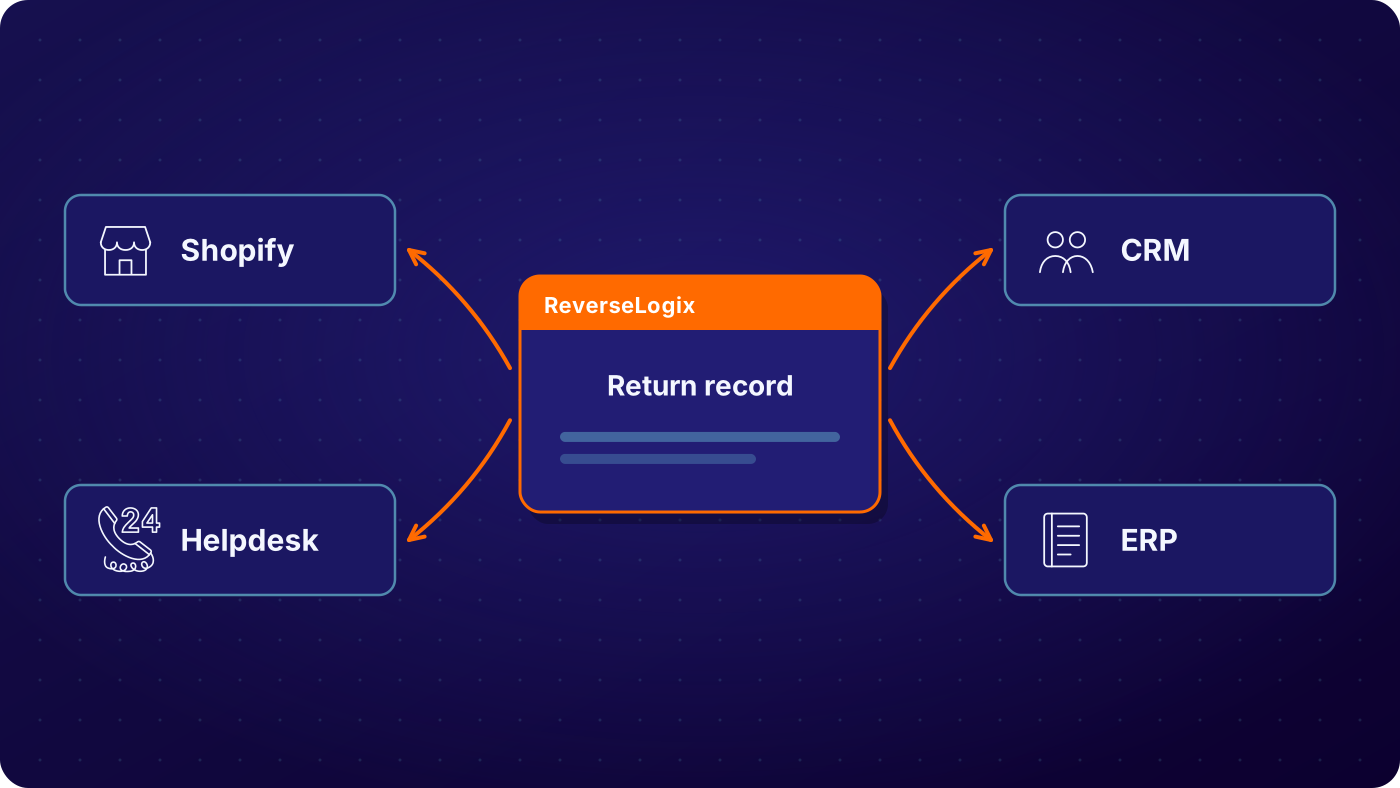
ReverseLogix runs the return and posts to the systems you already use. It integrates with commerce platforms such as Shopify, ERPs such as SAP, NetSuite, Dynamics 365 and Oracle, and CRM and helpdesk tools such as Salesforce, so the refund lands where finance expects it. Whether agents work in the ReverseLogix back office or see the return inside their helpdesk depends on how you set it up. The work is real: fields are mapped, a sandbox is built, your team runs user acceptance testing, and a go-live plan is agreed before customers see a change.
See: integrations
Who Overrode the Rule, and Can You Show Why?
Agents need room to fix a one-off, and supervisors need to see it. Role-based access sets who can override a rule, who can resend a label, who can release a held refund and who can only view. Supervisors can hold more access than agents without holding an admin role. When peak season adds temporary staff, you decide who can do what before they log in.
Every record carries a full audit history: who acted, what changed, when, and what evidence sat behind it, such as inspection photos and grade. When a customer disputes a refund or finance asks about a credit, the answer is on the record and not in someone’s memory.
See: the platform
Your next questions, answered






Returns management software for customer service: questions and answers
Give them the status before they think to ask. ReverseLogix shows the customer and the agent the same record: label sent, in transit, received, inspected, refunded. Emails go out at each step in your brand voice. The refund can be set to trigger on receipt and inspection, so it does not wait for someone to process it by hand.
Yes, if you allow it. Overrides are set by role, so you decide which agents can send a label when the rule says no, extend a window for a good customer, or issue a replacement now. Each override records who made it, which rule it bypassed and why, so supervisors can review patterns.
Set the label to generate when the RMA is approved. The customer gets it by email and in the portal, and the agent can resend it from the record. Nobody downloads a PDF, renames it to the return reference and attaches it to a ticket. ReverseLogix integrates with over 400 carriers in more than 100 countries.
Yes. One RMA can carry different outcomes by line, such as a refund on one item and a replacement on another. Exchanges, uneven exchanges and advanced exchanges are handled in the same record. The customer is not told one thing by email and another in the portal.
Warranty and repair cases run through the same record as refunds. The agent can take intake, run the checks and decide between repair, replacement or refund, and the customer can follow progress after the box is sent. Out-of-warranty cases can wait for a customer service approval before any work starts.
Not for everyday changes. Rules, roles and customer emails are configured in the platform rather than through a ticket for each edit. Bigger changes, such as a new integration, still take planning: mapped fields, a sandbox, user acceptance testing and a go-live date. Ask for the change process during your demonstration.
Compared with ecommerce-only returns portals, ReverseLogix covers the whole return after the customer clicks submit: receiving, inspection, disposition, repair, warranty and B2B returns. Your agents see what happens at the dock, and finance sees the refund or credit memo status. It posts to your ERP, WMS, OMS, CRM and commerce platform.
Use role-based access. Set what each role can view, override, refund or release before the person logs in, and give supervisors more access than agents without making them admins. Every action is recorded in the audit history on the return, so you can see who did what and when.
Further reading: National Retail Federation research on retail returns.
See What Your Agents Could Stop Doing By Hand
A specialist walks through your labels, refunds, exchanges and overrides and shows where calls and manual steps come from. Bring the return that gave your team the worst week.


