

Returns management software, from the shopper’s first click to resale or repair
Returns management software is one platform that runs every return, warranty claim and repair, from the customer’s first click to resale, restock or recycle. Most companies run six teams on six systems, and the customer feels every seam. One record changes that. Everyone sees the same story, and the customer stops telling theirs twice.
Global manufacturers and retailers run their returns, warranty and repair on ReverseLogix, on one platform.





Returns are a very large cost, and most of it hides in plain sight
Returns are not a side job. They are a very large cost that lands on many desks at once. The numbers below come from two sources that measure different things. NRF reports what retailers themselves call fraud. Appriss separates deliberate fraud from abuse, where a shopper bends the rules, and counts both in dollars.
$849.9B
Returns NRF projects for retailers in 2025, with 19.3% of online sales sent back.
NRF and Happy Returns, 2025 Retail Returns Landscape
30%
Of an item’s value is what Appriss says it costs to process one return.
Appriss Retail, 2026 Total Retail Loss Benchmark Report
9%
Share of returns that retailers themselves classify as fraudulent, according to NRF’s retailer survey.
NRF and Happy Returns, 2025 Retail Returns Landscape
2% + 12%
Appriss counts 2% of returns value as fraud and 12% as abuse, in 2025.
Appriss Retail, 2026 Total Retail Loss Benchmark Report
What returns management software does differently
Returns management software is the one place where a return, a warranty claim or a repair is decided, tracked and closed. It starts when the customer asks for help, not when a box arrives. With returns portal software, the customer gets a clear, branded path, and every step after that lands on the same record.
- One record follows the item from the first click to resale, restock, repair or recycle, so nobody asks the customer to start again.
- Returns, warranty claims and repairs share the same rules, the same approvals and the same history, instead of three separate queues.
- Vision AI checks the item images a customer submits before the box ships, so problems surface early, not at the dock door.
- Finance, operations, service and IT look at the same facts, in the same system, at the same time.
That is the whole idea. Fewer handoffs, fewer emails asking what happened, and one answer to the question every customer asks: where is my refund, my replacement or my repair? Your team can give that answer in seconds.
Why six teams and six systems leave one customer unhappy
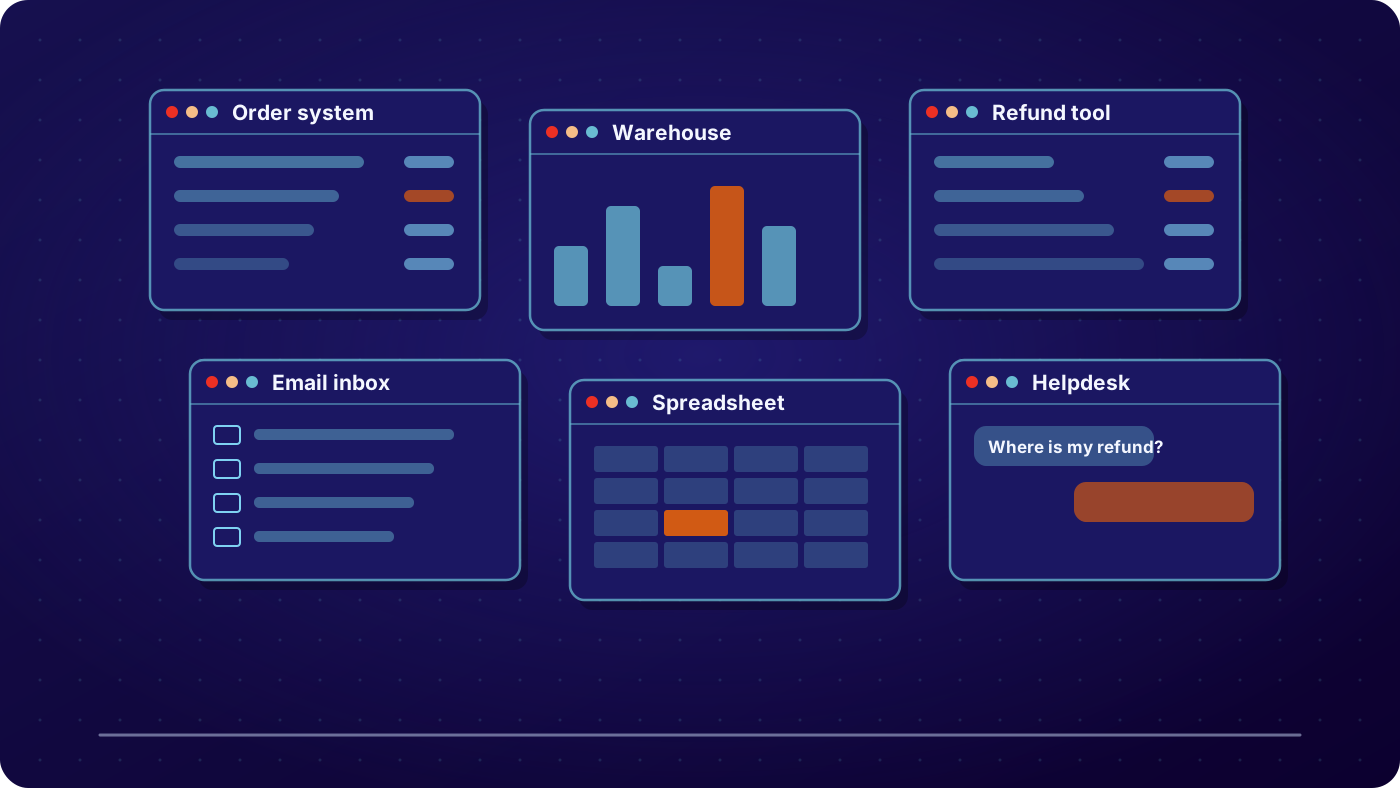
Picture one unhappy customer. A faulty item comes back, a warranty question follows, and a repair drags on. Six teams touch the case: service, warehouse, repair, finance, IT and the brand team. Each one has its own system. None of them sees the whole story, so the customer tells it again and again.
We call this the Franken-System. Every piece was bought for a good reason. Together they are stitched with spreadsheets, shared inboxes and someone’s memory. Receiving, inspection and grading belong on the same record as the claim that started them. That is what returns processing software should do inside one system, not beside it.
The cost is not only money. It is the email that says any update, the agent who cannot answer, and the loyal customer who quietly stops buying. Every seam in your process is a place where trust leaks out. One system closes those seams, and everyone behind the customer finally works from the same page.
What to ask before you choose returns management software
Ask the vendor one simple thing first. Can you show me a single item moving from customer request to final outcome, on one screen? If the answer is a slide about integrations, keep asking. You want to see the real record, with every step and every person on it.
Then ask about the odd cases. What happens to a warranty claim that turns into a repair, then a refund? Who approves it? Where is that decision written down? A good system has an answer for each question, and the answer is a rule, not a person who remembers.
Finally, ask how you will know it is working. You should see where items wait, what they cost and why they come back, using returns analytics software that reads the same record your team works in. If reports need a separate export, you are back to spreadsheets.
Where a split returns process quietly loses money
A refund goes out before the item is checked. The box arrives with a brick in it, or nothing at all. The system that issued the refund never hears what the dock found. The money is gone, and nobody owns the loss.
A warranty claim sits in an inbox. The customer waits and the product ages. When warranty claims software is cut off from the order and the return, someone has to look up coverage by hand, and the answer arrives late.
A repair waits on a part nobody ordered. The item sits on a shelf, taking space and losing value by the week. Without repair management software tied to the return, the depot cannot see what arrived, what is needed or what the customer was told.
A good item comes back and sits in a corner. By the time someone decides what to do with it, the season is over. When grading feeds recommerce software, a resellable item moves to its next sale, not to the back of the warehouse.
What changes when returns, warranty and repair share one record
When returns, warranty and repair share one record, the work feels different on every desk. Not because people try harder, but because they stop hunting for information that should already be in front of them.
- Customer service answers from the record, so a caller hears a clear status instead of a promise to check with the warehouse.
- The dock grades each item against the same rules every time, whoever is on shift and whichever site they work at.
- Finance sees what was refunded, credited or repaired, and why, without rebuilding the story from three separate exports.
- IT looks after one system and one set of connections to the ERP and ecommerce platform, not a growing pile of point fixes.
The change is quiet. Fewer escalations, fewer late-night spreadsheets, fewer customers who feel ignored. People get back to the work they were hired to do, and the customer notices the difference on the very next call.

A typical day with returns management software
This is a typical flow, not a single customer story. A customer opens the brand’s own returns page and says a blender has stopped working. The system finds the order and the warranty record, and asks for photos. Vision AI checks the images before anything is shipped, so nobody posts a box for nothing.
The claim follows the rules your team set. A label goes out. When the box lands, receiving scans it, an inspector grades it, and the same record shows the result to customer service. Nobody emails the warehouse to ask. The item is routed to repair, and the customer can see that step.
The repair depot finishes the job and the record closes the loop. The customer gets the blender back, or a refund or credit if repair is not the right answer. Finance sees the outcome. If the item cannot be fixed, the same record sends it on to resale, restock or recycle. One customer, one item, one history.
How one governed workflow keeps every decision on the record
ReverseLogix runs this as one governed workflow. Your team sets the rules once: who can return what, which items need photos, when a refund waits for inspection, and when a claim becomes a repair. The same rules can apply across regions and channels, so a decision does not change with the desk it lands on.
Approvals follow the rules, not the loudest email. A high-value item can ask for a manager. A warranty exception can go to the right team. Each step has an owner, so nothing sits with nobody, and nobody has to chase to find out who is holding it.
Every action lands on an audit trail: what was decided, by whom and when. When finance, compliance or a customer asks why, the answer is on the record, not in someone’s inbox. That is how returns management software earns trust beyond the returns team.

Who returns management software is right for, and who it is not
Returns management software is the right fit when returns touch many teams, many sites or many countries. If you handle warranty and repair as well as returns, or sell through dealers and wholesale as well as direct, one record matters most.
It suits brands that sell to other businesses too. Dealer and wholesale returns follow different rules from a consumer return, and B2B returns software inside the same platform means those rules live beside the rest, not in a side spreadsheet.

It is not the right fit for everyone. If you process a small number of returns and a storefront app already does the job, a full platform will be more than you need. We would rather tell you that now than after a demo.
Security and control for a system that touches every order
A system that touches every order, every customer and every refund has to be safe to run. ReverseLogix is built with that in mind, and independent audits back it up.
- ISO 27001 certified, so the way we manage information security is independently audited against a recognised international standard.
- SOC 2 certified, so an independent auditor has tested how we protect customer data.
- Role-based access, so each person sees and does only what their job needs, from the dock to finance.
- An audit trail on every action, so you can show who did what, and when.
Your security and procurement teams can ask for the detail. We would rather answer the hard questions early than have them surface at contract stage.

Connects to the ERP, ecommerce platform and carriers you already run
Returns management software only works if it talks to the systems around it. ReverseLogix integrates with SAP, Oracle, NetSuite, Dynamics 365 and Salesforce, and with ecommerce platforms such as Shopify. Orders and financial records stay in step, so your teams do not key the same thing twice.
Carriers matter as much. ReverseLogix works with more than 400 carriers across more than 100 countries, and it is global and multi-language, so a customer in Lyon and a customer in Ohio each get a return that makes sense to them. Your IT team connects once, and every market benefits.

Returns management software comparison
Six vendors show up on most returns shortlists. This returns management software comparison shows what each one publishes about the work that starts after the label is printed.
| Capability | ReverseLogix | Loop | Narvar | AfterShip | Inmar | Optoro | ClaimLane |
|---|---|---|---|---|---|---|---|
| Primary focus | End-to-end returns, warranty, repair and recommerce, B2B and B2C | Exchange-led consumer returns for direct-to-consumer brands | Consumer returns, order tracking and notifications | Consumer returns, warranty portal and order tracking | Pharmaceutical returns; retail returns business sold to DHL in 2025 | Retail returns and recommerce, part of the Blue Yonder suite | Warranty, returns and repair claims |
| Receiving, grading and disposition | Yes | Three grades; warehouse partners connect by API | Routing to sites; in-house grading not stated | Yes, four grades | Pharmaceutical processing only | Yes | Optional warehouse module |
| Warranty claims | Yes | Yes, warranty portal | Not documented | Yes, warranty portal | Not published | Secondary | Yes |
| Repair depot and parts | Yes | Not documented | Not documented | Not documented | Not published | Not a focus | Yes |
| B2B and dealer returns | Yes, bulk RMAs | Not documented | Not documented | Not documented | Pharmaceutical trade returns only | Primarily B2C | Yes |
| Recommerce and resale | Yes | Not documented | Not documented | Not offered | Moved to DHL | Yes | Not published |
| ERP integrations | SAP, Oracle, NetSuite, Dynamics 365 | NetSuite through a connector | SAP, Oracle, Dynamics 365 | NetSuite | Not published | Inside the Blue Yonder suite | SAP, NetSuite, Business Central |
Based on each vendor’s public website, as reviewed for our comparison pages in September 2026. “Not documented” and “Not published” mean we did not find it on the vendor’s site. Select a vendor name for the full comparison.
Questions buyers ask about returns management software
What is returns management software?+
Returns management software runs every return, warranty claim and repair on one record, from the customer’s first request to the final outcome. It covers the customer portal, labels, receiving, inspection, repair, refund or credit, and resale or recycling. One record replaces the spreadsheets and inboxes teams use to stitch those steps together.
How is returns management software different from a Shopify returns app?+
A storefront app handles the customer request well. Returns management software goes further: it covers warehouse receiving, inspection, warranty, repair, and the decision on what happens to each item, across many sites and systems. If your returns are simple and low in volume, an app may be enough. If six teams are involved, you need a system.
Does returns management software handle warranty claims and repairs too?+
Yes, when it is built that way. ReverseLogix covers returns, warranty registration and claims, and repair processing on the same platform, so a claim can become a repair or a refund without starting a new case. Some returns tools stop at the refund, so ask any vendor to show you this working.
How long does it take to implement returns management software?+
It depends on scope. Four to eight weeks is a fair estimate for returns initiation alone. Adding warehouse processing, warranty, repair and ERP connections takes longer, and the plan depends on your sites, systems and volume. A good vendor will give you a phased plan and dates in the first conversation.
Who in my company should help choose returns management software?+
Bring the whole group in early: operations, customer service, finance, IT and supply chain. Each sees a different part of the problem. Operations sees the dock, service hears the customers, finance sees the refunds, and IT inherits the connections. Choosing together stops the Franken-System growing back.
Further reading: National Retail Federation research on retail returns.
See your returns, warranty and repair on one record
Bring one messy return, one warranty claim and one repair. We will show you how they look on a single record, with your own team’s questions in mind. No pressure, just a clear picture of what one system changes.
One record.
One item, one history, every team looking at the same facts.
Book a demo. We keep it practical and short.


