

Shopify Returns Management Integration for brands that sell beyond the storefront
Order lookup, returns, exchanges and refunds tied to your Shopify stores, with wholesale, warranty and repair in the same record.
It is nine in the morning. A returned jacket was scanned in at the warehouse on Friday. The customer has written twice asking where the money is. An agent opens the order in Shopify, finds the refund still pending, and types it in by hand. Then she does it again for the next one. ReverseLogix connects to Shopify and Shopify Plus so that lookup, return, exchange and refund run from one returns record and post back to the store. It is not a Shopify-only app. The same record also carries wholesale returns, warranty claims and repairs, so the order in Shopify is one input, not the whole story.

Returns teams using ReverseLogix include:




What Breaks When Returns Live Outside Your Shopify Store?
Shopify holds the order. The return happens in a warehouse, a repair bench, a carrier network and an inbox. When those do not talk to the store, people fill the gap by hand.
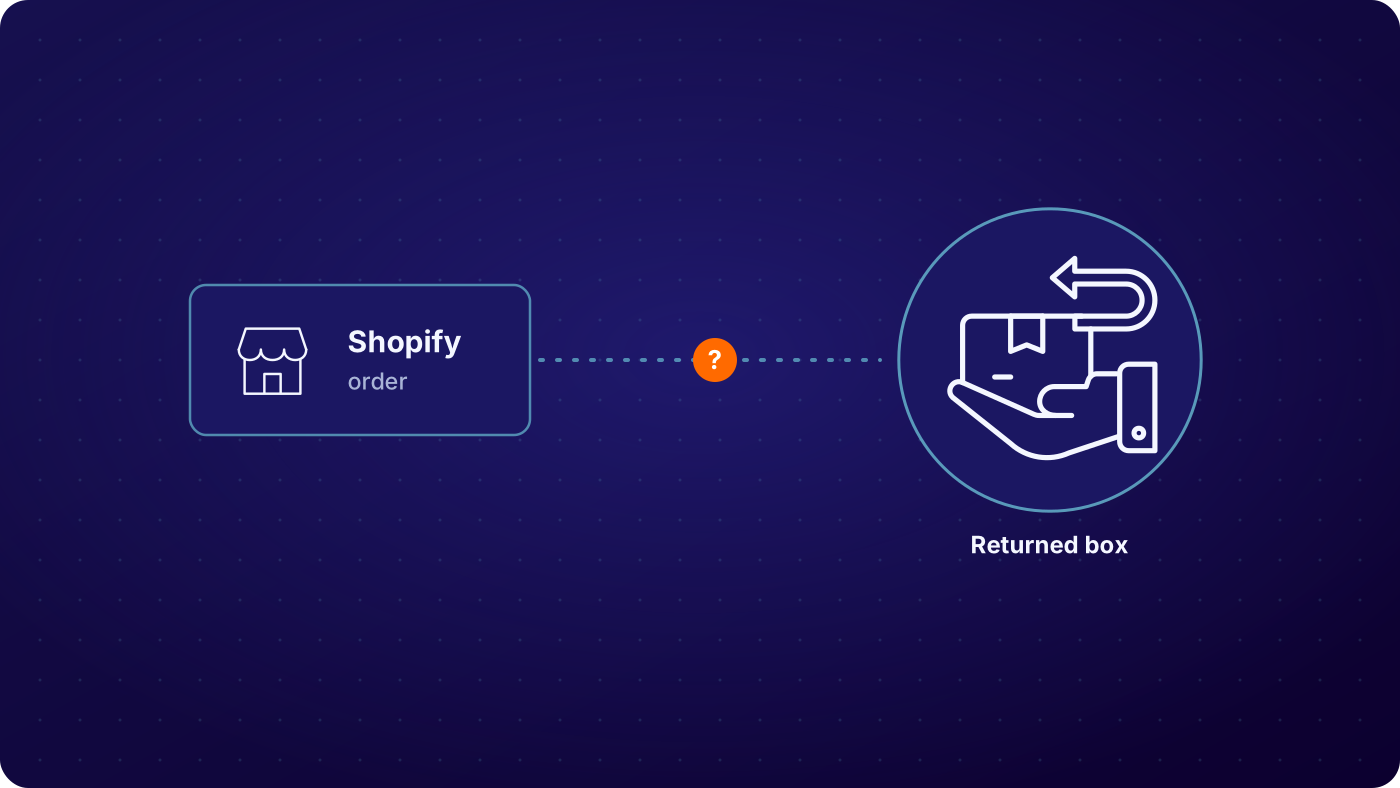

Refunds get finished by hand
The item is received, but the refund does not fire. Someone goes through the list every day and refunds each order inside Shopify. Customers write in to ask where their money is.

Agents cannot see the return from the order
The order sits in Shopify. The return sits somewhere else. The agent hunts across screens to learn whether a label went out, what the reason was and whether the box has arrived.

Exchanges, warranty and wholesale do not fit
A shopper wants a different size. A dealer sends back a pallet. A customer has a warranty claim on a unit that needs repair. A storefront returns flow was not built for these, so agents run them on the side.

Several stores mean several versions of the truth
Each region or brand has its own store, its own rules and its own report. Finance cannot compare them, and the same customer can be handled three ways.
How Does the Shopify Returns Management Integration Keep Orders, Returns and Refunds in Sync?

Order lookup reads from Shopify
The customer enters an order number and email in the returns portal, or an agent searches from the back office. ReverseLogix reads the order, line items, purchase date and store from Shopify and applies your return window and item rules before anything is offered.
See: returns initiation
Return or exchange is created
The customer picks items and a reason, and chooses a refund or an exchange. The system issues the label, creates the RMA and shows the same status to the customer and the agent. For an exchange, it can create the replacement order in Shopify or ship an advance exchange first.
Receipt and inspection set the trigger
The refund is tied to the moment of custody transfer, which your program defines. That can be a carrier scan or warehouse receipt, with inspection and grading first where the item needs it. The event and the grade are written to the return.
See: returns processing

Refund posts to Shopify
When the trigger fires, the refund is posted against the original order in Shopify for the amount your rules allow. No one re-keys it. If Shopify rejects the post, the failure shows in the message log and is retried, so it does not sit unseen.
See: analytics
| Condition at inspection | Typical route | Recorded on the return |
|---|---|---|
| Customer looks up an order | Order, line items and eligibility read from Shopify | Store, order number, line items, purchase date, eligibility result |
| Return approved | RMA created, label issued, status shown to customer and agent | RMA, reason, label, carrier, timestamp |
| Exchange requested | Replacement order created in Shopify, or advance exchange shipped | Original order, replacement SKU, price difference, timestamp |
| Custody transfer reached | Refund posted to the original Shopify order | Refund amount, line items, order reference, trigger event, timestamp |
| Warranty, repair or wholesale return | Handled in ReverseLogix with the Shopify order as reference | Entitlement, fault, repair or disposition, credit, serial, timestamp |
Example configuration. Programs set their own triggers, fields and rules; the field mapping is agreed during the project.
Who Touches the Shopify Connection, and What Does Each Team See?
Five teams touch this connection. Customer service looks up the order, sees the return and overrides a rule when a good customer needs one. Ecommerce owns the store and the portal branding. Warehouse teams receive and grade. Finance checks that refunds match what came back. IT owns credentials, mapping and release timing. Each role sees its own view of one record, with permissions set by role, so a new agent in peak season cannot do what a supervisor can.
One record, every team
- Customer service: order lookup, return status, label and reason on one screen
- Ecommerce: branded customer portal and store rules
- Warehouse: receipt, inspection and grade tied to the RMA
- Finance: refunds and credits matched to what was received
- IT: credentials, field mapping, sandbox and release control
How Do You Know Every Refund Posted to Shopify?
Every message between ReverseLogix and Shopify is logged, and failures are visible instead of silent. Your team can see what was sent, what came back, what was retried and what still needs a person. That matters because a refund that fails quietly looks like a customer complaint three days later. The log also lets finance reconcile refunds in Shopify against returns received.
- Order lookups that returned no match
- Refund posts that Shopify rejected, with the reason
- Retries, with attempt count and last attempt time
- Refund amounts in ReverseLogix that differ from the amount in Shopify
- Returns received with no refund posted yet
Shopify Stays the System of Record for Orders and Payments

ReverseLogix does not replace your store. Shopify keeps the orders, customers and payments. ReverseLogix keeps the return, the repair and the warranty claim, and posts the outcome back. Because it also connects to SAP, Oracle, NetSuite, Dynamics 365, Salesforce, your WMS and your helpdesk, a wholesale return or a warranty repair does not stop at the storefront. Shopify stores connect alongside Magento, BigCommerce and WooCommerce if you run more than one platform.
What Does the Shopify Returns Management Integration Project Take?
The project takes access, mapping, testing and a plan. Your store admin approves the connection and its permissions. Your team and ours agree which order, refund and inventory fields map to which return fields, for each store. We build and test against a sandbox or development store first, then run user acceptance testing with your service and finance teams before anything touches live orders. Credentials stay with your team, and access is limited to what the connection needs.
Release management is part of the plan, not an afterthought. Go-live dates are set around your peak season and any store change freeze. The standard go-live for initiation is 4 to 6 weeks, and repair and technician flows extend it. Certifications are shared during evaluation.
See: implementation, security
Your next questions, answered




Shopify returns management integration: questions and answers
A Shopify returns management integration connects your store to a returns system so that order lookup, returns, exchanges and refunds run without re-keying. ReverseLogix reads the order from Shopify, runs the return and inspection, and posts the refund or replacement back to the store. Shopify stays the system of record for orders and payments.
No. ReverseLogix is not a Shopify-only app. It connects to Shopify, but it also runs wholesale returns, warranty claims, repairs and exchanges, and it posts to your ERP, WMS and helpdesk. That matters for brands whose returns do not all start in the storefront and do not all end as a refund.
Yes. ReverseLogix integrates with Shopify, including Shopify Plus, and can connect more than one store to the same returns record. Each store keeps its own rules, branding and mapping where you need them, while reporting stays in one place. Store count and setup are scoped with you during the project.
The refund posts to the original Shopify order when your chosen trigger fires. Refund trigger at custody transfer is standard, such as a carrier scan or warehouse receipt. Where you want inspection first, the refund waits for the grade. Failed posts show in the message log and are retried, so nobody refunds by hand.
Yes. The customer picks an exchange in the returns portal, and ReverseLogix creates the replacement order in Shopify or ships an advance exchange before the original comes back. Price differences and out-of-stock swaps follow rules you set. The original order, the replacement and the return stay linked on one record.
Standard go-live for initiation is 4 to 6 weeks, and repair and technician flows extend it. We need store admin approval for the connection, agreed field mapping, a sandbox or development store, time for user acceptance testing, and a go-live plan around your peak season. Your team owns credentials.
Yes. We build against a sandbox or development store first, then run user acceptance testing with your service and finance teams. You see order lookups, returns and refund posts working end to end before go-live. Test results and open defects are reviewed together, and the go-live plan is agreed after that.
Yes. A wholesale return, a warranty claim and a repair share the same record as a consumer return, with the Shopify order as a reference where one exists. Each follows its own rules, and credits or refunds post where you configure them. Agents see the whole history without switching systems.
The failure is logged with its reason, the post is retried, and anything still failing is flagged for a person. Your team sees returns that were received with no refund posted, so nothing waits for a customer to complain. Finance can reconcile refunds in Shopify against returns received.
Further reading: Shopify Plus.
See a Shopify Return Go From Portal to Posted Refund
A specialist walks through your stores, your refund trigger and your exchange rules, and shows what would sync and when, before any demonstration.


