How Do You Know You've Outgrown Manual Returns?

You have outgrown manual returns when a single return touches three or more systems, refunds wait in a warehouse queue, and nobody can say what returns cost by product line. At that point the work needs returns management software that runs the portal, the eligibility rules, inspection and the refund in one system.
Key points:
- Manual returns processing at enterprise volume burns margin and drives customers away.
- Returns management software automates the full post-purchase process: self-service portals, automated eligibility rules, exchange-first flows, fraud detection, and returns reporting across all channels.
- Look for a platform that connects with your ecommerce platforms and order management systems without adding manual work.
- ReverseLogix runs all of this in one system built for enterprise returns and reverse logistics.
Ask the average enterprise-level organization about its returns function, and they will tell you it works. But ask them to run the numbers, and that answer changes quickly. In 2024, US shoppers returned about $890 billion of merchandise. That is not a rounding error. As Katherine Cullen, VP of Industry and Consumer Insights at NRF, put it in NRF’s 2025 returns report, “Returns are no longer the end point of a transaction.” Software that automates the whole returns workflow gives operations and finance control of the customer post-purchase experience.
In this article, we’ll walk through why manual return workflows break down at enterprise scale, the features that separate an enterprise returns platform from a ticket queue, and how to judge a vendor by what it does to your margin.
Why Manual Return Workflows Break Down at Enterprise Scale
Processing a single return can take out a huge chunk of, or wipe out, the entire profit margin on that sale. Multiply that across tens of thousands of returns every month, and then factor in the support hours, warehouse labor, shipping fees, and rising shipping costs no one budgeted for, and manual return workflows become one of the most expensive operational blind spots in the business.
The sequence typically goes like this: a customer starts by emailing support, and what should be a simple request turns into long email threads. An agent verifies an order in one system, verifies eligibility in another, and then manually creates a shipping label. The item ships back, sits in a queue at the warehouse, and doesn’t get to inspection for days because the returns team has hundreds of other packages ahead of it. The thing is, the customer notices that delay, and in most cases, they’ve already decided whether they’ll shop there again by the time the refund posts, which drags down customer satisfaction. And we live in a world where 80% of consumers say they’d share a bad returns experience with friends and family.
Key Features That Define an Enterprise Returns Management System
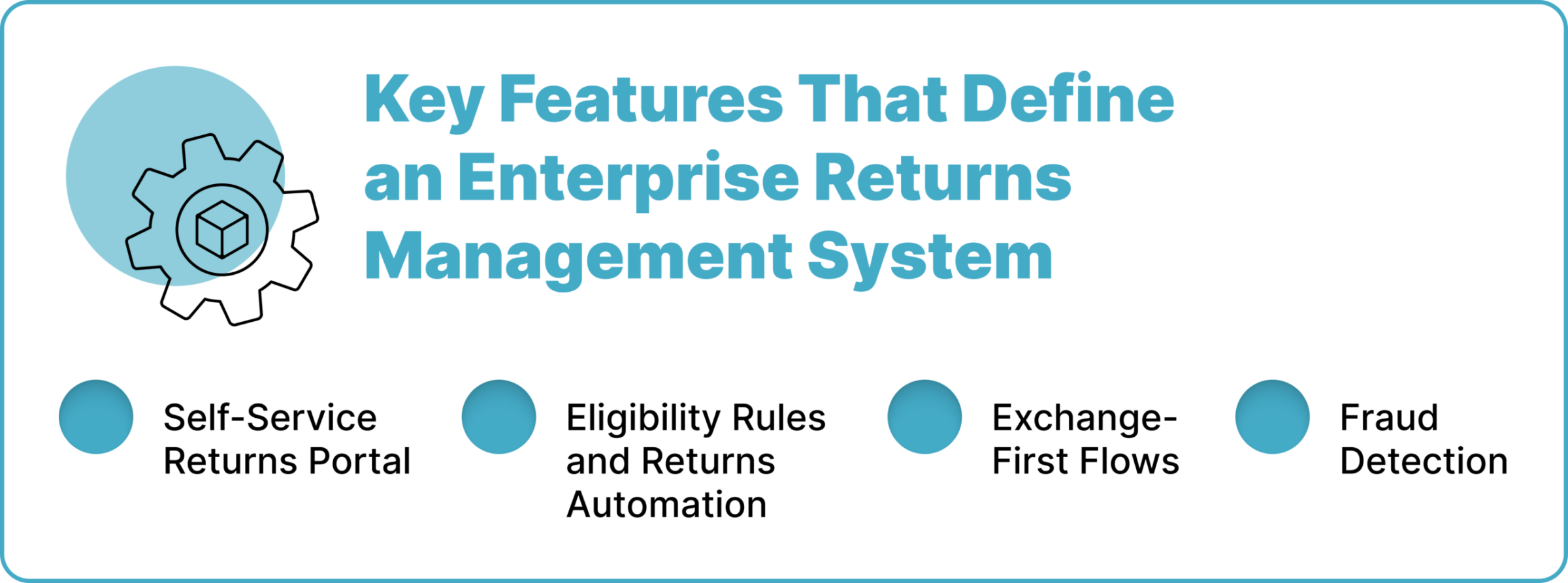
The capabilities that separate real enterprise platforms from basic return tools are:
Self-Service Returns Portal
This is probably the biggest one. With a branded returns portal, customers can handle everything themselves for a better customer experience, including entering an order number, selecting a reason, getting a shipping label or QR code, and receiving automated status updates after label generation. That means your customer support team is not spending all day responding to emails and cell phones from frustrated or angry customers, and automated status updates reduce “Where’s my order?” support tickets. They only step in when a return falls outside normal eligibility rules, which is where automated policy enforcement comes in.
Eligibility Rules and Returns Automation
Returns management software automates return policy enforcement with flexible rules across time windows, product categories, warranty coverage, and purchase channel to match different business needs. The system runs everything through eligibility rules it checks itself. Not all returns should follow the same logic, especially across channels or product types. At enterprise volume, automating that step takes most routine approvals off the returns team’s desk.
Exchange-First Flows
This changes the economics because the system offers an exchange or store credit when the customer starts the return, rather than defaulting to a full refund. Instead of a $200 refund on the jacket, the system nudges the customer to consider a size swap or a credit for another item. In practice, exchange incentives can retain a part of returns as exchanges. This way, these workflows help retain revenue and improve customer loyalty.
Fraud Detection
NRF found fraud accounted for 9% of all returns in 2025. That is about $76 billion in fraud exposure across U.S. retail with projected total returns of $849.9 billion. When considering any returns management system, make sure it includes pattern detection for serial returners, wardrobing, and customers returning counterfeit substitutes for the original product.
How Data-Driven Insights from Returns Data Protect Margin
Returns data provides feedback from the returns operations. Companies that leverage this effectively can identify their top-returning products, the most cited reasons for those returns, and the total return costs by product line. This way, they can take the necessary action to reduce returns.
For example, a home appliance company might find that one product has a return rate of 22%, while other products in its catalog have return rates around 9%. After pulling return reasons from the returned product, the company finds that the packaging included “unclear” instructions. To reduce future returns, the company needs to ensure the instructions are clear before shipping to customers.
Reporting on return reasons by SKU, refund-to-exchange ratios, and cost per return gives finance and operations team leads measurable data to make decisions based on facts rather than guesswork. Without this type of reporting, returns remain a cost line that can’t be measured accurately enough to reduce.
Evaluating an Operations Platform: What to Ask About
Your returns management software’s ability to integrate with e-commerce and order management systems matters more than any single feature. Without integration with solutions like Salesforce Commerce Cloud, SAP Commerce, Oracle, or Microsoft Dynamics, returns management software can’t make disposition decisions or maintain accurate inventory counts in real time because data points remain disconnected.
Returns occur across many types of enterprise commerce. Each may be fulfilled through different transaction models (DTC, Wholesale, B2B, Marketplace), and each type of transaction feeds into the same operational processes. Therefore, operational processes should include rules and reports that work across every possible transactional model without requiring an additional process for each.
When evaluating vendors, consider two key questions. Will the vendor post prices to a pricing web page when you request a quote, or will it require a complete sales cycle to receive pricing? What does the vendor’s support structure look like? Is there a dedicated support team, or will you enter a ticket and go to a waiting list?
ReverseLogix: Managing Post-Purchase Operations in One Platform
ReverseLogix is built for retailers, brands and manufacturers with complex reverse logistics requirements. The platform offers a single system that ties together return processing, warranty management, and product repair; all these processes (initiation, inspection, grading, disposition) occur in the same system and don’t require jumping between tools.
ReverseLogix, named a 2026 Top 100 Logistics IT Provider by Inbound Logistics, integrates with many enterprise systems, including SAP, Oracle, Microsoft Dynamics, NetSuite, and Salesforce, as well as more than 400 shipping carriers, helping keep post-purchase operations and customer communication connected in one platform. Once ReverseLogix connects to an enterprise system, return data flows back into that system automatically, eliminating manual entry. ReverseLogix supports both B2B and B2C returns and can track serialized products and help companies manage cross-border returns, which is important for companies with a global supply chain. Get a demo today to see how ReverseLogix can fit into your unique return process workflows.
Frequently Asked Questions
How does a self-service returns portal reduce the need for contacting support?
A self-service returns portal lets the customer handle the full initiation step on their own. They enter order details, select a return reason, and the system generates a shipping label or QR code without anyone on your team needing to touch it, which cuts down on emailing support and repetitive email threads. Support only gets involved for exceptions. For enterprise retailers running thousands of returns per month, that pulls the highest-volume, lowest-complexity requests away from agents and into an automated returns process. That also creates happier customers because they are not left waiting for basic return-status answers.
Can returns management software detect fraudulent returns?
Most enterprise returns management systems include fraud prevention tools that catch suspicious behavior. These include serial returners, wardrobing, and mismatched-item returns. The system applies eligibility rules and routes flagged cases to manual review while auto-approving legitimate ones. Nine percent of all returns are fraudulent, according to the NRF, which makes detection a question worth raising with any vendor you’re evaluating.
Does returns management software connect with shipping carriers and ecommerce platforms?
Enterprise returns management software connects with shipping carriers to automate return label generation, shipment tracking, routing across multiple sales channels, and in some cases order editing within the broader post-purchase stack. ReverseLogix connects with over 400 global shipping carriers alongside ERP, WMS, OMS, and CRM systems, putting returns into the same operational flow as forward fulfillment.
Get a Demo
Discover how you can jump-start your returns management efforts with ReverseLogix.