How Do I Set Up a Reverse Logistics Process From Scratch?
Article Brief:
- Design the reverse logistics process before selecting the tools.
- Develop intake and authorization, receiving, inspection and grading, disposition, refunds, and reporting, and then draft return policy rules by channel and customer type.
- Receiving through disposition is where you win or lose returned value. Give those steps the most depth.
- If the process involves multiple sites, regions, or partners, they all need to work from a single record. The technology should match the process you created, not the other way around.
It is not uncommon to see a $200 million manufacturer using the same reverse logistics process as a five-person online company. That’s because most companies building their returns management process use the same strategy: build backward. Some just do it bigger than others. The reverse logistics process that scales at enterprise volume starts on paper, with decisions on who can send back what, how, in what situations, and what happens to each returned unit when it arrives at a receiving dock. Only when you have those answers does it make sense to bring in the technology.
This guide presents the full reverse logistics process as an eight-step build sequence for manufacturers, retailers, and brands setting up returns management from scratch, so they design the process before purchasing a single tool.
Policy and Eligibility Rules by Channel and Customer Type
Return policies set every step in the reverse logistics process. A good returns policy is clear and lays out what customers can return, how long they have to return it, the condition it must be in, and whether the refund is cash, store credit, or an exchange. That’s why you write the return policy first. It also tells the operations team what to expect at the dock.
Rules should vary by channel and by who is making those returns. A D2C shopper returning online purchases requires a different return window and shipping arrangement than a B2B distributor returning excess inventory under a contract allowance. Brick-and-mortar stores that accept in-store returns can make exchanges on the spot, eliminating reverse shipment and shipping costs. Return policies should include acceptance rules, time frames, and condition requirements. This way, the receiving team doesn’t have to guess because they have clear rules for what they will accept, and the customer gets a straight answer before anything ships.
Intake and Authorization: Return Requests, RMAs and Warranty Claims
Customers initiate the returns process, but intake decides whether a unit should be returned. A returns management portal provides customers with a self-service option to initiate returns, verify eligibility against the policy, and get a return authorization before creating a shipping label. Self-service returns flows decrease the number of requests that require human intervention.
The system automatically generates an authorization and label if the return request qualifies; otherwise, it routes the request to a team member with the reason attached. Automating returns processing at intake eliminates errors and prevents end customers from waiting days for manual review of return requests that would have been approved anyway.
For B2B accounts, the request is typically an RMA tied to account-level terms and a check against the contract’s return allowance. Warranty claims add another dimension, prompting the system to verify entitlement before the claim can proceed. That means the system needs access to purchase dates, warranty periods, and serial numbers.
Customer Communication From the First Request
When a customer decides to return an item, they want to stay in the loop after submitting their request. That is why, as soon as you receive a return request, you should start with confirmation, a timeline, and clear instructions on what to do with the item, since effective communication during returns helps keep customers happy and reduces customer dissatisfaction. Receipt, inspection, and refund updates keep buyers informed and prevent support calls. Automated tracking gives customers real-time updates on return status.
This also applies to B2B accounts and distributors. A delayed credit or missing status update can strain a relationship worth millions in annual revenue. The fix is cheap and entails automating updates at every stage. Meeting customer expectations on communication is one of the cheapest ways to build customer loyalty, and optimized reverse logistics improves customer satisfaction while bringing repeat customers back.
Receiving: Where Processing Returns Begins on the Floor
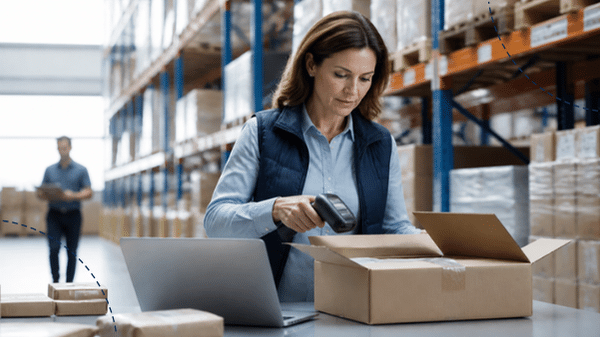
The first physical touchpoint in reverse supply chain management is receiving, and it sets the pace for everything that follows. Every unit needs a scan that links it back to the original return request, a check against what was authorized, and a record of its condition on arrival to preserve inventory accuracy and keep control over returned products. A reverse logistics process handles returned, damaged, and end-of-life products, all of which arrive at the receiving dock unannounced and in mixed condition, with paperwork that may or may not match. If receiving is slow or inconsistent, units sit on the dock without a status, and the rest of the logistics process stalls.
Good receiving means a unit gets a status within hours instead of waiting days. The dock team notes quantity, condition, and any damage, then updates the return record so customer service can answer questions without chasing the warehouse. Gaps are painful, and discrepancies between what the customer sent and what the warehouse recorded lead to disputes that consume labor on all sides.
Inspection and Grading
The inspection process should determine the value of a returned unit. It is where the returned value is won or lost, so getting this wrong either way is equally costly. An inspector inspects the product, tests it if the product category requires it, and grades it to inform the disposition decision. A failing grade puts a fixable unit in the scrap heap, and a soft grade puts a bad item back on the shelf to be returned again, doubling the cost.
Product lines should develop grading criteria, and inspectors at all sites should use the same test framework so one site doesn’t rate a cosmetically scratched appliance as refurbishable while another throws it away. By their own rules, neither is wrong, but different rules leak out recovered value every single day. Consistent grading is a form of quality control for the entire reverse supply chain and is one of the first things to audit when recovery numbers look off.
Disposition: Restock, Refurbish, Repair, Return to Vendor, Resell or Scrap
Disposition rules dictate how each returned product is categorized and processed after inspection. It is the core function that determines whether a returns management process recovers value or destroys it. Reverse logistics can support the product life cycle through sustainable practices like recycling, refurbishing, and reselling, and the disposition decision assigns each unit to its path.
Here are the most common options:
- Restock as new if untouched
- If it is cosmetically damaged but functional, refurbish it and resell it through an outlet or resale channel.
- If the fault is fixable, send it to the repair department. And if it is under warranty from a supplier, send it back to the vendor and let them eat the cost.
- Scrap the unit if it can’t be recovered through any disposition path for more than it would cost to bring it back, with clear disposal guidelines for environmentally responsible handling that help reduce waste.
Each path has a processing cost and a recovery value, meaning the financial value retained from returned goods, and the math should be specific enough that a warehouse worker can follow the rule without calling a manager. Clear rules produce consistent results at every site, whereas vague rules inevitably lead to calls, delays, and lower recovery. Since reverse logistics can recoup value from returned products along every disposition path except for scrap, getting this step right matters more than almost anything else in the supply chain.
Inventory Management for Returned Stock
Add returned units to the inventory record after disposition; when returns inventory management is separate from the forward supply chain, rather than aligned with forward logistics, the business loses sight of what it has in stock. That disconnect also obscures excess inventory that could be liquidated or redirected to a region that needs it, and better control of returned inventory helps minimize storage and distribution costs. Refurbished items have a separate SKU or condition code, while repair items flow through a queue tied to the repair department’s capacity.
Refunds and Credits
Process refunds based on inspection outcome and return policy. That could mean deciding whether to give the customer a full refund, partial credit, store credit, or exchange using the returns policy as a guide. Speed matters because the longer a credit takes, the louder the complaint, while effective returns management can improve customer retention and operational efficiency. A slow credit can hold up a distributor’s payable cycle for B2B accounts. Post each credit to the ERP from the return record, along with the reason and product data, so finance doesn’t have to reconstruct the story using spreadsheets at month-end. Fast credits with a traceable reason help reduce costs and improve cash flow in returns management.
Reporting and Continuous Improvement
Monitoring key metrics is critical for improving reverse logistics performance. This is usually where a returns management process starts to pay for itself. Without the data, you are guessing. Tracking can identify return reasons for product improvement and feed engineering, merchandising, and supply chain planning, with key performance indicators supporting that effort. Ideally, your reverse logistics should integrate customer service, warehouse operations, and product development so returns data can reach the teams that can act on it and create a feedback loop that improves product quality. Regular reviews of return reasons help identify and mitigate root causes. Recovery rate measures the percentage of financial value held back from returned goods. Tracking this by product line, site, and reason for return shows where the process loses money and where costs can be cut.
Gather Feedback From Return Reasons
Group return reasons by SKU, channel, and time period, and review them regularly to identify and mitigate root causes. If you see a spike in ‘not as described’ on a new product, poor product descriptions are often the driver, so it’s probably time to update the product descriptions or sizing guides. If the returns team clusters “arrived damaged” returns in one carrier lane, it points to a packaging or handling issue. If you see a rise in “delivery failure” returns in a certain lane, investigate the carrier before it spreads to other lanes. “No longer needed” returns on items with long shipping times may mean that customers found the item elsewhere faster. Since around 20–30% of online purchases are returned, this work also helps minimize returns. Every pattern you can identify is a cue to reduce returns at the source and transform the post-purchase journey into a feedback loop where return data improves the product quality as well as the process at the same time.
What Changes Across Several Sites, Regions and Partners
A single-site returns process scales by adding volume. When you try to scale a multi-site process by adding rules, it gets complicated. So a company with warehouses in 3 countries would need routing logic for forward and reverse logistics. Each return goes to the nearest site that can handle it, not to a centralized return center on the wrong continent. Especially when you consider the fact that cross-border returns can get complicated because of customs paperwork and country-level policy differences. If your logistics providers and repair partners work outside the returns record, they create handoff points where data can go dark. Each new site, region, or partner adds complexity to managing reverse-flow supply chains. The solution is to ensure every party works from one system and one set of rules, so outbound logistics and the reverse logistics strategy use the same data.
Choose the Tooling Last
Policy, intake, receipt, inspection, disposition, refunds, and reporting all help you learn what the tooling has to do. Reverse logistics software should not be forced to fit the process. The right returns processing software ties the return inquiry to the inspection result, the refund, and the report, keeping one record through all the stages.
Returns management software like ReverseLogix sits between every person and partner who touches a return. But if you pick the tooling first, the process defaults to the vendor’s defaults, and the business spends the first year working around limitations that wouldn’t exist if you started with requirements. A good product returns management process is designed on paper, tested with a small batch of returns, and supported by the technology that supports what you’ve already proven works.
Common Returns Management Challenges When Building From Zero
Starting from nothing usually means solving problems that established operations have buried under workarounds. As you can imagine, that comes with challenges. These include writing grading criteria before volume arrives, connecting the returns record to the ERP before month-end close, and training dock and inspection teams on a process that didn’t exist last week. The fix is the same for most of them, though, just write the rules, test them on a small batch, revise, then open the full flow. Check out our post on which KPIs show your reverse logistics is working, and for more on how to ensure you have the right reverse supply chain process in place. Connect with a returns specialist today to build the perfect reverse logistics process for your business.
Frequently Asked Questions
How long does it take to set up a reverse logistics process from scratch?
For returns initiation alone, a typical go-live runs four to six weeks with a platform like ReverseLogix. The full process, including inspection, disposition, and reporting, takes longer because it depends on warehouse readiness, product-line grading criteria, and ERP integration. Companies that design the process before selecting the tooling tend to move faster through technology setup, because the requirements are already defined and the team isn’t retrofitting decisions after go-live.
What is the most common mistake companies make when building a returns process?
Picking the technology before designing the process. When the tool comes first, the business inherits its default rules for return policy, grading, and disposition. Changing those defaults after go-live costs more than writing them down upfront. The second mistake is using one set of rules for every channel and customer type, which treats B2B accounts and repeat customers the same as one-time online buyers, and that mismatch shows up in slow credits and lost accounts.
Can a reverse logistics process work without dedicated software?
It can at small volumes. Spreadsheets and email cover a few dozen returns a month. Once the business processes returns across channels, B2B accounts, and several sites, the gaps between manual tools start costing more in lost credits, misgraded units, and delayed refunds than the software would. Reverse logistics moves goods from consumers back to sellers, and every handoff in that chain needs data. A returns management platform connects the steps and turns a collection of workarounds into a smooth returns process that produces consistent results.
Get a Demo
Discover how you can jump-start your returns management efforts with ReverseLogix.