

Returns Implementation Due Diligence: The Questions to Answer Before Kick-Off

Article brief:
- A returns management software implementation checklist covers six areas before kick-off: systems, flows, rules, grading, the calendar, and testing.
- List every existing system the returns platform will connect to, including the order management system, enterprise resource planning, warehouse management system, carriers, and support team tools, with one owner for each.
- Agree which flows go live first and how to manage returns across sales channels, including in-store returns and brick-and-mortar stores.
- Write down the return window, eligibility, return merchandise authorization approvals, routing rules, and drop-off options.
- Set a grading scale and make returned inventory available only after grading. Settle warranty claims rules with finance.
- Book go-live outside peak periods, name UAT testers, and write a rollback plan.
- Track the return rate, refund time, exchange rate, support tickets, and manual handling hours.
You won’t see many returns software projects run into problems during the build phase. The slip usually happens around week three, when someone finally asks who owns the warehouse feed and nobody has an answer. A returns management software implementation checklist fixes that by answering the hard questions before kick-off, while changes are still cheap.
At ReverseLogix, returns initiation goes live in about eight weeks and Pulse order tracking in four weeks or less. Those dates hold. But only when the buying committee walks in with systems, flows, rules, grading, the calendar, and testing all settled. This guide gives your committee the questions for each one, who should answer them, and what tends to go wrong when they skip them. In short:
Your Returns Management Software Implementation Checklist at a Glance
Six areas cover nearly everything. Here’s the short version your committee can work through in one meeting.
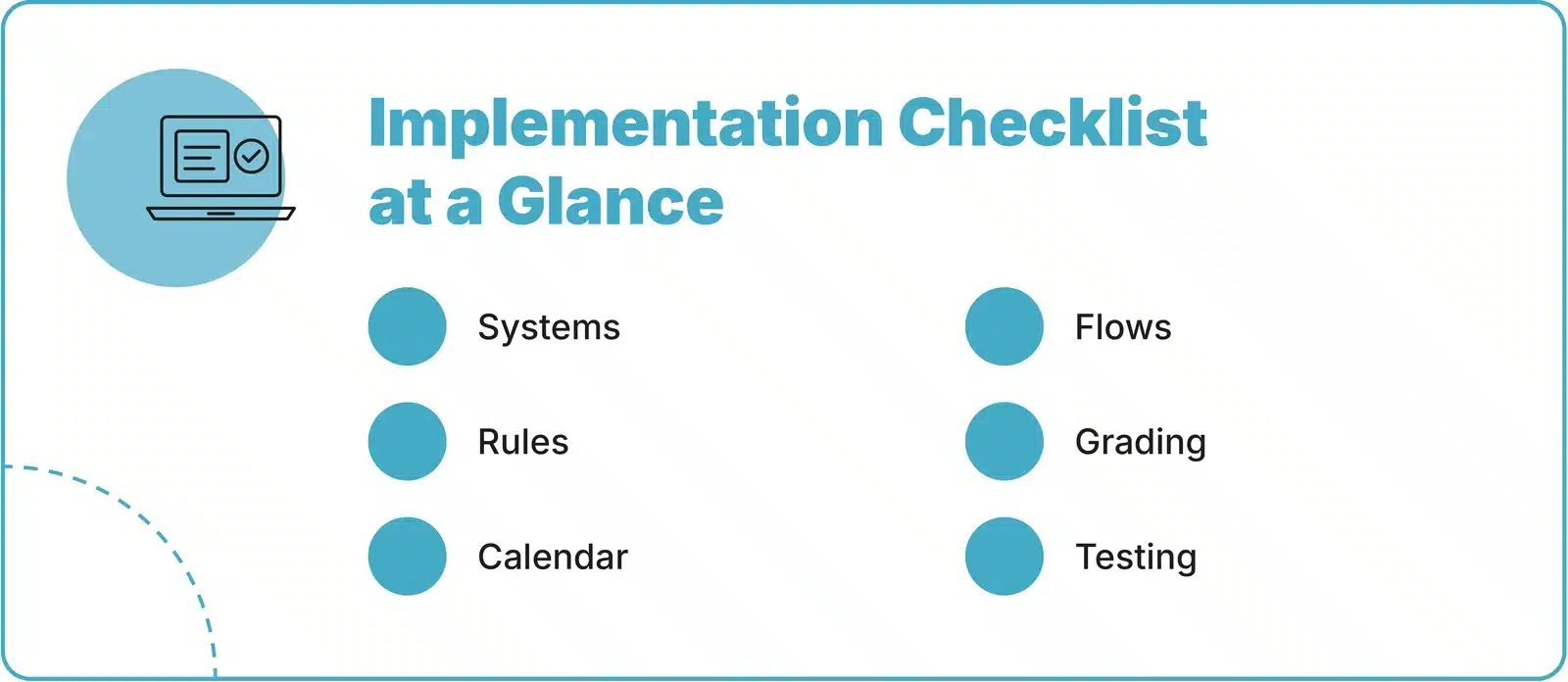
| Area | The question to settle | Who usually answers | Phase it feeds |
|---|---|---|---|
| Systems | Which systems connect, and who owns each one? | IT lead and system owners | Design, Integration |
| Flows | Which returns flows and sales channels go live first? | Returns or operations lead | Design |
| Rules | What are the return window, eligibility and routing rules? | Returns lead, legal, finance | Configuration |
| Grading | How are incoming returns graded, and when is stock available again? | Warehouse manager | Configuration |
| Calendar | When are the code freeze and peak periods? | IT and operations | Go-Live |
| Testing | Who runs UAT, and what’s the rollback plan? | Customer service, finance, warehouse | Testing, Go-Live |
You can print the table, bring it to the first committee meeting, and refuse to approve kick-off until every row has a name in the third column.
Which Systems, From The Order Management System to The ERP, Will The Returns Management System Connect To?
Start with the integration list, because it drives the timeline more than anything else. Returns management software connects customer requests in the portal to warehouse operations, finance, and support, which means a single return can pass through four or five of your existing systems, and through several sets of hands, before the end customer sees a refund. Each connection carries its own data and runs its own test cycle.
So the first questions are about the stack:
- Which order management system holds the original order, and does it handle exchanges?
- Which enterprise resource planning (ERP) system posts credits and keeps the financial records, and does finance want credits posted per return or batched at the end of each day?
- Which warehouse management system receives returns, and at how many distribution centers? Do any other warehouse systems or 3PL partners in your supply chain also take returns?
- Which carriers handle return shipping, including any international returns?
- Which support tools need status?
- Does field service or a warranty tool need to see the record?
For each system, write down one owner who can answer field questions within a day. Then check two things that often get missed. First, does the test environment match production, with the same fields, the same security settings, and the same message types you’ll use live? Second, is the relevant data clean?
Duplicate customer records, retired SKUs, and outdated addresses are easier to fix before migration than in the middle of testing. Returns initiation usually connects two or three of these: a carrier, the ERP and/or OMS, and sometimes the WMS. Processing can touch all of them.
Which Flows Are In Scope, And How Will You Manage Returns Across Sales Channels?
Decide what goes live first, and write it down. A committee that can’t agree on scope will keep adding to it during the build, and that’s the most common reason a date moves.
Most enterprise programs start with return initiation, sometimes alongside processing. The first returns module usually covers how return requests come in, how the portal and carriers generate labels, and whether instant refunds are offered for low-risk items. Warranty claims and repair usually come later, because entitlement rules and technician workflows take longer to set up. The ReverseLogix implementation plan treats this as the first decision, before mapping any field.
Then map your sales channels. A multi-brand retailer might sell through its own online store, a wholesale portal, marketplaces, and brick-and-mortar stores. Each channel may need its own route back. Ask whether in-store returns of online orders are in scope on day one. Ask whether each brand needs its own branded returns page, or whether one self-service returns portal will serve all of them.
The self-service portal is the piece of the post-purchase platform your customers actually see, so the customer experience there shapes how they judge the entire process. It also determines what happens when the customer chooses a refund, an exchange, or store credit. Many teams set exchange or store credit as the first option shown, since it keeps revenue in the business, but that’s a policy call for your leadership, not the software vendor.
Policy Rules, Routing Rules, Drop Off Options and The Return Logic to Write Down
Your return policy has to become rules a system can follow. But that sounds simple until someone asks what happens to a final-sale item bought with a gift card, shipped to Canada, and returned to a store in Ohio. So before kick-off, write down:
- The return window by product category, plus any exceptions for holidays or VIP accounts.
- Eligibility rules, including which items can’t be returned and which need photos or a reason code before approval.
- Who approves return merchandise authorization, and which requests can be approved automatically.
- Routing rules that send each return to the right distribution center, store, repair partner, or liquidator, including what happens when the nearest site is full or a product is under recall.
- Drop-off options, such as carrier locations or a drop-off point at your own stores.
- How label generation works for each carrier and country, including who pays for the shipping label on online purchases sent back from abroad.
Policy rules that differ by brand, region, or product are normal at enterprise scale. Trouble comes from rules that live only in someone’s head. If your current return logic is three people and a shared spreadsheet, budget a full working session to get it onto paper before kick-off.
Grade Scales, Warranty Claims and Inventory Availability
Grading determines what each returned item is worth, so settle the scale before the warehouse starts testing it. This is where the reverse logistics process meets your warehouse processes, and where most teams find out how differently each site has been grading. Provide a written grade scale, for example, A for resellable as new, B for open box, C for refurbish, and D for recycle. Tie each grade to a destination.
Next, settle inventory availability. When does returned inventory become available to sell again? The safe answer is after grading because if items post to stock the moment they’re scanned in, some fraudulent returns get resold to the next customer.
Warranty claims need their own rules. Who checks whether a product is still covered? What proof of purchase counts? How are uneven exchanges handled, especially where the replacement is worth more or less than the original? These questions touch finance systems as much as the warehouse, so finance should sign off on them before configuration starts. Getting them wrong often shows up later during reconciliation.
Peak Periods, UAT Owners And A Rollback Plan
The calendar won’t negotiate. Ask IT for the code freeze dates and ask operations for peak periods before you set any go-live date.
Say your freeze starts November 1. A December go-live leaves little room for slippage, and one failed mapping in the last week of testing pushes the launch past the holidays and into the new year. ReverseLogix ensures the go-live window doesn’t conflict with your freeze and peak calendar in the first step, rather than waiting until after testing.
User acceptance testing needs named people. So, pick testers from customer service, finance, and the warehouse who know the daily work. They’ll run real scenarios like a standard return, an exchange of a different value, a missing item, an international return, or a warranty claim. Agree in advance which defects block go-live and which can wait for a later release.
Then write the rollback plan. What happens if live returns fail on day one, who makes the call to switch back, and how long does it take for the old process to resume? Most teams never use it, but having it on paper helps everyone agree to the date. Plan role-specific training too. This way, each team learns the screens they’ll actually use in the weeks before launch. A warehouse crew meeting a new grading screen on the first busy Monday will make mistakes that look like software problems but aren’t.
Manual Handling, Customer Expectations and Customer Retention, The Numbers to Track
Decide what success looks like before go-live, or you’ll have nothing to compare against. Your returns process and returns workflow will change on launch day, and the old numbers disappear with them. Every team that processes returns, from the dock to finance, should agree on the baseline. Pick a short list of numbers and record today’s baseline:
- Return rate, by category and by channel, so you can see whether one brand or one marketplace drives most of the volume
- Time from warehouse receiving to refund
- Share of returns that become exchanges or store credit
- Support ticket volume about returns
- Hours of manual handling per week, including re-keying into the ERP
That last number matters most to many operations teams, because it’s where the old process hides its cost. If your team spends 30 hours a week keying returns into SAP, you’ll want proof that number fell.
Customer expectations belong on the list too because they are less likely to shop with a retailer again after a poor return experience. Customer retention and customer loyalty can turn depending on how one return goes. Set up a feedback loop as well, so warehouse staff and agents can flag what isn’t working in the first weeks.
What Drives Management Software Cost
Cost questions belong in the due diligence stage. For ReverseLogix, quotes are built around the modules you turn on, your yearly return volume, how detailed your flows are, and how many integrations you need. There’s no charge per user or per site.
Each quote lists the annual license, annual service and support, one-time implementation and integration costs, and the term. Ask any vendor for the same breakdown, because returns management software costs tend to look smaller when integration work is left off the first page.
How to Judge The Best Returns Management Software on Readiness
The best returns management software for an enterprise is the one whose vendor can answer your due diligence questions such as:
- Will I get a scope document listing every field, message, and owner?
- Is your sandbox tied to my test environment?
- Does my team run UAT, and how are defects ranked?
- Is the go-live window agreed against my code freeze and peak calendar before build starts, or only after testing is finished?
- Is there a written rollback step?
A vendor that can’t answer these may still have good software. It probably doesn’t have a good implementation process, and that’s what determines your date.
How ReverseLogix Runs Kick-Off
ReverseLogix is a returns management platform that connects to your OMS, WMS, ERP, CRM, service desk, and field service, with over 400 carriers already linked. Your existing systems stay the systems of record.
Kick-off starts with a scope document that includes every field, every message, and every owner. It turns this checklist into a plan for your returns management process, built around how your reverse logistics already runs. Then the work moves through design, configuration, integration, testing, and go-live. Returns initiation takes about eight weeks. Processing, repair, and warranty take longer and are usually added later in the same record, so the platform scales with the business instead of arriving all at once. Talk to a returns specialist to walk through this checklist against your own systems.

Frequently Asked Questions
How long does it take to prepare for a returns software implementation?
Most enterprise teams need two to four weeks of internal work before kick-off. That covers naming system owners, agreeing on which flows go live first, documenting return policy and routing rules, setting a grade scale, and booking the go-live window against the code freeze. Teams that skip this tend to do the same work during the build, when it delays testing. Returns initiation itself then takes about eight weeks at ReverseLogix.
What’s included in the cost of returns management software?
At ReverseLogix, each quote lists the annual license, annual service and support, one-time implementation and integration costs, and the contract term. The license depends on the modules you turn on and your yearly return volume. Integrations and flow complexity affect implementation cost. There’s no charge per user or per site, so adding a team or a warehouse doesn’t change the license.
What happens if a returns software launch goes wrong?
A written rollback plan covers it. Before go-live, the team agrees who can call a rollback, what triggers it, and how live returns move back to the old process. The first live returns get close attention from both your team and the vendor. Defects that don’t block launch go into a later release. Most teams never use the rollback plan, but having it is what makes the go-live date safe to agree on.
Get a Demo
Discover how you can jump-start your returns management efforts with ReverseLogix.


