Duty Drawback Guide: Recovering Lost Revenue on International Returns
Many global e-commerce businesses selling into the U.S. treat losses on returns as a cost of doing business. Every shipment into the U.S. is subject to import duties, taxes and fees. If those goods are later returned and re-exported, you may be eligible for a duty drawback: a refund of some or all of the duties paid. Claiming it depends on accurate documentation.
For the software side of this topic, see reverse logistics management.
International returns are expensive, and much of the cost is money that was never claimed back. Some businesses do not know the refund exists. Others think it is too hard to manage. With the right returns process, the paperwork a claim needs is collected as each return happens.
This article explains how duty drawback works on returned goods and how to set up import and export documentation so you can claim it.
What Is Duty Drawback and Why Does It Matter?
Duty drawback is a refund of customs duties, taxes and fees paid on goods imported into the U.S. that are later exported or destroyed. U.S. Customs and Border Protection (CBP) runs the program. Its rules allow companies to recover up to 99% of certain duties and taxes if they can prove the goods left the country.
Here is why it matters. When a buyer in the U.S. returns a product and the item goes back across the border, you have paid twice: once to import it and once to ship it out again. Without a drawback claim, the import duty is lost as well.
A typical example: a cross-border fashion retailer imports 10,000 jackets into the U.S. and pays $60,000 in import duties. Customers return 1,000 jackets, which are shipped back to the retailer’s warehouse in Singapore. Without a drawback claim, the $6,000 in duties paid on those jackets stays with the government. With a claim, most of it can be refunded.
Why most online retailers lose this money
U.S. CBP data shows businesses lose over $2 billion annually in unclaimed duty drawback refunds. Most international sellers lose their refunds because they do not track returns with drawback claims in mind. Others never file because they do not know the process exists.
Every step of the import and the return has to be documented for a claim to qualify. Without proof of export, customs entry paperwork, return reason codes and a claim filed on time, the money is not recovered, and the loss adds up over time.
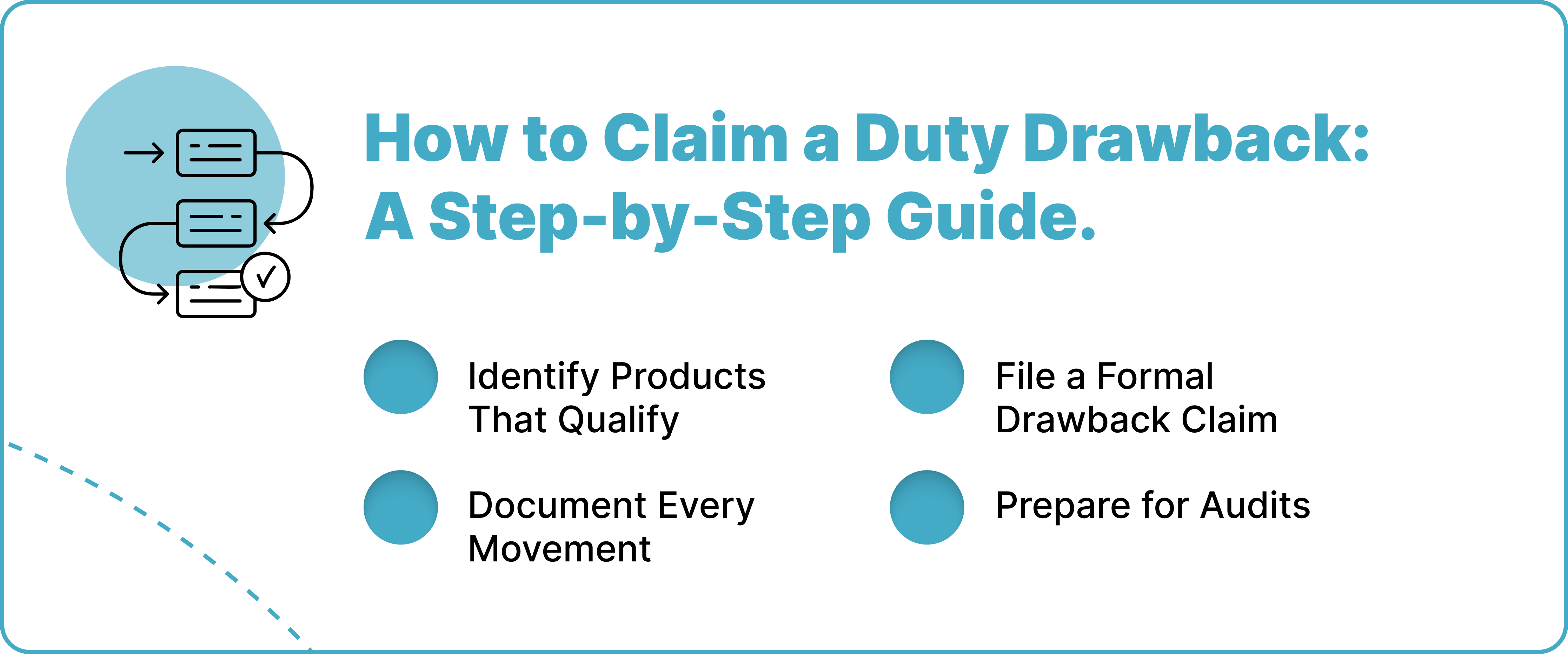
How to Claim a Duty Drawback: A Step-by-Step Guide
A drawback claim looks complicated on paper. In practice it needs a clear step-by-step process in your returns operation.
Processing and approval can take several months, and claims are paid only once they are fully processed. The steps:
1. Identify Products That Qualify
Not all returns qualify. To be eligible, the returned goods must:
- Be imported into the U.S.
- Be exported or destroyed.
- Not be significantly used or altered in the U.S.
- Be unused, for unused merchandise drawback and rejected merchandise drawback, which cover goods exported or destroyed without being used.
Digital goods, food and custom-manufactured items often do not qualify. Categories with frequent, predictable returns, such as electronics and fashion, qualify when the goods come back in the same condition.
2. Document Every Movement
CBP requires proof, and a claim without it can be denied. Documentation may include:
- Entry summary from import
- Export shipping documents
- Proof of return from the customer
- Inventory records matching serial numbers or SKUs
- Return reason (must be legitimate, not just disposal)
- For some claim types, such as direct identification drawback or manufacturing substitution drawback, you may need to trace imported materials through the supply chain and show that the exported goods are the same as those imported or used in production.
These documents are not hard to collect if you plan for them. A returns portal, for example, can capture the import ID and return reason and generate the shipping label, all of which serve as evidence of the return.
3. File a Formal Drawback Claim
A claim is more than an email with evidence of the return. It must be:
- Supported by all required documentation
- Submitted within 5 years of the date of import
- Filed with U.S. CBP using the correct drawback code
You can file through a customs broker, an attorney or yourself. Claims are filed electronically in CBP’s ACE system; paper filing is no longer accepted. Claims typically take 3 to 12 months to process, depending on volume and accuracy. Businesses that meet the requirements can apply for accelerated payment, which can bring refunds forward, often to within 90 days.
4. Prepare for Audits
Drawback claims are subject to review. If your documents are incomplete or inconsistent, you may lose your refund, and future claims may be flagged. Keep a clean record, including manufacturing records and chain of custody, and store your records securely for at least five years. For certain types of drawback claims, such as destruction of goods, CBP supervision is required to ensure compliance and eligibility for refunds.
Best Practices to Maximize Your Refunds
Retailers who recover the most treat duty refunds as part of their returns management process. These practices help:
- Automate document collection at the return start point. When the customer initiates a return, capture the SKU, order ID, and return reason up front.
- Train fulfillment staff to link exports to original imports. Don’t let returns pile up without a clear match to original shipments.
- Use technology to sync returns and reverse logistics data. This prevents mismatches between inventory and customs filings.
- File monthly, not yearly. Frequent filings make auditing easier and improve cash flow.
Recent updates to the program under the Trade Facilitation and Trade Enforcement Act widened eligibility and simplified procedures. Rules change, so check current CBP guidance before you file.
Simplify Duty Drawback Claims With ReverseLogix
You can record returns and prepare drawback claims by hand, but it is slow and easy to get wrong. Returns management software like ReverseLogix keeps the records a claim depends on:
- Customs IDs
- Refund amounts
- Return shipment flows
- Import/export paperwork
- Claim submission deadlines
ReverseLogix tracks each return from the buyer through to export, with the shipment tagged to its import number, so the records your broker or filing team needs are complete and in one place.
That means less staff time, fewer lost refunds and more efficient cross-border returns. Get a demo.

Duty drawback FAQs
Q1: How much money can I recover through duty drawback?
You can recover up to 99% of duties and import taxes paid on goods that are later returned and exported. The exact amount depends on your country’s rules, the kind of product, and how well your documents match up.
Q2: Which countries support duty drawback programs?
Many countries offer some form of tax refunds on returns. These include:
United States (via CBP)
Canada (through CBSA)
European Union (via the Union Customs Code)
India (via the Duty Drawback Scheme)
Australia, Mexico, Brazil, and China, among others
Each has its own rules, claim forms, and timelines. If you sell to more than one country, consider using returns software or hiring local experts to keep things organized
Q3: What documents do I need to file a duty drawback claim?
To file a valid claim, you’ll usually need:
Proof of import (customs entry form, duty payment receipt)
Export documentation (commercial invoice, shipping label, export declaration)
Return data (RMA numbers, return dates, refund confirmation)
Product matching (serial numbers or SKU-level detail that links import to export)
Missing documents are the number one reason duty drawback claims are rejected. Automating this step reduces risk and speeds up the recovery of international return costs.
Note: For certain types of claims, such as manufacturing substitution drawback or direct identification drawback, additional documentation may be required to prove the use of raw materials or the identity of the exported prod
Q4: What’s the biggest mistake retailers make with duty drawback?
Not linking the return to its original import record is the biggest mistake retailers make. If your systems can’t prove the same item was both imported and later exported, your claim will fail.
Tip: Assign return tracking numbers that tie back to import batches or SKUs. This lets you build an audit trail. The best international returns management platforms handle this mapping for you in real time.
Q5: How long do I have to submit a drawback claim?
The deadline depends on the country:
U.S.: Up to 5 years from import date
Canada: 4 years from duty payment
EU countries: 3 years (varies slightly)
India: Within 1 year of export
The sooner you submit, the faster you recover funds. Claims submitted late or missing required data often get delayed or denied.
Get a Demo
Discover how you can jump-start your returns management efforts with ReverseLogix.