

How to Phase a Returns Program, One Flow at a Time
Article brief:
- A returns management rollout plan works best in phases. Start with one flow, then add the rest on the same record.
- Pulse forward-order tracking goes live in four weeks or less, and cuts support tickets with proactive notifications. Returns initiation takes about eight weeks. It adds a self-service portal, eligibility rules, return authorization, label generation, and an exchange-first flow with store credit. Teams whose dock is the bottleneck can start with initiation and processing together.
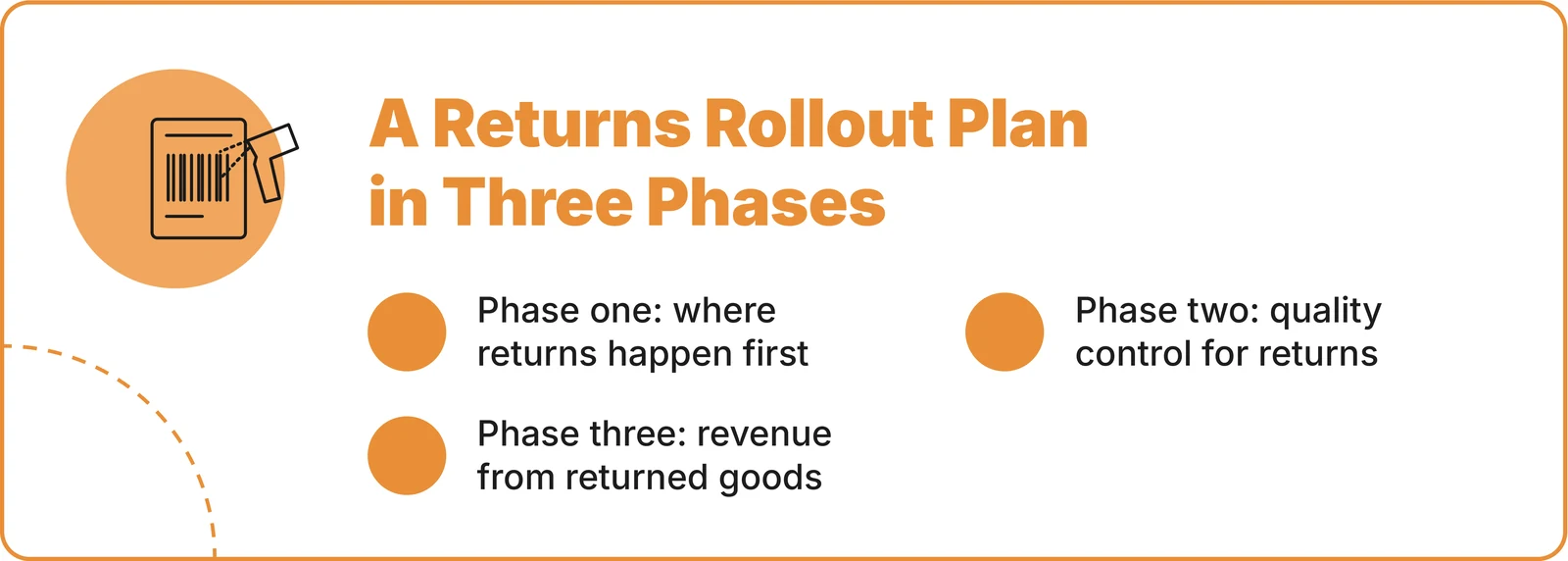
- Phase two adds quality control for returned items, including receiving, inspection, grading, and disposition, so returned goods don’t post to stock before they’re checked. Phase three adds repair, warranty, and recommerce, bringing more revenue back from returned products and lowering the carbon footprint of returns.
- ReverseLogix pricing is modular, so later phases amend the same agreement, with no per-user or per-site fees. Time each go-live outside peak season.
Launching returns software isn’t one big switch that lets the portal, warehouse, refunds, repairs, and warranty go live on the same Monday. That kind of returns software implementation approach is why so many projects stall. A better returns management rollout plan starts with one flow, gets it live, and adds the rest on the same record as the business grows. For ReverseLogix, that first flow can be Pulse order tracking in four weeks or less, or returns initiation in about eight.
This article explains how to pick your first phase, what each later phase adds, and how to time the program around peak season.
Why a Returns Management Rollout Plan Beats a Big-bang Launch
A phased rollout reduces risk by shrinking what has to work on day one. It’s also the most direct answer to the claim that a returns management platform is too heavy to get running. When everything goes live together, you have to test every connection at once, including your carrier, ERP, order management systems, WMS, CRM, and service desk. But one failed mapping can hold up the whole launch.
Most retailers can’t afford to wait for all that to be sorted out. Returns in 2025 were about $849.9 billion of merchandise, roughly 15.8% of retail sales. Online sales were higher, at an estimated 19.3%. Phasing gives the business a working win in weeks, and it gives your team a chance to learn the system on one flow before the harder ones arrive. That’s a calmer way to change how a large company handles returns, and it tends to hold up better under finance scrutiny.
Phase One Starts Where Returns Happen First
The first phase should fix whatever causes the most pain today. For most enterprise teams, that falls into one of three places:
Pulse, If “Where’s My Order?” Floods Your Service Desk
Pulse is ReverseLogix’s forward-order tracking. Design takes about a week, and the full setup takes four weeks or less. It usually needs a carrier integration, sometimes your OMS, and email templates in your brand’s look and language. Proactive notifications tell customers where an order stands before they think to ask, so that fewer of them ever have to contact support. Pulse also sets up the carrier connection that returns will reuse later. Forward and reverse shipments then sit on the same record from the start.
Returns Initiation and Return Authorization, If The Front of The Return is The Mess
Returns initiation takes about eight weeks. That covers two to three weeks of design, one to two of configuration, a week of integration, and two weeks of testing. It typically connects two or three systems, such as a carrier, the ERP and/or OMS, and sometimes the WMS.
This is where returns begin, and customers start the process. A branded portal, the returns portal your customers see, gives customers self-service returns without calling anyone, and it’s where return requests first enter the returns management system. Eligibility rules check each request against the original order and your return policy. Return authorization happens automatically for requests that pass, and only the odd cases go to manual review. Label generation produces return labels on the spot.
Many retail brands also set up an exchange-first flow at this stage, offering product exchanges or store credit before a refund. That keeps more revenue in the business, keeps customers happy, and helps cut return and outbound shipping costs for replacement orders. Refunds and exchanges both settle on the same record, so finance can match every refund approval to the return that triggered it.
Initiation Plus Processing, If The Dock Is The Bottleneck
For customers using Reverselogix, most programs start with returns initiation and returns processing together. That makes sense when inbound returns pile up at the warehouse faster than staff can sort them, and processing returns by hand becomes the biggest drag on the returns management process. It’s a bigger first phase, with more systems to test. But for high-volume retailers with a jammed dock, fixing only the portal would just send more cartons into the same queue.
Phase Two Adds Quality Control For Returned Items
Phase Two covers what happens after returned products arrive, including receiving, inspection, grading, and disposition. Returned products get checked against grading rules, and that grade decides whether they go back to stock, to refurbishment, to resale, or to recycling. Product grading matters because it is where most return revenue is won or lost. Automation tools can then move each item to its next stop and update inventory without someone re-keying it, which also speeds up refund approvals.
Quality control also protects inventory. A returned item shouldn’t post back to sellable stock until it’s been graded. NRF found that 9% of all returns are fraudulent, with retailers reporting more empty boxes, overstated quantities, and counterfeit swaps. If returned goods go straight onto the shelf, some of those items get sold again to the next customer. When grading comes first, the inventory count updates only once someone has actually checked what came back.
Processing usually connects more systems than initiation does. Your carrier, OMS, WMS, ERP, CRM, RMA tool, and ticketing system can all be involved. Configuration can take up to four weeks depending on how detailed your rules are, and testing runs four to six weeks when several integrations are involved. Most of that time goes to testing each connection individually.
Phase Three Earns More Revenue From Returned Goods
Repair, warranty, and resale usually come last, and for good reason because they ask the most of your systems and your rules.
Warranty adds entitlement checks, which confirm whether a product is still covered before anyone approves work. Repair adds technician statuses, parts orders, and customer quote approvals. Uneven exchanges add another layer, since a replacement worth more or less than the original has to settle correctly in both the ERP and the commerce platform. None of that is padding. A home appliance maker running in-warranty and out-of-warranty repairs across a dealer network already handles all of it today, just across several tools.
The payoff is real, though. Recommerce lets graded stock go to a resale storefront or marketplace instead of a liquidation pallet. That brings more revenue back from returned goods. It also lowers the carbon footprint of returns, because fewer usable items end up in landfill.
The Business Impact of Keeping One Record and One Agreement
Phasing doesn’t mean starting over at each stage. Every module adds to the same return record, so the warehouse, customer service, and finance teams all see one history per item. Nothing gets migrated between phases.
The contract works the same way. ReverseLogix pricing is built around the modules you run. Phase two adds to the same agreement. It is not a new purchase. There’s no charge per user or per site, so adding a second warehouse or a new team doesn’t change the license.
However, it changes how leadership can treat returns. Many businesses still run returns as a cost center, a place where margin quietly leaks. Other businesses have started treating returns as a way of protecting margin instead. A phased program lets you prove value one flow at a time. Exchange-first rules in phase one help protect margin. Grading in phase two recovers more from each item. Resale in phase three turns returned products into revenue. Each step gives finance a number to check before approving the next one.
Best Practices For Timing Each Phase in High-Volume Operations
Timing matters as much as scope. These habits keep each phase on track.
- Book go-live outside your code freeze and peak calendar. The implementation plan can actually fix that window in the first step, before build starts.
- Pick the numbers you’ll watch before adding the next phase. Return rate, processing time, refund cycle time, and the share of returns that become exchanges are a good start.
- Name an owner for each phase on your side. That means a returns lead for the rules, an IT contact for each system, testers who know the daily work, and someone to approve go-live.
- Train the team that touches each new flow before it launches. Don’t wait until after the fact because a warehouse crew learning grading on the first busy Monday will make mistakes.
- Use returns data from the live phase to plan the next one. Reason codes and return patterns help you identify trends and changes in customer behavior, like a SKU that keeps coming back for the same fit issue.
- Match each phase to your business needs, rather than a vendor’s template. A returns strategy for a dealer network looks different from one for a direct-to-consumer brand, even on the same new technology.
That last point is easy to skip, but it is where a phased rollout earns its keep, because each phase hands you evidence for the next.
Customer Communication, Customer Experience and Competitive Advantage Between Phases
Customers shouldn’t notice your rollout. The front of the post-purchase journey should stay steady while the back end grows behind it.
That matters more than it might seem. NRF found that about 71% of consumers are less likely to shop with a retailer again after a poor return experience. The report also found that 76% are more likely to choose a return option that offers an instant refund or exchange. So phase one should get customer communication right early, meaning clear status updates, a refund timeline people can trust, and proactive notifications when a return reaches each stage. Later phases can then add returns capabilities and help you track returns more closely without changing what the customer sees.
For omnichannel brands, the post-purchase experience also covers in-store returns. A customer who bought online may drop off a return at one of your brick-and-mortar stores. The portal, the store system, and the warehouse all need to agree on what happened. That’s another reason to include stores as a defined step in the plan, rather than treating them as an afterthought.
A smooth returns experience is a competitive advantage for most retailers right now, and customer loyalty tends to follow it. A phased plan protects that while the bigger changes happen out of sight.
How ReverseLogix Management Software Scales With Your Returns Program
With ReverseLogix, you can start where it hurts most. That might be Pulse in four weeks or less, initiation in about eight, or initiation and processing together. Then you can add repair, warranty, and resale on the same record and under the same agreement as the program grows. That’s what scaling with the business looks like for an enterprise returns team. Talk to a returns specialist to map out what your first phase would include.
Frequently Asked Questions
Does adding a returns module later mean a new contract or a data migration?
No. ReverseLogix pricing is modular, so adding a module is an amendment to the existing agreement, not a new purchase. The new module runs on the same return record as the first one, which means there’s nothing to migrate. Each new module still goes through design, configuration, integration, testing, and go-live. Any new systems it connects to, such as a field service tool for repair, get their own mapping and test cycle.
Can you phase a returns rollout around peak season?
Yes. The go-live window for each phase is agreed at the start, against your code freeze and peak calendar. Many enterprise teams go live with returns initiation in late summer, run it through the holiday peak, and then add processing or warranty in the new year. If a date slips, the plan shows what moves, so a phase never lands in the middle of your busiest weeks by accident.
How much does phasing a returns program cost compared with a full rollout?
ReverseLogix doesn’t publish a rate card. Pricing is quoted per customer based on the modules you run, your yearly return volume, how detailed your flows are, and how many integrations you need. Because you pay for the modules you turn on, a first phase with returns initiation alone costs less than a full launch with grading, repair, and resale. You’re not charged per user or per site.
Get a Demo
Discover how you can jump-start your returns management efforts with ReverseLogix.


