Installation Damage or Warranty Claim? Why MDA Disputes Need a Faster Answer

In brief:
For the software side of this topic, see warranty management software.
- MDA warranty claims stall because the liability question (factory defect, transit damage or installation error) takes days or weeks to resolve. Each day adds cost.
- Electrolux replaced a flat $250 damage allowance with a configurable, ceiling-gated rules engine and cut that line by $100,000+ per month, contributing to a $25M+ reduction in warranty claims.
- Speed of assessment is what breaks the cost cycle on MDA disputes. Getting the payout amount right matters less than getting the answer fast.
When a major appliance comes back, everyone asks what is wrong with it. The question that decides the cost is who is at fault. A dented dishwasher panel could be a factory defect, transit damage or an installation mistake, and liability and the warranty payout differ in each case. This article explains why the liability question stalls MDA warranty claims, what the delay costs at scale, and how Electrolux reduced its damage claims line by more than $100,000 per month by replacing a flat allowance with a rules engine that answers the question in hours.
Where MDA Warranty Claims Actually Stall
MDA warranty claims rarely stall on the repair. The liability question holds them up.
A factory defect means the unit had a problem when it left the production line. In this case, the manufacturer is responsible, and warranty covers it. This is usually straightforward and clean, but it is also the rarest in MDA disputes, since quality checks usually catch true defects before they ship.
Transit damage means the unit was damaged in transit between the factory and delivery site. The carrier or logistics provider is usually liable, but to prove it, you will need to provide shipping records, condition-at-receipt documentation, and sometimes a third-party inspection. Getting money back from the responsible carrier (also known as supplier recovery) depends entirely on having that paperwork ready when you open the claim.
The main friction is installation damage. If the unit was working on arrival and the setup caused the problem, the installer is at fault, not the manufacturer. Proving it takes field team data, installer reports and often a second site visit. The installer says the unit was damaged on arrival and the manufacturer says the installer did it. None of that matters to the customer, who just wants a working dishwasher.
That ambiguity is how costs compound. Every day the dispute stays open, the manufacturer bears holding costs and the customer loses patience, which affects satisfaction and loyalty.
What Delayed Warranty Claim Resolution Actually Costs
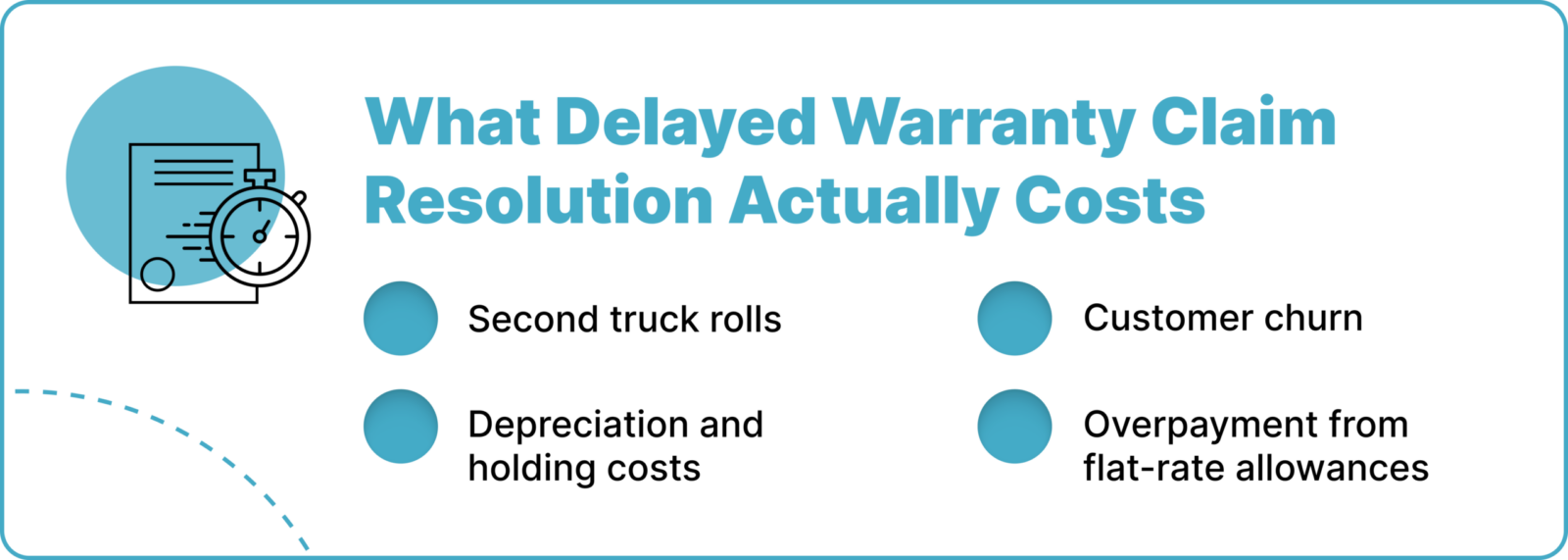
The payout is seldom the costly part of a delayed MDA warranty claim. The cost is in everything that happens while the payout is stuck.
The most obvious cost is a second truck roll. If the first field visit does not settle the liability question, somebody has to go back, which adds to the cost of a claim already in progress.
Depreciation is slower but real. A $2,400 range sitting in a warehouse or a customer’s home during a dispute is not being refurbished or resold, and it loses residual value every week. Graded and moved to refurbishment within 48 hours, it could recover $1,200. Left for a month and then liquidated, it recovers far less, sometimes less than half of that.
Customer churn is expensive, but it doesn’t show up on the warranty claims line. If a customer has to wait 3 weeks for a warranty fix on a $3,000 fridge, they’re unlikely to buy that brand again.
The less visible cost is the flat-rate damage allowance. If companies can’t triage fast enough, they pay a flat payout on any disputed claim to make the problem go away. That solves the speed problem but pays too much on every claim that wasn’t worth the full amount.
That is how Electrolux, the home appliance manufacturer, ended up paying $250 per disputed claim regardless of how serious the claim was. Before using the ReverseLogix platform, it paid a flat $250 damage allowance on every disputed MDA claim because it could not triage fast enough to right-size the payout. The flat rate was fast, but it was expensive and inaccurate: a cosmetic scratch on a dryer door was worth the same $250 as a fridge with compressor damage.
With ReverseLogix, the company moved to a configurable, ceiling-gated rules engine. It does not apply a blanket rate. It evaluates each dispute against preset criteria, including damage type, severity, who initiated the claim, warranty status, installer data and shipping records, then assigns a disposition path and a payout amount, with a ceiling to prevent outlier overpayments.
The gain in speed was even larger than the gain in accuracy. The engine answered the installation-or-warranty question within hours, where claims used to sit in a manual review queue while people argued over liability. Most disputes were given a path on the business day they were submitted. That cut second truck rolls and reduced holding costs on disputed units.
What Warranty Management Software Needs to Handle For MDA Disputes
Most warranty management software is built for simpler claims. A customer makes a claim, the system checks the coverage, and the payout is made. An MDA dispute requires more.
An MDA-capable system needs multi-party claim intake, as consumers, dealers, and installers submit different data with different validation rules. This requires a rules engine that can be configured to compare damage type, severity, initiator, warranty terms, and shipping records to pre-defined criteria. Payout logic has to be ceiling-gated rather than a flat rate to prevent overpayment on low-severity claims while still covering legitimate damage.
Most systems do a poor job of tracking supplier recovery. If the carrier or installer is liable, you need to track the recovery claim separately from the warranty payout. Without that separation, recovered costs get lost in the warranty line, and the true cost of claims stays hidden.
The field team integration closes the loop. Installer reports, service agent notes, and condition-at-receipt data, which is the kind of documentation that typically lives in a binder nobody opens, must flow directly into the claim record. Without that field data, the engine must make decisions with incomplete information. And that incomplete information gave rise to the flat-rate problem in the first place.
How ReverseLogix Resolves the Installation-vs.-Warranty Question
MDA warranty disputes are expensive because they are slow, and they are slow because the liability question sits in a manual queue while people argue over paperwork.
ReverseLogix provides a warranty management platform for manufacturers and retailers, with the rules engine Electrolux used to reduce damage claims by more than $100,000 per month. Returns, disposition routing and supplier recovery run on the same platform, so warranty claims and returns follow one workflow. Contact us today to get started.

Frequently Asked Questions
Q1. What is warranty management software and how does it reduce warranty claim costs?
Warranty management software automates the claims workflow from intake through resolution. For MDA disputes, it replaces manual review queues with rules-based triage that evaluates damage type, initiator data, and warranty terms against preset criteria.
Q2. What is supplier recovery in warranty management?
Supplier recovery is the process of recouping costs from the party that caused the product damage when that party isn’t the manufacturer. If a carrier damages a refrigerator in transit, the manufacturer may pay the warranty claim upfront and then pursue recovery from the carrier. Tracking supplier recovery separately from warranty payouts gives manufacturers visibility into where damage originates in the supply chain and how much they’re absorbing that they shouldn’t.
Q3. How do field teams handle MDA warranty disputes?
Field teams collect the data that determines who’s liable for an MDA warranty claim. That includes installer reports, condition-at-receipt documentation, service agent assessments, and photographic evidence of damage. When field team input feeds directly into the warranty management system, the rules engine can triage disputes accurately. Without it, the engine makes decisions on incomplete data, which usually defaults to a flat-rate payout.
Q4. What is a 48-hour disposition SLA in returns management?
A 48-hour disposition SLA means every returned product gets inspected, graded, and routed to its next destination within two business days of arriving at the facility. For MDA warranty disputes, this benchmark applies to the triage decision: determining whether the claim is a factory defect, transit damage, or installation error. Missing the 48-hour window increases holding costs and raises the risk of a second truck roll.
Q5. How do reverse logistics and warranty management connect?
Reverse logistics covers the physical movement of a returned product from the customer back to the manufacturer or processing facility. Warranty management covers the financial and liability side: who’s responsible, what the payout is, and how the claim resolves. When both run through the same system, the warranty disposition informs the physical disposition, so a unit triaged as an installation error gets routed differently than one confirmed as a factory defect.
Repairs and warranty in one flow
How repair intake, warranty entitlement and parts move through a single system.
Get a Demo
Discover how you can jump-start your returns management efforts with ReverseLogix.