SDA vs MDA: Why Major Domestic Appliances Need a Different Post-Purchase Playbook

In brief:
For the software side of this topic, see appliance returns management software.
- SDA returns are ship-back, low-cost, and rarely disputed. MDA returns need a field service visit, cost more per unit, and carry liability questions that don’t exist for smaller products.
- Who initiates the return changes the entire claim. End consumers, dealers, and installers each bring different data and different dispute types.
- How quickly a company triages an MDA dispute determines whether the claim resolves in days or balloons into weeks of avoidable cost.
To return a $40 air fryer, the customer prints a label, boxes it and drops it at a carrier location, and is done in 15 minutes. Returning a $2,800 side-by-side refrigerator needs a scheduled pickup window and dedicated resources. The air fryer costs a shipping label and a few minutes of inspection. The refrigerator costs a truck, a service technician’s labor, precise timing and sometimes a second trip.
Both products are appliances, but their post-purchase experiences have little in common. Cost structure, dispute type and disposition path all diverge along the SDA and MDA line, which is how the appliance industry classifies these products. This article explains the divide and where it costs the most for companies handling appliance returns at scale.
What SDA and MDA Mean in The Appliance Industry
Small domestic appliances (SDA) are products customers can carry and ship without assistance, such as blenders, coffee makers, vacuums, air fryers, and toasters. Major Domestic Appliances (MDA) are products that are delivered and installed (often by a third party) and cannot be boxed up for return shipping. Examples include refrigerators, ranges, dishwashers, washing machines, and dryers.
The classification matters because each category’s post-purchase flow involves completely different cost structures and dispute types.
How The Post-Purchase Flow Splits Between SDA and Major Appliances (MDA)
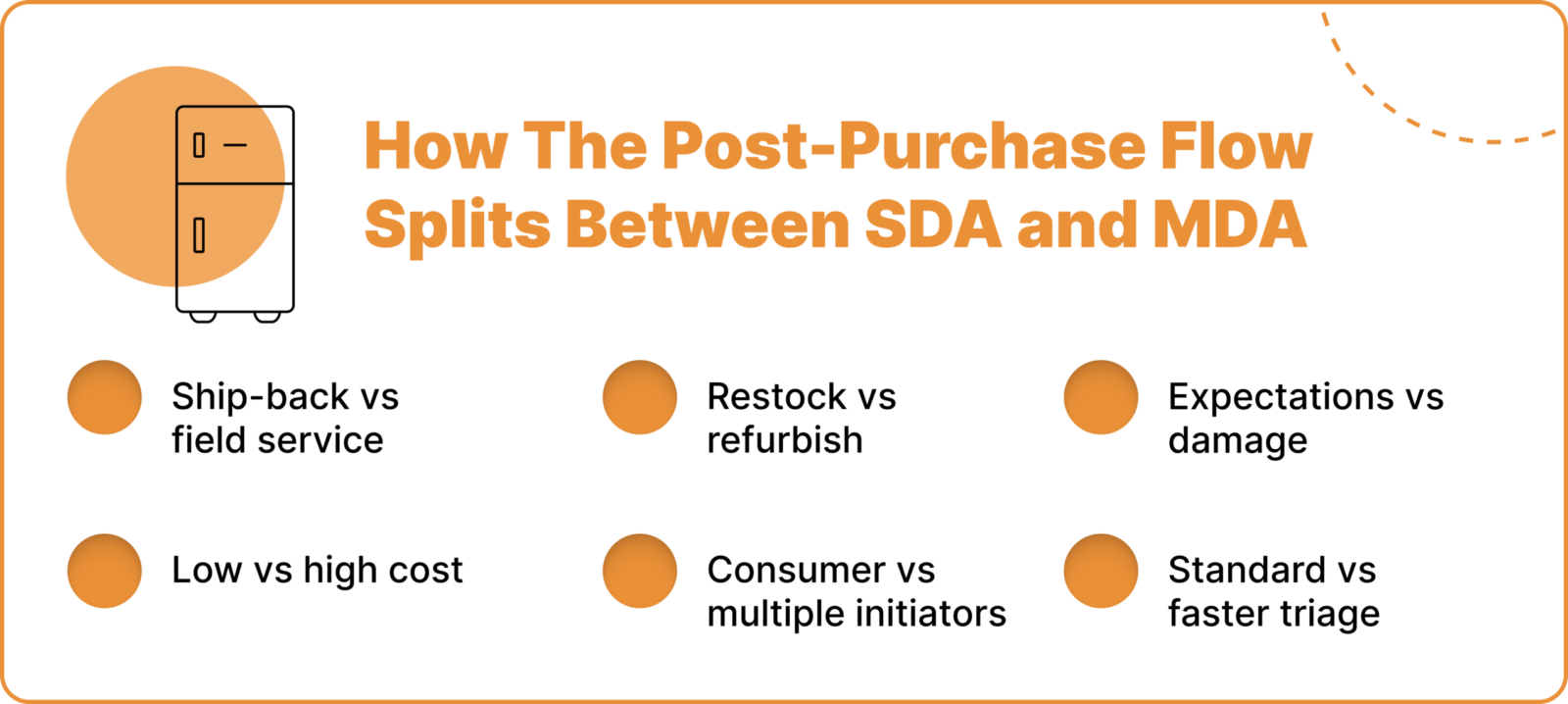
Every dimension in the table below changes the cost and speed of processing an appliance return.
| Dimension | SDA | MDA |
| Service requirement | None. Customer ships it back. | Field service agent, sometimes two visits. |
| Cost per return | Low. Shipping label + inspection. | High. Truck roll + labor + potential second visit. |
| Disposition path | Restock, refurbish, or liquidate. Grading is fast. | Refurbish, liquidate, or scrap. Restocking is rare. |
| Who initiates | Almost always the end consumer. | Consumer, dealer, or installer. |
| Typical dispute | “Product didn’t meet expectations.” | “Was it defective or damaged during installation?” |
The biggest gap is the service call. Returning an SDA costs a shipping label and a few minutes of inspection time at a facility. Industry estimates for truck rolls and field service labor put an MDA return at $150 to $300 before any claim is filed. For a manufacturer managing 5,000 MDA returns a year at $200 per return, service costs alone total $1 million before any product recovery.
Because of this cost gap, MDA returns require faster triage, different authorization rules, and a disposition path built around the reality that restocking is seldom the outcome.
Most returns management systems are set up for the SDA model by default: ship back, check, grade and route. That works when the priciest product in the pipeline is a $120 vacuum cleaner. When $2,000 ranges and fridges go through the same workflow, nothing flags the cost difference until finance sees it in the quarterly numbers.
Who Initiates a Major Appliance Return Changes Everything
End consumers, dealers and installers bring different data, liability exposure and urgency, so the shape of an MDA claim depends on who starts it.
The end user calls because the dishwasher leaks. They do not know whether it is a manufacturing issue or an installation error. They want it fixed or replaced. The claim starts with incomplete information, and another party has to fill in the gaps before the dispute can move.
The dealer or distributor starts a claim because the unit was damaged on arrival or a customer complained. Dealers have the shipping records, delivery notes and account details that consumers do not. They also have a financial incentive to move the claim quickly, which can mean documentation arrives piecemeal.
The installer reports damage found during installation, or a unit that does not work once connected. This raises the hardest question: did the product break before installation or during it? That needs a more specific intake path from the start.
In some cases, no one knows who started what. A consumer calls the manufacturer, the manufacturer sends a field agent, the agent finds damage from installation, and the claim moves to the installer’s insurance carrier. This can go back and forth for weeks before anyone decides who pays. A returns process that treats all three initiators the same will misroute claims, slow resolution and cost more than necessary.
Most systems do exactly that.
Why MDA Disputes Stall and What That Costs
The question that most often stalls MDA warranty claims is who caused the damage. The answer touches transit logistics, installer liability, manufacturing quality and warranty terms at once, and few of the parties have an incentive to move quickly and take responsibility.
When a $2,400 refrigerator shows up with a dented panel, someone has to work out whether it happened in transit, during installation or at the factory. That can take days or weeks. Meanwhile the customer waits, logistics costs rise and the item depreciates in a warehouse. If the claim is denied or diverted, it all starts again.
Automated triage breaks this cycle. A rules engine can assess a claim against shipping data, installer reports and warranty terms in hours instead of days, identify the likely source of damage and route the claim, which stops costs from compounding.
How ReverseLogix Handles The SDA and MDA Split
ReverseLogix runs SDA and MDA workflows on the same returns management platform, with different rules for each category. The SDA process is light and direct. MDA returns trigger a different workflow that includes field service scheduling, multi-party claim intake (consumer, dealer or installer) and automated triage before the claim stalls.
The platform assesses incoming claim data such as damage type, initiator, warranty status and shipping records to find the likely cause and route the claim. That speed is what keeps a $300 truck roll from becoming a second truck roll.
ReverseLogix and the MDA Cost Problem
The SDA and MDA difference is a cost-structure issue. Companies that run both categories through the same post-purchase flow overspend on SDA processing and triage MDA disputes badly. The result is needless cost at both ends.
ReverseLogix has a returns management system that matches product categories to workflows for appliance makers and retailers. Different rules for different products mean faster triage on the disputes that compound fastest. Request a demo today.
Frequently Asked Questions
Q1. What is the difference between SDA and MDA in the appliance industry?
SDA stands for small domestic appliances: products like blenders, vacuums, and coffee makers that a customer can carry and ship back without help. MDA stands for major domestic appliances: refrigerators, ranges, dishwashers, and washing machines that require delivery, installation, and often a field service agent for returns. The classification determines how the post-purchase flow, return costs, and dispute types differ between the two categories.
Q2. How does a post-purchase flow differ for major appliances vs. small appliances?
SDA post-purchase flows are simpler. The customer requests a return, ships the product back, and the manufacturer inspects and grades it at a facility. MDA post-purchase flows add layers: field service scheduling, multi-party claim intake from consumers, dealers or installers, and a liability triage step to determine whether the issue is a defect or installation damage. Automated post-purchase flows reduce the time MDA claims spend stuck in that triage step.
Q3. Can automated returns management reduce MDA return costs?
Yes. MDA returns carry high per-unit costs because they require truck rolls, field service labor, and sometimes repeat visits. Automating the triage step, where the system evaluates damage type, warranty status, and initiator data to route the claim, cuts the time a dispute sits unresolved. Each day an unresolved MDA claim sits adds cost: storage, depreciation, and the risk of a second service visit.
Q4. How does proactive communication reduce post-purchase anxiety for major appliance buyers?
Major appliance purchases are high-consideration decisions. Proactive communication after the sale, like delivery scheduling updates, installation preparation guides, and warranty registration reminders, reduces the cognitive dissonance that can lead to buyer’s remorse. Customers who know what to expect during installation and setup are less likely to misread normal installation steps as product problems, which means fewer avoidable returns.
Q5. Who initiates a return on a major domestic appliance?
MDA returns can come from three sources: the end consumer, the dealer or distributor, or the installer. Each brings different data and a different dispute type. Consumer-initiated returns often start with incomplete information. Dealer-initiated returns carry shipping and delivery data but may arrive with rushed documentation. Installer-initiated returns raise the hardest question: whether damage happened before or during installation.
Get a Demo
Discover how you can jump-start your returns management efforts with ReverseLogix.