Who Owns Reverse Logistics Inside the Company?
Article Brief:
- Reverse logistics needs a single accountable owner with decision rights shared across operations, finance, customer service, and IT. And even when you get away with it, informal reverse logistics ownership is hard to sustain at scale.
- Every default model covers part of the job: Operations misses customer expectations, customer experience misses fraud and recovery, finance misses the dock, and a dedicated function only works if it has real authority.
- Some decisions slip through without an owner, including refunds and credits, disposition, warranty entitlement, vendor returns, and repair-vs-scrap calls.
Reverse logistics should be owned by one person or team within the organization that is accountable and has decision rights shared across operations, finance, customer service, and IT. But unfortunately, most companies don’t set it up that way; they just assign returns and the reverse logistics process to the team that feels the pain first. That’s usually the distribution center, which is why you often have piles of returned stock sitting there, waiting for someone to decide what it is actually worth.
Reverse logistics is an enterprise-wide discipline, so whoever owns it needs authority beyond their department. But that kind of ownership is rare. In this article, we discuss why splitting reverse logistics across departments leaves expensive decisions without an owner, the four ownership models companies fall into, each model’s blind spot, and what changes when returns span multiple sites, sales channels, and ERP instances.
Who Owns Reverse Logistics When Every Team Touches a Return?
On average, one returned product touches at least four departments before it closes, making it difficult for one department to own the reverse logistics process alone. A typical returns process involves customer service managing the return request until the warehouse receives and grades the unit; finance issuing the refund or store credit; accounting booking any write-off; and IT keeping the ERP, warehouse system, and carrier links talking.
In 2010, Diane Mollenkopf, then a supply chain professor at the University of Tennessee, noted in a Supply Chain Management Review that returns management is a cross-functional process. Sixteen years later, many org charts still haven’t caught up.
However, shared work is not shared responsibility. When four teams have a stake in it, no one owns the trade-offs, and that’s where the money is. Finance wants fewer refunds while customer service wants to process the returns faster. Meanwhile, the warehouse wants the dock cleared by Friday.
A single owner can set the returns policy, disposition rules, and cost and recovery targets. But within those rules, each function has its own decision-making authority: customer service approves standard refunds, the warehouse grades and routes units, finance approves credits above a certain threshold, and IT owns the integrations. When a decision isn’t covered by the rules (for example, a $60,000 credit claim from a distributor), it goes to the owner.
Four Ownership Models and What Each One Misses

Most companies fall into one of four reverse logistics management models, and each does part of the job well while leaving gaps elsewhere.
Operations or Supply Chain Process
Supply chain management teams know how to receive, sort, and move goods, but they have blind spots outside the building. Unlike traditional logistics, reverse flows move in the opposite direction, starting with the end consumer and moving back through the supply chain. A supply chain leader assessed on dock-to-stock time is incentivized to clear the backlog fast, which can mean shipping repairable units to liquidation because grading them properly would slow the line.
Teams may also route repairable units or excess inventory into secondary markets to save money, but that can hurt customer satisfaction when the decision is made too narrowly. Meanwhile, customer communication is often up to whoever answers the phone. This model may improve operational efficiency inside the building while missing broader reverse logistics goals to reduce costs and reduce waste across the full process.
Customer Experience, Where Customer Loyalty Comes First
Customer experience in the returns management process is great for shoppers because a generous, hassle-free response can improve customer satisfaction and boost customer loyalty. On paper, this should work and foster repeat business, but refunds are often sent before anyone has time to inspect the item. That’s great for repeat business, but refunds are often sent out before anyone has inspected the item.
According to the National Retail Federation (NRF), U.S. retailers expected 15.8% of all retail sales to be returned in 2025, with return rates for online purchases reaching an estimated 19.3%. Retailers reported to the NRF that about 9% of their returns are fraudulent, and a CX-led process that prioritizes instant refunds over the grading step is nearly the perfect setup for that 9%. CX teams also rarely see what happens to a unit after the label prints, so they can’t weigh a refund against what the item could resell for.
Finance
Finance-led returns are generally tightest on cost and slowest everywhere else. The finance team sets refund thresholds, approval chains, and write-off rules, which is very critical. But a finance team usually doesn’t understand dock operations, nor does it know whether a credit is stuck waiting for approval or whether the unit is sitting unopened in receiving. B2B customers feel this first. A distributor who has to wait six weeks for a credit memo on a pallet of damaged goods might start ordering elsewhere.
A Dedicated Returns Function
A dedicated function is one of the reverse logistics strategies companies use when they need end-to-end ownership, sometimes led by a Chief Returns Officer or a VP of reverse logistics. But this will only work if the role has budget and the power to change policy. It also needs the authority to optimize reverse logistics operations across policy, partners, and systems rather than just coordinate handoffs. Without them, the role becomes a coordinator with a big title, chasing four departments that report elsewhere.
If you are considering this route, our Chief Returns Officer job description template can give you an idea of what the role can look like. Not every company needs to hire at the C-level, though; a director with clear decision rights and a seat in operations review can do the job well. That kind of ownership can play a vital role in broader logistics processes, especially when returns, repairs, recycling programs, and disposal all need one authority.
The Decisions That Need a Named Owner
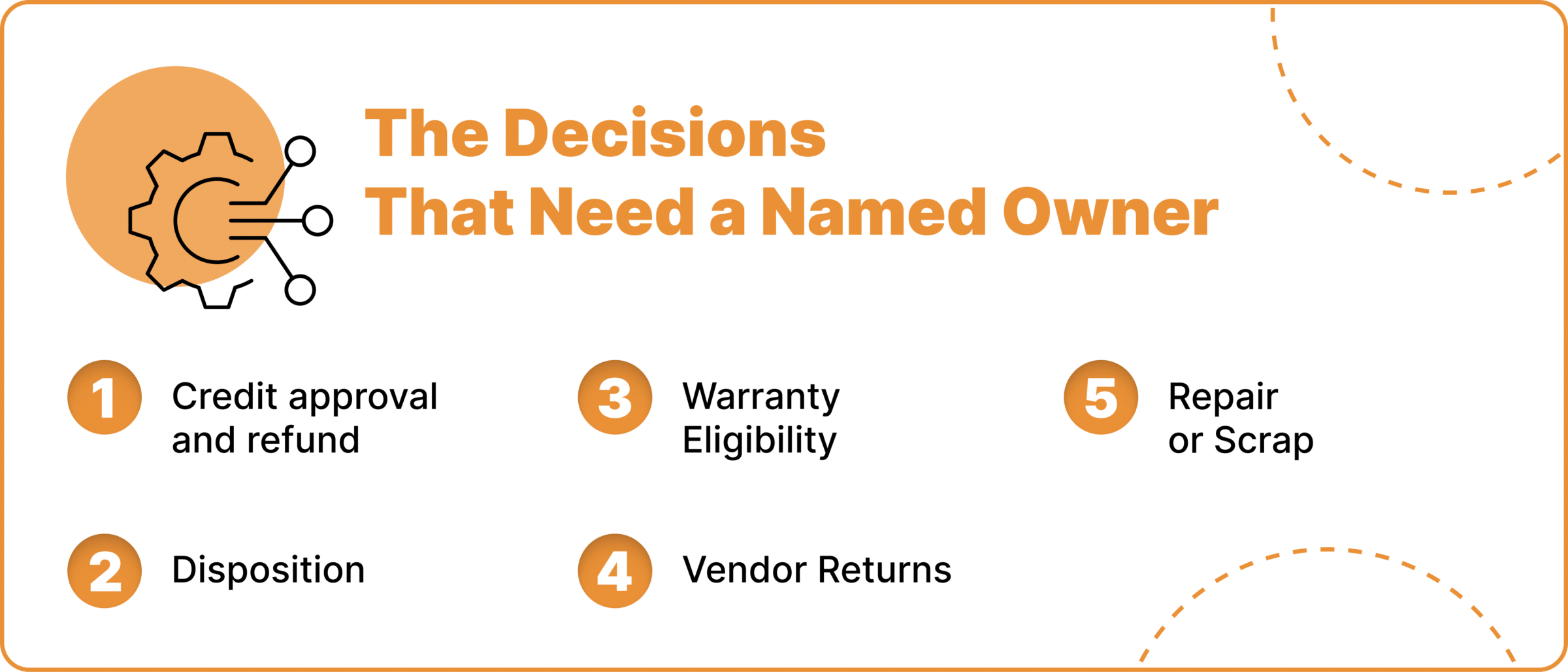
Documenting everyday decisions makes ownership of reverse logistics operations concrete. A common reverse logistics process still depends on clear ownership of a few high-impact decisions. The following are the ones that cause the most friction when nobody owns them:
- Credit approval and refund: Who approves what, at what value, and whether this is before or after inspection. This one rule dictates your fraud exposure and your customer wait times.
- Disposition: Restock, rework, resell through another channel, recycle, or scrap. Inspection and sorting is where you make each routing call, including end-of-life routing for waste management and recycling materials. Every routing call is an inventory management decision with a dollar value attached.
- Warranty Eligibility: Is the unit covered, under what policy, and should the claim go to repair, replacement, or refund?
- Vendor Returns: Which units return to the vendor, and who pursues the chargeback if the vendor disagrees?
- Repair or Scrap: A $900 commercial floor scrubber with a shot motor is probably worth fixing. That is almost certainly not the case for a $40 accessory. Somewhere between those two prices is a cutoff, and a named person should decide where it is.
The primary activities of reverse logistics include returns management, remanufacturing, and end-of-life recycling.
Each of these is a compromise between cost, speed, and customer experience. Without a named owner, each team will choose for itself: the warehouse chooses speed, finance chooses cost, and customer service chooses the customer, so no one weighs the result for the company as a whole.
How Reverse Logistics Ownership Changes at Enterprise Scale
Informal ownership of the reverse logistics process may work at one site with one sales channel, but as the business expands, that structure either breaks or gets infinitely more complicated.
Several Sites, Regions and Partners
A manufacturer running return centers in Ohio, the Netherlands, and Mexico must manage three sets of return rules, tax treatment, recycling obligations, and environmental regulations. Each site may also use a different 3PL or repair shop, adding complexity without a solid reverse logistics plan or clear ownership. That makes strict regulations and regulatory compliance harder when partners handle collection, packaging management, and disposal differently by region. Carriers often consolidate multiple returns at local hubs before shipping them to processing facilities, which affects control, timing, and environmental impact. The company still needs someone to set grading rules for each site and decide what happens when a partner’s data doesn’t match yours. A single owner also plays a crucial role in coordinating sustainable practices and environmental sustainability across sites.
B2B and D2C returns, Plus ERP Posting
B2B and D2C returns behave differently but often end up in the same building. D2C returns are low-value, and customers want their money back in days, partly because customer demand in that channel favors fast credits, while B2B is shaped more by contract requirements. A B2B return might be 400 units of one SKU on a contract, with credit terms, and a sales rep wanting it cleared before quarter end. The owner needs different rules for each channel, but without running two separate operations.
All returns have to go back to the books, too. Credits, write-offs, refurbished stock, and vendor recoveries all book into the ERP, often over multiple legal entities. Implementing a reverse logistics plan often costs about 7-10% of goods’ cost, so unclear ownership and poor posting controls can quickly raise operational costs. If the returns process and the finance close don’t sit with the same team, month-end becomes a reconciliation exercise where someone in accounting has to piece together the history from email threads. That person usually has a very strong opinion on who should own reverse logistics, and it’s not them.
Why One Shared Returns Record Matters More Than the Org Chart
An org chart may decide who is responsible, but the returns record decides whether they can actually act. For most enterprises, each team keeps its own returns. Customer service has a ticket, the warehouse has a receipt in the WMS, finance has a credit memo, and the repair partner has a work order in a system nobody else can access. None match perfectly, so the owner spends the week reconciling records instead of making decisions. That fragmentation creates lost revenue when products sit unresolved instead of being recovered, refurbished, or resold.
One common record can fix that to optimize reverse logistics and improve customer satisfaction across teams. When everyone works from the same return data, the owner can see where a return is stuck and who’s holding it, from the first request to final disposition. Customer service can answer “where’s my credit?” without emailing the warehouse, and finance can see a refund’s full history without rebuilding it. That’s what good reverse logistics software like ReverseLogix does. It also gives all teams the same record and automates routine return authorizations, so people only deal with exceptions, including issues like delivery failure, more smoothly.
What Data Analysis Looks Like on One Record
A shared record enables proper data analysis, delivers valuable insights, and supports continuous improvement. Data analytics can also forecast return volumes and minimize leakage. When the single owner can track return reasons, grading results, customer feedback, and recovery values at the SKU level, it becomes so much easier to discover patterns that no single team would catch. For example, a commercial kitchen equipment manufacturer might see that one fryer model is being returned at twice the rate of the rest of the line, and that most of those units are graded as “no fault found.” Unclear setup instructions or limited dealer training might cause this, but a warehouse report or a credit ledger alone would never show it. Over time, data analysis identifies trends in product returns and customer feedback to help optimize reverse logistics operations.
Where to Start
If you are not sure who owns, or should own, reverse logistics in your company today, this short exercise will help.
- Get the last 20 returns over $5,000 (B2B claims, warranty swaps, vendor returns) and see who made each decision along the way.
- You will probably find three or four people approving things, two or three systems holding the data, and no one who could explain the full history of a single return.
- From there, pick an owner, document each team’s decisions, and agree on a single record everyone works from to optimize reverse logistics operations.
If you’re still trying to figure out where returns end and the bigger reverse supply chain operations begins, our post on returns management vs reverse logistics lays out the difference.

Frequently Asked Questions
Is operations or customer service responsible for optimizing reverse logistics operations?
Neither one alone. Ownership often depends on company size and operating model, but at enterprise scale, reverse logistics needs one owner whose rules cover the two teams. Customer service manages return requests and customer and account communication. Operations handles receiving, inspection, sorting, and routing. Each sees half the picture. A named owner sets the rules and targets and lets each team decide within them, so returns don’t stall over whose call it is. It also has to stay aligned with traditional logistics because returns affect the broader supply chain process and customer satisfaction.
What does a Chief Returns Officer do?
A Chief Returns Officer owns the full returns process, from the first request to final disposition, and answers for its cost and recovery. The global reverse logistics market is projected to reach $1.17 trillion by 2032, which helps explain why some companies formalize executive ownership. The role sets return policy, decides how to handle disposition and repair calls, and coordinates operations, finance, customer service, and IT. Tony Sciarrotta, executive director of the Reverse Logistics Association, has argued that retailers could cut the financial and environmental cost of returns by putting an executive in charge of reverse logistics. The authority matters more than the title, because with real control over policy and disposition, the role can also advance sustainability efforts and support a more sustainable future.
Can a 3PL own reverse logistics for you?
A 3PL can do the work. The ownership stays with you. Many large enterprises in the retail industry outsource receiving, inspection, repair, or resale to specialized third-party logistics providers and recyclers. The partner still follows your rules, including grading standards, disposition rules, turnaround targets, and what counts as a recovered unit. Reverse logistics examples include outsourced inspection, repair, resale, and recycling workflows managed under the company’s standards. Your owner also has to check the partner’s data against your own records, because when nobody does, returns go quiet for weeks and the cost only surfaces at month-end. These partner models can support the circular economy, extend the product life cycle, and reduce landfill waste by recycling materials.
Get a Demo
Discover how you can jump-start your returns management efforts with ReverseLogix.