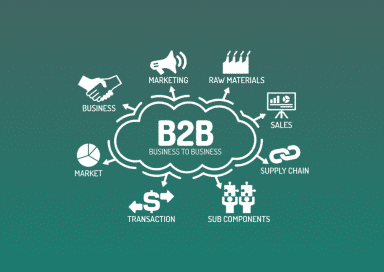
As more B2B buying moves online, B2B enterprises face a new expectation. B2B customers now want the same simple, efficient return process that B2C retailers offer.
This post explains why B2B returns are harder to manage than B2C returns, and gives practical ways to streamline them, reduce costs and improve customer satisfaction.
Why Are B2B Returns Complex?
1. Many Stakeholders Decide on a Return
A B2B return is rarely decided by one person or one department. Procurement, finance, logistics and the account team can all have a say. Each return decision affects the supply chain, cash flow and the business relationship. In B2C, the decision sits with one consumer.
2. Volume vs. Value
B2B returns often involve many units, and each unit may not be worth much on its own. The combined financial impact is still large. B2C returns typically involve lower volumes but may carry a higher unit value.
3. Custom Terms and Agreements
B2B returns are governed by contracts and agreements. Each business often negotiates its own terms, covering return policies, warranties, and liability clauses. Each return has to be checked against those terms. In B2C, the rules are more standardized, with consumer protection laws in play.
4. Wide Range of Product Types
B2B returns cover a wide range of product types: industrial machinery, specialized equipment and customized solutions. B2C returns cover a broader scope of consumer goods. This variety calls for a deep understanding of different products and their specific return challenges. Brands selling through B2C and B2B channels must balance increasingly complex return management factors, from monitoring costs to addressing repairs to managing complex contracts to maintaining inventory levels.
How to Measure the Cost of Your B2B Returns
The first step is to measure what returns cost you.
Consider this: online return deliveries alone cost companies $550 billion each year. Measure the direct costs of return shipping and restocking, and also the less obvious expenses, including:
- Lost sales from items that can’t be resold at full price
- Resources consumed by customer service to handle return inquiries and process refunds
- Costs linked to damage control, such as mitigating negative customer reviews and social media posts
An average of 40% of customers buy items intending to return some of them. Understanding your return rate and its financial implications is vital, and at ReverseLogix, we offer the tools to break these numbers down and show what returns cost you.
How to Identify the Root Cause of Your Returns Problems
Knowing why returns happen is the first step to reducing them. Statistics indicate that 68% of buyers scrutinize their suppliers’ return policies before making a purchase, but sometimes, returns persist despite clear policies. Is it a matter of product quality, or is it perhaps a misalignment of customer expectations? Analyze customer feedback, product return patterns, and seasonal fluctuations to pinpoint the root causes.
Companies selling through B2B channels have traditionally used a patchwork of point systems to manage product returns, such as an order management system and warehouse management system. But solutions like a WMS aren’t efficient because they don’t have a complete, end-to-end view of a return’s lifecycle. These point systems also lack automated, returns-related processes, and so your teams spend extra time doing manual data entry, creating reports and forms, or contacting customers one by one.
Here are a few common culprits behind B2B returns:
- Product quality issues: Defective or damaged items remain a significant return trigger. Strong quality control processes can minimize these defects.
- Misaligned customer expectations: If your product descriptions and marketing materials don’t align with the actual products, customers may return them. Transparency in your marketing materials is key.
- Mixed sources: Returns come from a range of customers and locations, such as wholesale accounts, 3PLs and small shops, and items may come back in bulk with several return types in one shipment.
- Complex ordering and return processes: Returns can result from customers struggling with the ordering or return procedures. Ensure these processes are user-friendly.
- Poor customer service: Unresponsive or unhelpful customer service can lead to returns. Train your customer service team to manage returns efficiently and professionally.
ReverseLogix analyzes your returns data, identifies trends and highlights problem areas, so you can address the causes of returns directly.
How to Develop and Implement a B2B Return Prevention Strategy
Return prevention doesn’t mean discouraging returns but rather fine-tuning your processes to reduce them. Use tailored workflows so each type of return gets the right treatment. Offer value-added services, such as warranties and repairs, to retain customers. Put measures in place that address the root causes covered above.
For instance, if returns stem from size discrepancies or product quality issues, optimizing these areas can significantly decrease returns. It’s about preventing issues before they lead to returns.
Here are tips for developing and implementing a B2B return prevention strategy:
- Use artificial intelligence (AI) and machine learning to identify trends and patterns in your return data, predict which products or customers are likely to return items, and develop targeted prevention strategies.
- Invest in product configurators to help customers choose the right products based on their needs, reducing returns due to product mismatches.
- Implement a customer feedback loop to collect insights from customers about their return experiences. This feedback can identify areas for process improvement.
- Partner with a reverse logistics provider to manage returns efficiently and cost-effectively, streamlining your returns process and maximizing returned product resale.
How to Streamline Your Returns Process for Optimal Efficiency
ReverseLogix’s Returns Management System (RMS) is built for B2B sellers. It streamlines returns processing, lowers its cost and improves the customer service experience. Here is how ReverseLogix tackles the key challenges of B2B returns.
Full Control over Returns Initiation
Customers can initiate returns themselves while B2B sellers keep full control over the process. The Returns Management System offers a range of features, including:
- Views of Inbound RMAs.
- Disposition Assignment.
- Item Receiving (Scanning RMA Label).
- Order Log/Timestamps.
- Inspection & Grading.
- Customer Notifications.
- Image Capture.
- Queue Based Dashboards.
- Discrepancy Log.
This level of control ensures transparency throughout the returns process for both you and your customers.
Minimize the Revenue Impact of Returns
Managing returns effectively is crucial for maintaining revenue. With ReverseLogix, you can stay on top of return discrepancies, add rules for faster disposition, and offer various types of return entitlements to different customers automatically. This leads to significant savings, with our powerful B2B functionality helping customers save millions of dollars annually by avoiding over-crediting and vendor policy abuse.
Simplified, Reliable Returns
At ReverseLogix, our platform covers the entire B2B returns lifecycle. It helps companies:
- Receive and process returned items efficiently with no manual work required.
- Standardize analytics, reporting, and processing across all locations.
- Manage discrepancies effectively without destroying customer confidence.
That keeps customers satisfied even when a return goes wrong.
A Better B2B Returns Experience
Companies partnering with ReverseLogix are not only delivering a better returns process that increases customer satisfaction by 15-25%, but they’re also saving valuable employee time with faster workflows. Profits rise by up to 5% through total insight into returns data. As the only provider offering an end-to-end RMS, ReverseLogix completes the end-to-end logistics ecosystem, enhancing existing operations with advanced AI-enabled technology.
Customized Workflows for a Smoother Process
We understand that not all returns are the same. That’s why we offer the ability to create customized tasks and workflows for various types of returns, from basic returns and refunds to warranties and repairs. With ReverseLogix’s B2B Returns Module, you get these functionalities on a single, streamlined platform:
- B2B Portal
- ASN Upload
- Returns Reasons
- RMA Initiation
- Warranty Checks
- Product and Policy Validations
- View Account Policies
- Image Capture
Operational Benefits of an RMS
- Data accuracy and consistency: Know how many returns to expect and when.
- Dealer and distributor on-boarding: Set clear expectations of how returns should be initiated.
- Cost savings: Faster times to process returns, fewer employee touch points, and better standardization that catches fraudulent returns.
- Flexibility: Set rules, policies and exceptions for certain dealers, distributors, or item categories.
ReverseLogix helps B2B sellers save time and money on every return.
The Hidden Costs That Drain B2B Reverse Logistics ROI
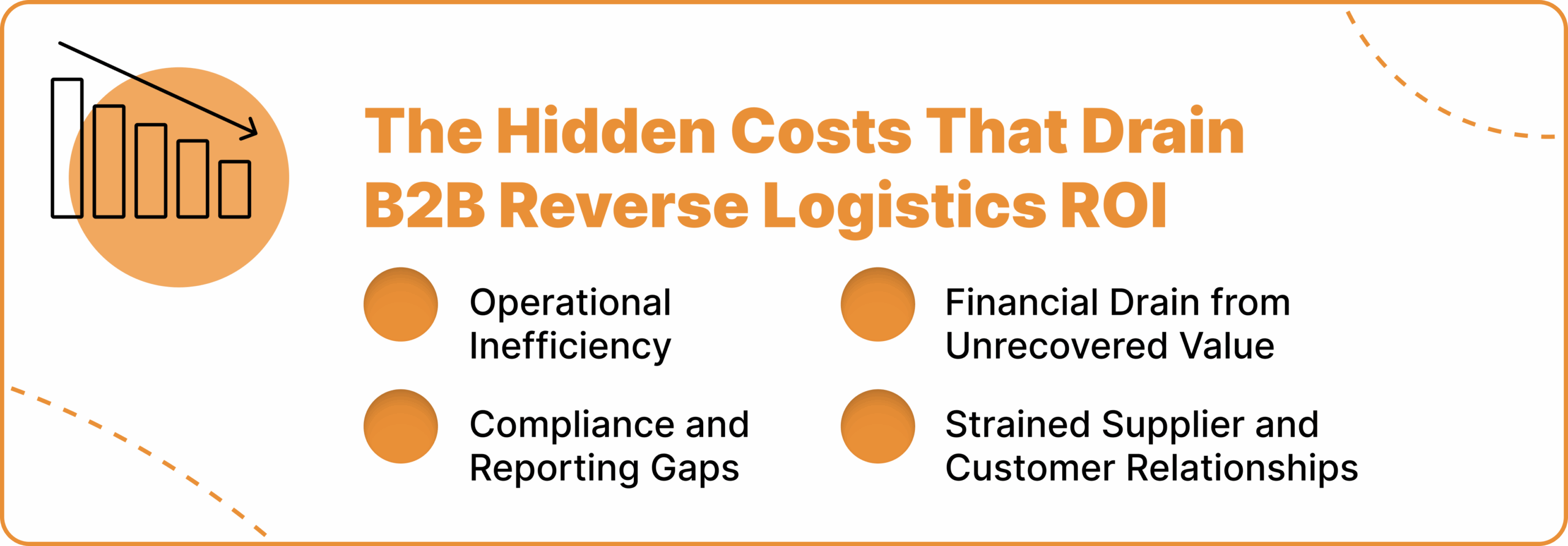
You have certain expectations when making your investment into the B2B reverse supply chain, but sometimes that can be derailed by hidden costs such as:
1. Operational Inefficiency
Manual returns processes create friction. Teams have to sort through emails, spreadsheets, and PDFs to authorize return shipments, and then track all of it across disconnected systems, which costs time. Each delay adds labor costs, and each mistake inflates warehouse space usage. Without structured return flows, inbound shipments clog docks and choke throughput.
For example, a retailer returning unsold stock from 200 stores without a centralized process will likely see a significant increase in return handling time. That additional time eats into both warehouse bandwidth and outbound logistics schedules. Untracked returns don’t just create backlogs, they disrupt inventory management and cost accounting.
2. Financial Drain from Unrecovered Value
Returned products often still hold value, either as refurbished goods, resale stock, or parts. But if those items sit idle, that value evaporates. Every unprocessed return delays cost recovery, and every missing inspection or lost unit erodes profit margins. The problem compounds when returns aren’t tied to enterprise resource planning systems, which delays credits and causes reconciliation errors.
3. Strained Supplier and Customer Relationships
Returns aren’t just about physical movement, they’re part of how businesses communicate. On one hand, when a supplier receives late or incomplete return data, credits get delayed. And on the other hand, when a customer doesn’t see acknowledgment, trust fades. Poor return handling leads to disputes over condition, credit timing, or contract terms. That friction harms repeat orders and damages brand reputation.
Imagine a business that delays return approvals by two weeks; customers waiting for store credit may withhold future purchases or seek alternate vendors. Small delays compound into long-term losses.
4. Compliance and Reporting Gaps
Commercial returns often trigger reporting obligations, especially in regulated industries. Items returned for environmental disposal, quality control inspection, or product recalls must follow strict handling procedures. A breakdown in the reverse logistics process can violate contractual or legal obligations, putting the business at risk. With more companies aligning with eco-conscious customers and environmental goals, ensuring transparency in returns is no longer optional.
How One B2B Company Saved $700,000
A B2B customer using the ReverseLogix returns management system saved more than $700,000 on lost and missing inventory, all while improving customer service.
The returns management system delivered real-time return inventory tracking that identified discrepancies and caught lost items during processing. This reduced the volume of lost items to an almost negligible number.
| Total Value of RMA Credits | $12,655,488 |
| Customer Calculated Lost Value Percentage | 6.6% |
| Reported Lost Item Value | $838,868 |
| Proposed Reduction: Lost Value at 1% | $126,554.80 |
| Estimated Savings in Lost Item Value | $712,314 |
Three Practical Ways to Turn Returns Into Assets
There are three established ways to turn returns into assets. They are used across industries including telecom, industrial parts and consumer electronics.
1. Refurbishment for Resale
Refurbishment typically refers to restoring an item to its original condition, making it ready for sale again, and this usually involves cleaning, part replacement, testing, or repackaging.
For example, an industrial distributor receives returned power tools with minor wear and tear. After testing and replacing a battery, they can repackage the product and sell it at a slight discount to contractors. The tool is safe, and the margin is still positive.
Refurbishment works best where product value is high, replacement parts are readily available, and buyers are willing to accept repackaged goods.
2. Redeployment Within the Distribution Network
Redeployment moves returned goods to where demand still exists, which means that instead of selling, you reassign the returned item to another warehouse, branch, or customer order. For example, a distributor receives 200 returned valves because a project ended early. Say another region in the network has an open order for the same model. Instead of reselling them, the warehouse transfers the returned goods directly to the region that needs them.
The result is no waste, no resale handling, and no shipping costs beyond internal transfers. It works best when your organization has multiple stocking points.
3. Secondary‑Market Resale
Some items hold value even when they cannot be sold in the primary channel. They can be sold in the secondary market: outlet channels, liquidation partners, online B2B exchanges, auctions and industry resellers.
For example, a technology distributor can sell refurbished network switches to certified secondary dealers with an adjusted, disclosed warranty, and earn revenue that would otherwise be lost. Secondary markets require careful brand protection.
Conclusion
B2B buyers now expect the return experience B2C set as the standard. The steps above give you a practical way to meet that expectation.
We covered how to assess the financial impact of returns, find the underlying causes, build a prevention plan, make the process more efficient and use returns as a chance to deliver good customer service.
B2B returns work differently
What breaks in B2B returns, and how to build a process that holds at volume.
Get a Demo
Discover how you can jump-start your returns management efforts with ReverseLogix.