The Ultimate Guide to Warranty Entitlement Software

In brief:
- Automated coverage verification: Warranty entitlement software confirms whether a product qualifies for service before the claim moves forward.
- Fewer costly entitlement errors: Accurate verification helps prevent claims that should not be approved while reducing delays for legitimate claims.
- Rule-based claim decisions: Purpose-built entitlement software applies business rules to registration data, purchase records, and contract terms automatically, so claims route based on logic rather than manual research.
Most warranty teams think they have a claim volume problem. The real problem is entitlement. Verification is the gate every claim passes through, and warranty entitlement software removes that bottleneck. Without a system that checks whether the product is covered, whether the contract applies and whether the product was registered, every claim becomes a manual research project, and the cost adds up quickly.
Depending on the manufacturer, warranty claims can consume around 2 to 5% of revenue. Much of that comes from entitlement errors: approving claims that should not have been approved, or delaying valid claims because coverage could not be verified in time. This guide covers what warranty entitlement software is, how it works and what to look for when choosing one.
What Is Warranty Entitlement Software, and What Do General Warranty Tools Miss?
Warranty entitlement software automates the claim coverage check that general warranty management tools leave to people. Before a claim can be approved, someone has to verify that the product is still under coverage and that the warranty terms apply to the defect. In a typical warranty management system, that check lives in a custom field or a side spreadsheet. In entitlement software, it runs automatically against contract rules, registration data and purchase records.
The difference matters because entitlement errors cascade. Approve a claim on an item two months out of warranty and you have paid what you did not owe. Deny a legitimate claim because your team could not confirm coverage quickly enough and you may lose the buyer.
Manual entitlement processing is where most warranty operations lose money, and it is also where the fix has the clearest return.
How Warranty Claim Verification Works
When a claim is received, the system checks the product registration data, including the date of purchase, confirms the status of warranty coverage, and applies the applicable business rules for that product or type of contract.
If everything checks out, the claim moves to the next step automatically. If something does not match, the claim is held and flagged for manual review.
The mechanics:
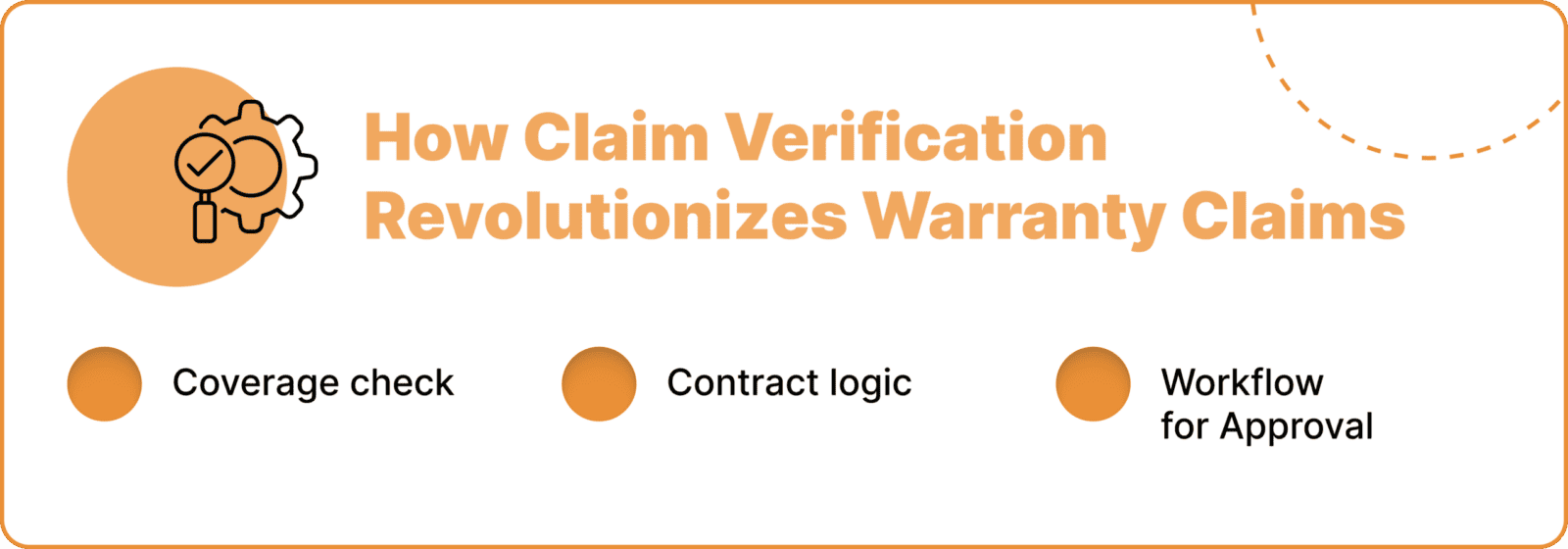
- Coverage check: The system verifies if the product is within the warranty period using its registration and purchase records.
- Contract logic: If the product has a service contract or added coverage, the system automatically applies those terms instead of someone having to look them up.
- Approval workflow: Claims that are entitled and meet the set conditions go to approval or fulfillment without a handler touching them. Failed claims go to an exception queue with the reason attached.
Automated coverage verification cuts claim processing time, and how much depends on how manual the current process is. The larger benefit may be accuracy: automated entitlement catches mismatches that manual review routinely misses, which means fewer improper payouts and fewer valid claims delayed.
Warranty Lifecycle Claims Management: From Warranty Registration to Extended Warranties
Entitlement is not a one-off check at the start of a claim. It follows the product through its whole warranty lifecycle, and handling that lifecycle is what separates serious entitlement software from a simple validation rule.
Coverage changes over the life of a product. It begins with warranty registration, which starts the clock on standard coverage. If the buyer or dealer bought additional coverage, the product may move into an extended warranty or service contract, and the terms can change again if the product is transferred, repaired or fitted with a part that carries its own warranty. At each stage, the entitlement question is what is covered right now and under which contract.
For manufacturers that sell service agreements with their products, the entitlement system must tell standard warranty claims apart from service-contract claims, where coverage terms, approval rules and cost allocation may differ. Without that separation, claims management gets messy and your teams have to sort claims by hand.
With warranty management across the whole lifecycle, entitlement becomes the spine. Every claim runs through the same verification logic at every step, so the rules stay the same wherever the product is in its coverage.
How Dedicated Warranty Management Software Manages Warranty Claims at Scale
General-purpose tools fail at scale. When you handle hundreds or thousands of claims a month, manual processing at the entitlement stage creates backlogs, errors and missed recoveries.
A dedicated warranty management platform automates the work that scales worst by hand:
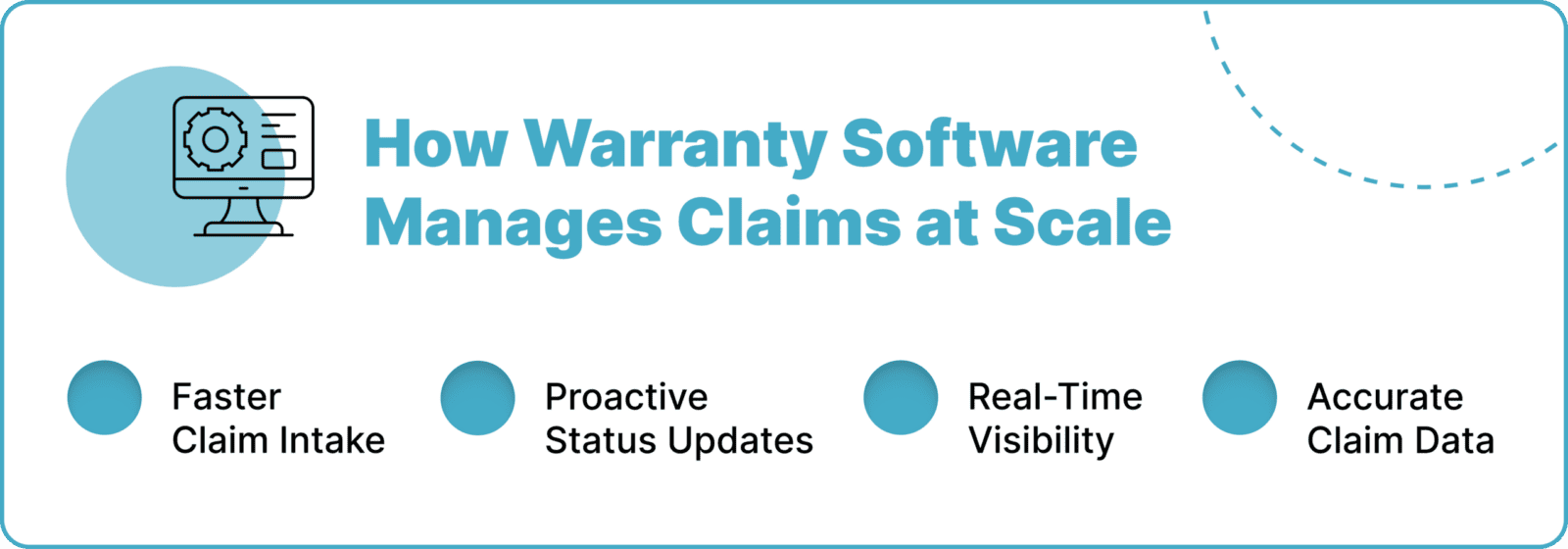
- Multi-channel claim intake: self-service portals let customers and dealers submit claims and track warranty status without calling your customer service team, which reduces inbound call volume.
- Automated status updates let claimants know what’s happening at every step so your support team isn’t fielding “where’s my claim” questions.
- Real-time dashboards show claims volume, average cycle time and other key metrics in one view, so warranty operations teams see problems before they become backlogs.
- Data quality controls keep duplicate claims, mismatched serial numbers and incomplete submissions out of the queue, and give support agents visibility into customer entitlements.
Modern platforms keep warranty data in one place instead of scattered across several tools. That consolidation is what makes automation reliable: approval workflows and coverage verification only run correctly when they read from a single set of records. It also removes the reconciliation work that eats time when warranty data lives in three places.
Linking Warranty Claim Management Software to Service Management
Entitlement software works best when it is connected to the systems around it. With direct integration to ERP, CRM and field service management, a claim validated at the entitlement stage can trigger a repair dispatch, a replacement shipment or a credit note without a separate handoff. Repair workflows track parts availability and technician assignments and help coordinate external service providers. API availability matters, because integration and data synchronization with your enterprise and inventory systems keep the operation moving without manual bridges.
Supplier recovery is one of the biggest quiet wins. It traces defective-part claims back to the upstream vendor, linking each claim to a part and a supplier. Most manufacturers do not do this consistently by hand because the effort per claim is too high. Warranty software automates the tracing and follows up on every eligible claim, which helps control warranty costs and sharpens planning for warranty reserves.
Warranty analytics feed claim data to root cause analysis and product quality teams. Seeing claim trends, failure rates and defect patterns in real time, instead of in a quarterly report, lets design and engineering teams act on field data. Warranty becomes a source of product intelligence that improves the next version.
How ReverseLogix Makes Warranty Entitlement the Foundation of Every Claim
If entitlement is the gate every claim must pass, it should work on data you trust and rules you control. ReverseLogix brings warranty registration, entitlement verification, claims, repairs and reverse logistics into one platform, so the coverage check that starts the process and the resolution that ends it use the same records.
For enterprise manufacturers and retailers with high claim volumes, that means faster claims, cleaner data, consistent supplier recovery and a warranty process that scales without additional headcount. Talk to a returns specialist today.
Frequently Asked Questions
Q1. How much does warranty management software cost?
Warranty management software cost varies based on claims volume, integration needs, and operational complexity. Most vendors quote based on your specific setup rather than a fixed price. The more useful question is what your current warranty process already costs you: the manual hours per claim, the improper payouts that slip through without automated verification, and the supplier recovery you miss. Weighed against 2 to 5% of revenue typically consumed by warranty claims, a dedicated platform often pays for itself through recovered margin and lower handling cost.
Q2. Can warranty entitlement software integrate with CRM and ERP systems?
Yes. Most warranty management solutions are built to connect with existing CRM, ERP, and field service systems through direct integration. This connection lets entitlement checks run against live purchase and registration data without re-keying. API availability matters for custom integrations and data synchronization between warranty and the rest of your enterprise systems, and implementation should preserve existing customer records during migration and sync. Before choosing a platform, confirm it supports the specific systems your warranty process already uses, because shallow integration forces your team to bridge data gaps manually and cancels the speed gains automation is supposed to deliver.
Q3. How does warranty entitlement software handle extended warranties and service contracts?
Entitlement software applies separate coverage rules for standard warranties, extended warranties, and service contracts, so each claim routes through the correct verification logic. When a buyer or dealer purchases added coverage, the system attaches those contract terms to the product record and applies them automatically at claim time. This separation matters because coverage terms, approval rules, and cost allocation differ between contract types. Without it, internal teams end up sorting claims by hand, which creates errors and delays. Contract management across multiple coverage types is one of the clearest advantages of purpose-built entitlement software.
Q4. What is supplier recovery in warranty management?
Supplier recovery traces defective-part claims back to the upstream vendor responsible, so the manufacturer recovers the cost instead of absorbing it. Warranty entitlement software automates this by linking each claim to part, supplier, and contract records. When a claim matches a supplier-responsible defect, the system flags it for recovery automatically. Done manually, this step gets skipped because tracing a single claim to a specific vendor takes time most teams do not have. Automated supplier recovery processes turn a cost that quietly leaks into recovered margin on every eligible claim.
Q5. Does warranty software support predictive analytics and root cause analysis?
Yes. Connected claim data feeds analytics that surface defect trends, failure rates, and component-level patterns over time. This goes beyond reporting what happened to showing where problems are heading, which lets quality and design teams act before a defect pattern becomes a claim wave. Root cause analysis built on real field data is more precise than analysis based on returned-product inspections alone, because it ties failure to specific batches, suppliers, and warranty periods. Analytics capabilities vary across platforms, so evaluate whether the system can produce the reports your quality and engineering teams actually need.
Repairs and warranty in one flow
How repair intake, warranty entitlement and parts move through a single system.
Get a Demo
Discover how you can jump-start your returns management efforts with ReverseLogix.